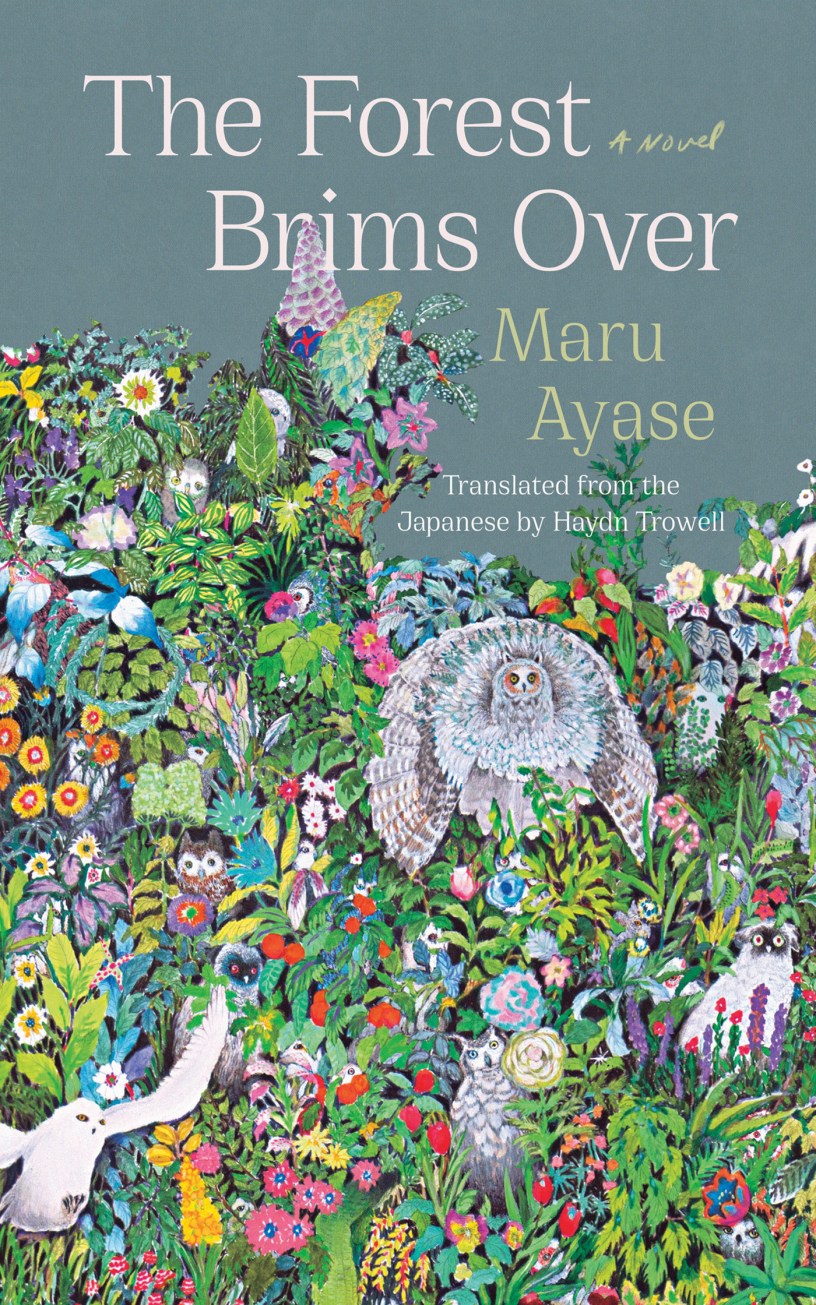
The Forest Brims Over
By Ayase Maru
Translated by Haydn Trowell
2019, Translated 2023
Counterpoint
Love triangles are a perennial favorite of readers and streamers, and in The Forest Brims Over, the plot features any number of triangle-based complications focused on the 21st-century production, promotion, and consumption of popular fiction. Ayase sets her sites on the exploitative relationships between publishers and their content creators and male writers and their female muses. The first triangle consists of the fraught relationship between the author Nowatari Testusya, his wife Rui, and the editor assigned to jump-start the author’s recently stalled project, Sekiguki Masashi. Sekiguki has his hands full. Several years before, Nowatari’s first novel burst into the scene, rocketing the author to fame and making Nowatari a household name. Reporters and super-fans of the author’s Tears who were enamored of the May-December romance between a middle-aged professor and an alluring and passionate former student connected the dots and realized that Tears was a thinly disguised memoir of Nowatari’s relationship with a wife who is twelve years his junior, Rui– a name which can be translated as “tears.” When the novel begins, Nowatari is still churning out texts that sell, but his editors recognize that he is merely recycling old ideas. When the editor Sekiguchi arrives for his regular meeting with the author, we learn that he too has fallen for the author’s wife, a desire no doubt heightened by Nowatari’s habit of investing each of his fictional manic pixie dream girls with his wife’s well-documented frank attitude toward sex and desire. A married man, the editor is astonished to overhear the couple in crisis over Rui’s suspicion that her husband has taken a younger lover–-not surprisingly, another of his students. Worse, before the evening is out, Nowatari calmly informs Sekiguchi that Rui has consumed a large bowl of seeds and is beginning to sprout. Would the editor be so kind as to go to the local hardware store to purchase a waterproof tank, soil, fertilizer, and a good-sized watering can? When Sekiguchi asks if he shouldn’t call a doctor first, Nowatari explains that his wife does not desire medical assistance. In the surreal scenes that follow, Ayase documents the increasing fury of the chief editor at Rui’s choice to become soil for an ever-increasing forest. How selfish could she be? Is she not aware that matrimonial conflict will cause a breakdown in the well-ordered machine that produces reliable literary product? How will the suddenly woman-less author feed and clothe himself? Why has this unruly couple entrapped an editor in their bizarre relationship? To further complicate matters, as the beautiful Rui wilfully disappears into the exuberant growth that all but consumes the family home and the adjacent plot, her husband, true to form, begins writing a new novel about a wife who gorges herself on seeds and begins to sprout plants from every pore. The much put-upon Ayase, overcome by his fear of being discovered for his complicity in hastening Rui’s demise (or transformation), takes to betraying his own wife more frequently with prostitutes–a transactional relationship that somehow seems more honest than the author’s relationship with his passel muses. Nowatari’s new lover takes the stage and a second editor is sent in to rescue a novel that may be running off the rails–an outcome that will benefit no one. And finally, there is the forest Rui, ever-expanding, transforming and challenging the world around her. Is Rui still there amid all those branches and vines? And if so, what is she doing?
“Sekiguchi suddenly realized that he no longer recognized Rui as a human being. She had become some otherworldly entity beyond his abilities of comprehension. Even if it was possible to find a slither of beauty in someone who clothed themselves in vegetation in some kind of artistic endeavor, once they deviated too far from base humanity, the only response could be one of unbearable revulsion. Entities that were like people but not, that occupied the ambiguous space between human and thing, were nothing short of terrifying. He checked to make sure that the watering can was empty before hurriedly retreating from the bedroom.”
 East Asian Literature in Translation