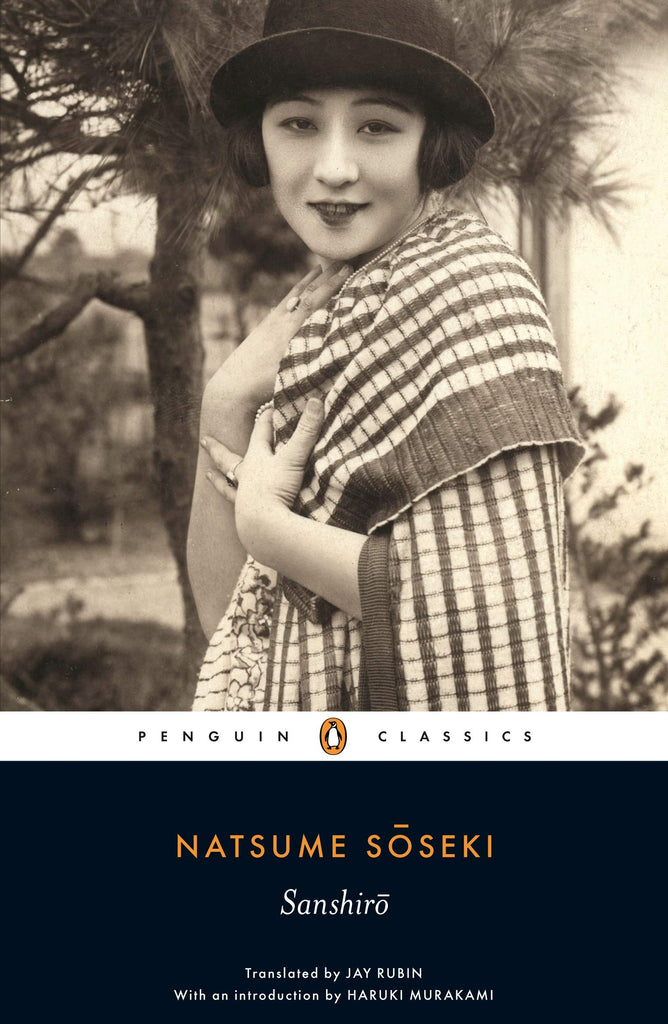
Sanshiro
By Soseki Natsume
Translated by Jay Rubin
Introduction by Murakami Haruki
(1908, translated 1977, 2010)
Penguin Classics
Sanshiro is a slow-burning coming-of-age story set at the end of the Meiji Period, a time of rapid modernization and Westernization. Sanshiro is a country boy from Kumamoto in Kyusho. A bright enough young man, he is a fish out of water at Tokyo University. Diffident and socially awkward, he sits in the shadows at school, studiously taking notes while failing to understand the point of many lectures. He is easily infatuated by the bright modern women of Tokyo, but he dares not make overtures. He falls in with Yojiro, an over-the-top would-be mover and shaker who writes agitprop under a variety of pseudonyms, promotes traditional and Western theater and lobbies to seat his philosophical mentor, Hirato, on the faculty at Tokyo University. Yojiro and most of his fellow college students are caught up in a desire for all things Western (they refer to women of their generation as Ibsen characters), but they want the university to replace its Western and Western-educated faculty to be replaced by Japanese professors. Yojiro sweeps Sanshiro up in this political scheme and the young scholar follows along because he is interested in the intellectual circles Yojiro has access to, such as a researcher named Nonomiya and Hirohata, who is studying the pressure of light. He is also fascinated by Yoshiko, Nonomiya’s emotionally needy sister, and her friend, the beautiful Mineko. Sanshiro’s attraction to Mineko is strong, but he is hobbled by his insecurities and his devotion to his mother. For her part, Mineko makes her interests clear, yet Sanshiro vacillates, certain that this sophisticated woman is merely mocking him. While he second-guesses himself, Sanshiro grows closer to Hirohata, an old bachelor-academic, and tags along on many adventures with the comically extroverted Yojiro. The work seems to wander at times, but in the final pages, the various threads of the story come together. A highlight is a late shift in the novel towards the topics of the performing and representational arts. The characters attend a double-billing of a Japanese historical drama and Hamlet, and a Western-trained artist paints a portrait of Mineko that becomes the centerpiece of his high-profile exhibition. The entire novel covers but one-half of Sanshiro’s first year at university, and though the hero does not accomplish much, at the end of the novel he seems to have a deeper understanding of the life of an academic and the vagaries of romantic attraction. Sanshiro is the first in a trilogy that includes …And Then (Sorekara) and The Gate (Mon).
“According to Yojirō, you could tell the Professor’s mood by the way the smoke emerged. When it streamed out thick and straight, his philosophy had attained its ultimate height, and when it crumbled out slowly, he was serene in spirit—which meant there was some danger of his unleashing his wit on you. When the smoke lingered beneath his nose and seemed loath to part from his mustache, he was in a meditative frame of mind, or else he was feeling poetic inspiration. Most terrifying of all were the whirlpools at the nostrils, which meant he was going to drag you over the coals. Since the source of this information was Yojirō, Sanshirō did not take it seriously. But given the nature of the occasion, he carefully noted the forms in which the smoke emerged. He discovered none of the clear-cut types that Yojirō had mentioned. Instead, all of the characteristics seemed to be there at once.”
 East Asian Literature in Translation