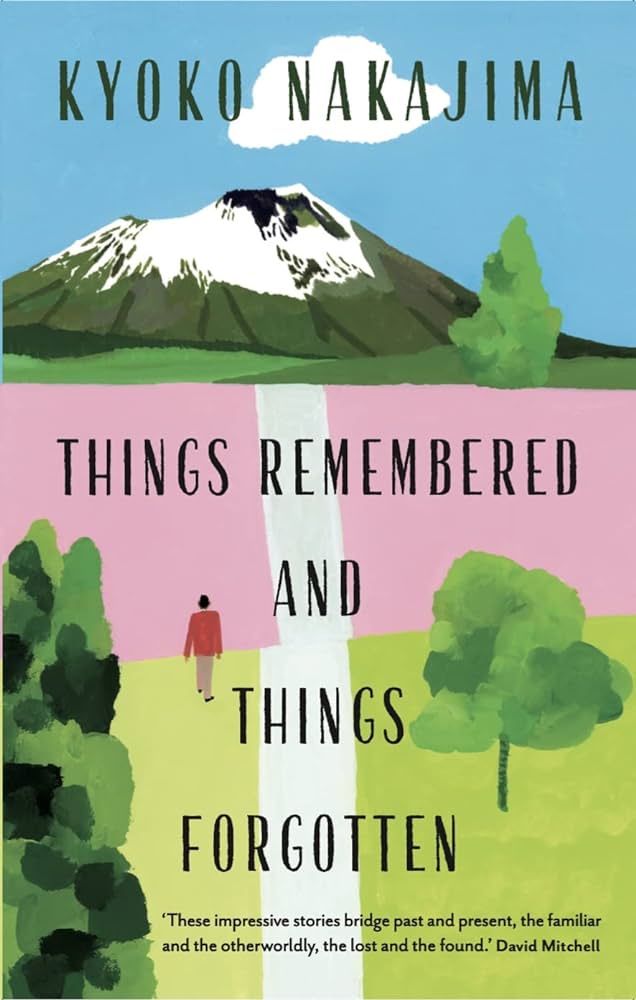
Things Remembered and Things Forgotten
By Nakajima Kyoko
Translated by Ian MacDonald and Ginny Tapley Takemori
(2014, translated 2021)
Sort of Books
(Short Stories)
Nakajima is also the author of the 2010 novel The Little House, which features the account of an extraordinary maid/cook/nanny who records current events, the personal dramas of her employers, and her own family story. The Little House is a complex masterwork spanning the years from 1926 to 1989. Nakamori’s Things Remembered and Things Forgotten is a collection of short stories that range across a similar time period, each addressing the topics of societal change and the role of memory in constructing our sense of who we are. In many of the stories, a key element of the exposition involves introducing the family members, their jobs, spouses, and children, and the constellations of work and educational demands that send individuals to distant parts of Tokyo, cities across Japan, and far continents. Characters, caught up in schedules, over-committed, and over-worked, find themselves stymied by the challenge of reconnecting. Not surprisingly, in the first story, “Things Remembered and Things Forgotten,” a wife convinces her husband to finally visit his brother who is several years into a stay-at-home for seniors with dementia. Although the two don’t say much beyond superficial pleasantries, an omniscient narrator explains their childhood spent in the ruins of post-war Tokyo. In many of the stories, the reason for assembling the sisters and brothers is a death in the family. In “The Last Obon,” when a mother passes on after returning to her childhood home in the country, her children struggle to recall the proper local rituals to celebrate the first anniversary of her death. A granddaughter uses the occasion to write a report on Japanese traditional holidays, local acquaintances visit, and middle-aged daughters pore over long-forgotten photos as the family reaches the limits of their knowledge of who their mother was. In “The Pet Civet,” an unmarried salarywoman travels to a backwater to dispose of the property of a deceased maiden aunt. A young man claiming to know the late aunt stops in, surprised to hear of her passing. As they reminisce, he reveals that in her final years she struck up a lively romance with an elderly handyman. Shocked to discover her aunt’s secret, she too wonders about her own single life and missed opportunities. The tone of these stories is wistful without being maudlin. In many cases, Nakajima brings to life objects, practices, and ideas that were everpresent for a time and today seem like museum pieces. There is also a strong supernatural current coursing through Nakajima’s stories of the foggy stuff of remembering and forgetting. Things and people are not what they seem, especially after dark.
“‘But it’s completely different from the image I had of my aunt. How can I put it … she was a bit like a withered old tree, a spinster with nothing remotely sexy about her or any hint of having had any male friends.’
‘A withered old tree?’ He was clearly offended, and Saya realised she’d said too much. All she knew of her aunt was that photo where she was glaring fiercely at the camera, and then more recently seeing her burn incense at her stepfather’s funeral.
‘A photo,’ Saya said suddenly. ‘Are there any photos of her? I really don’t know much about her at all.’
‘I doubt it. They weren’t like that. They weren’t the type to pose for the camera.’ No, I don’t suppose they would have had their photos taken, Saya thought. She
didn’t know anything about them, but that much she could well believe.”
— “The Pet Civet”
 East Asian Literature in Translation