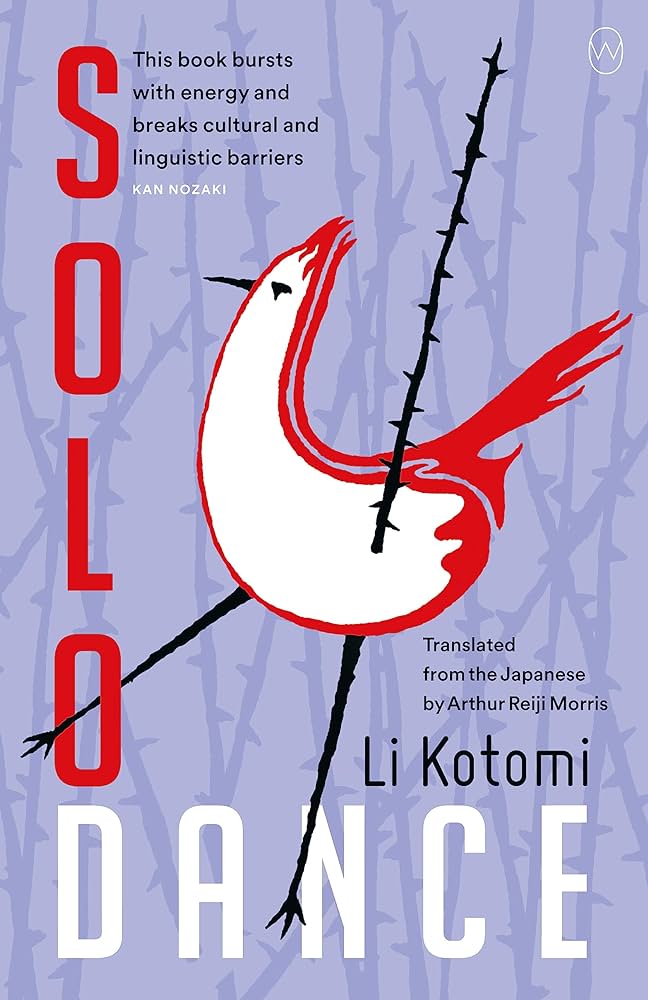
Solo Dance
By Li Kotomi
Translated by Arthur Reiji Morris
(2018, translated 2022)
World Editions
Li Kotomi’s Solo Dance chronicles the trials and adventures of a young woman as she strives to discover herself and her place in her family, relationships, and community. Li’s protagonist is “she,” a melancholic Taiwanese girl who realises she loves women when she falls hard for a talented grade school classmate, the pianist Shi Danchen. Their relationship is entirely one sided, as “she,” though overcome by thoughts of her beloved, is unable to give voice to her love before Danchen is struck down in a fatal accident. Inconsolable, “she” falls into a depression that is finally alleviated when “she” discovers that writing about her loneliness and her relentless fascination with death calms her anxiety. As Li’s protagonist matures, she satisfies her parents’ wishes by completing her academic requirements while pouring out her thoughts into her diary and secretly reading and rereading feminist and LGBTQ writers. In Notes of a Crocodile and Last Letter from Montmartre, she discovers Qiu Miaojin’s Lazi and embraces her as a kindred spirit and guiding light. Li’s hero experiences relationships with women in both high school and college. In each case, the lovers rename one another, giving each other poetic nicknames, a powerful act that validates the girls and lifts them out of the ordinary world. But “she” struggles when she enters the work world, where she dares not reveal her sexual preferences. To the hero’s eyes, Taiwanese office culture is preoccupied with knowing and sharing the dating lives and marital dramas of heterosexual employees. Deeply closeted throughout the day, she only comes alive online and in gay-friendly environments, and might have spent a lifetime in this shadow world were she not targetted and traumatized by the literal embodiment of homophobic culture. The narrator concludes that she must escape Taiwan for what she imagines is a more liberal Japan. To fit into her new home, she changes her name to Cho Norie, lives a kind of half-life in online communities, and winds up experiencing some degree of freedom in Tokyo before her new life crashes all around her. Cho experiences overwhelmingly intense relationships that end catastrophically for her. Like her hero, Lazi, Cho experiences unrelenting episodes of depression and suicidality. In the aftermath of each breakup, she engages in a quest for a city or land that will open its arms and welcome her on her own terms. She eventually visits San Francisco and Sydney, and in the latter especially, she comes close to finding a critical mass of fellow travelers to buoy her through her moments of self-doubt, loneliness, and self-harm. This is Li Kotomi’s first work; she has gone on to write many more well-received and lauded novels, though she regards Solo Dance as a personal favorite.
“Intrigued by what Haoxue was reading, she approached slowly, one step at a time, so as not to shatter Haoxue’s solemn air. It was just as the title was close enough to read that Haoxue noticed her presence and looked up. It was Haoxue who broke those few seconds of silence between them.
‘Hello there, I didn’t realize you had come too.
Haoxue’s words struck her heart. She’s looking at me—she’s noticed me.
Those words were a famous line from Eileen Chang’s “Love.” “Love” was a short work, only a few hundred words long, yet it managed to contain an inexplicable amount of pain within it. She had been reading a lot of Eileen Chang recently, and was particularly drawn to “Love.” The fact that Haoxue chose this line must mean she had been watching her.
‘I hope happiness and health await you,’ she said quietly. Haoxue was reading Last Words from Montmartre—and this was its last line.
Haoxue stared at her for a second before breaking into a smile. The frozen space between them thawed as they found common ground.”
 East Asian Literature in Translation