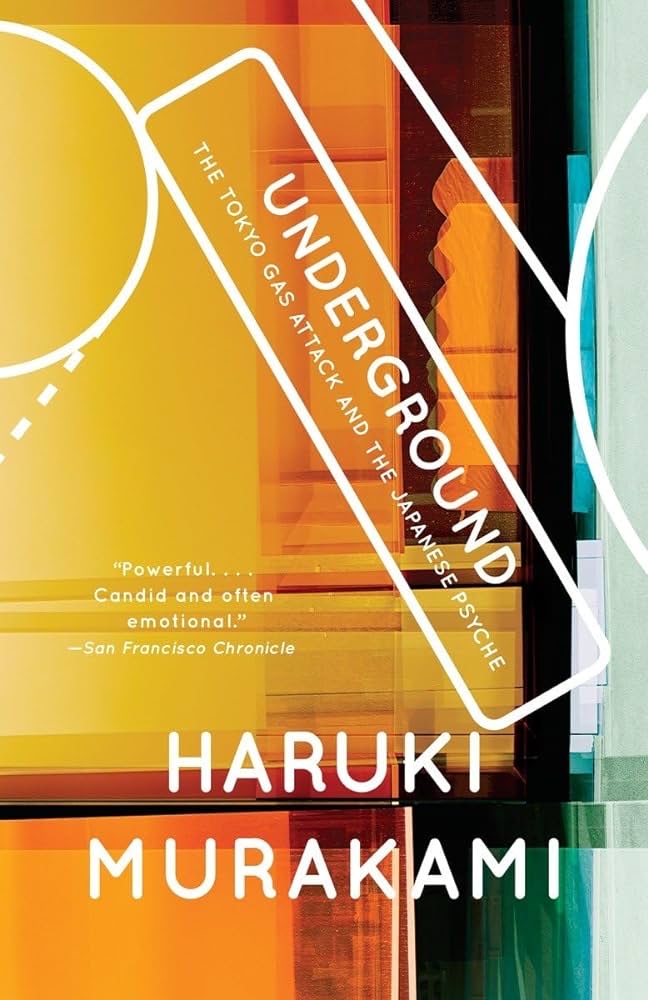
Underground: The Tokyo Gas Attack and the Japanese Psyche
By Murakami Haruki
Translated by Alfred Birnbaum
(1997, English translation 2010)
Vintage
Underground is Murakami’s investigation of the lasting physical and psychological effects of those who were injured by agents of the Aum Shinrikyu cult who released sarin gas on crowded trains on March 20, 1995. In his introduction, Murakami explains that his mission is to interview the survivors, collect their stories, and, inspired by the work of Studs Terkel, present those stories in their own words. Murakami’s argument is that the statements will reveal essential elements about the Japanese people in the way they respond to the terrorist attack and in how they live their lives in its aftermath. The inspiration for his investigation began with his reading of a magazine article about how a man who suffered permanent nerve damage from the attack was mocked and bullied by coworkers who essentially forced him to quit his job. Murakami calls this phenomenon a “double victimization.” And so it is that among the stories of bravery and loss, Murakami is also focused on exposing the ways the Japanese government and Japanese citizens failed the victims before, during, and after the attacks. More provocatively, he suggests that the growth of extremist groups like Aum Shinryuki is a direct consequence of Japan’s all-or-nothing commitment to capitalism and materialism. Underground includes Murakami’s controversial essay “Blind Nightmare: Where Are We Japanese Going?” Murakami and his team began their project with a list of seven hundred names of victims published in newspapers, but as there were no addresses or phone numbers, their search was especially difficult. Many contacted did not want to be involved, others expressed a willingness to talk but did not want to be recorded. In the end, Murakami presents excerpts from interviews of over sixty survivors. He also includes a variety of interviews with some of the followers of Aum Shinrikyu. Interestingly, the group still exists after promising to follow the law and rebranding the cult as “Aleph.”
“Once out of the exit I took a good look around, but what I saw was—how shall I put it?—“hell” describes it perfectly. Three men were laid on the ground, spoons stuck in their mouths as a precaution against them choking on their tongues. About six other station staffers were there too, but they all just sat on the flower beds holding their heads and crying. The moment I came out of the exit, a girl was crying her eyes out. I was at a loss for words. I didn’t have a clue what was happening.” (Kiyoka Izumi, age twenty-six)
 East Asian Literature in Translation