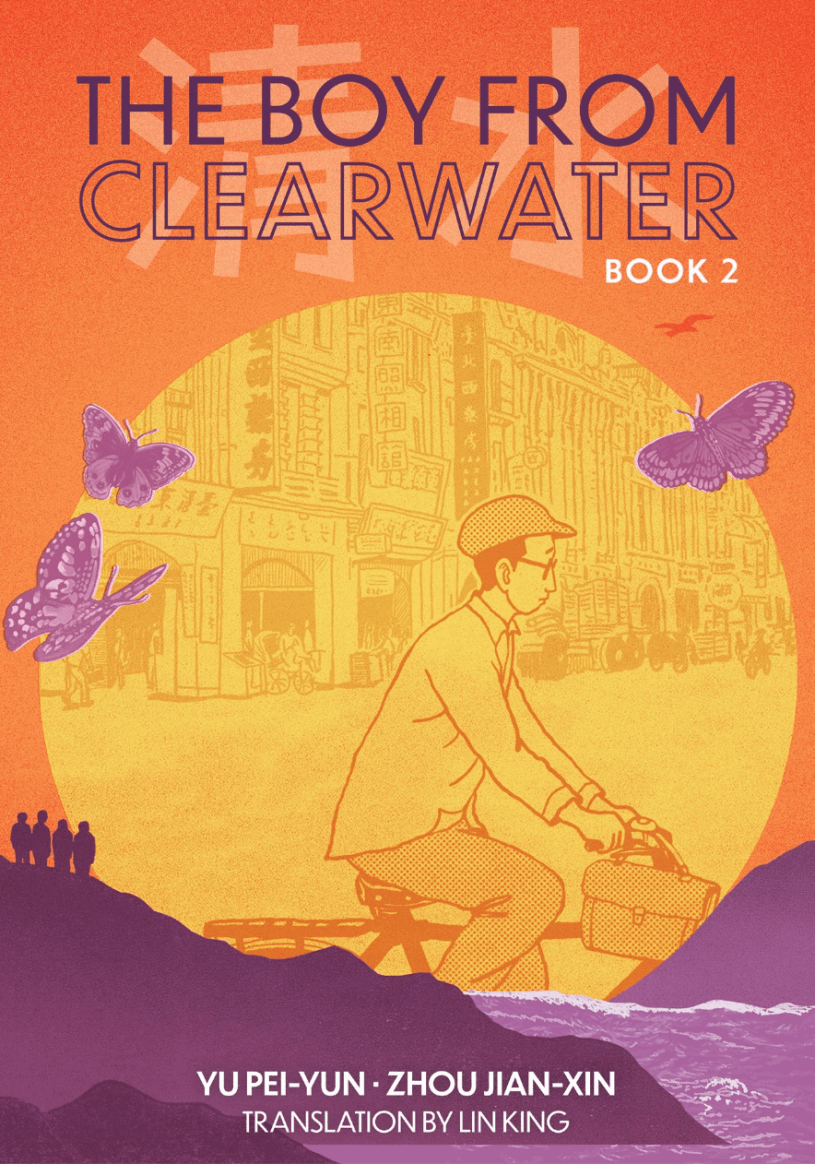
The Boy From Clearwater, Volume 2
By Yu Pei-Yun,
Illustrated by Zhu Jian-Xin
Translated by Lin KingIn,
(2024)
Levine Querido
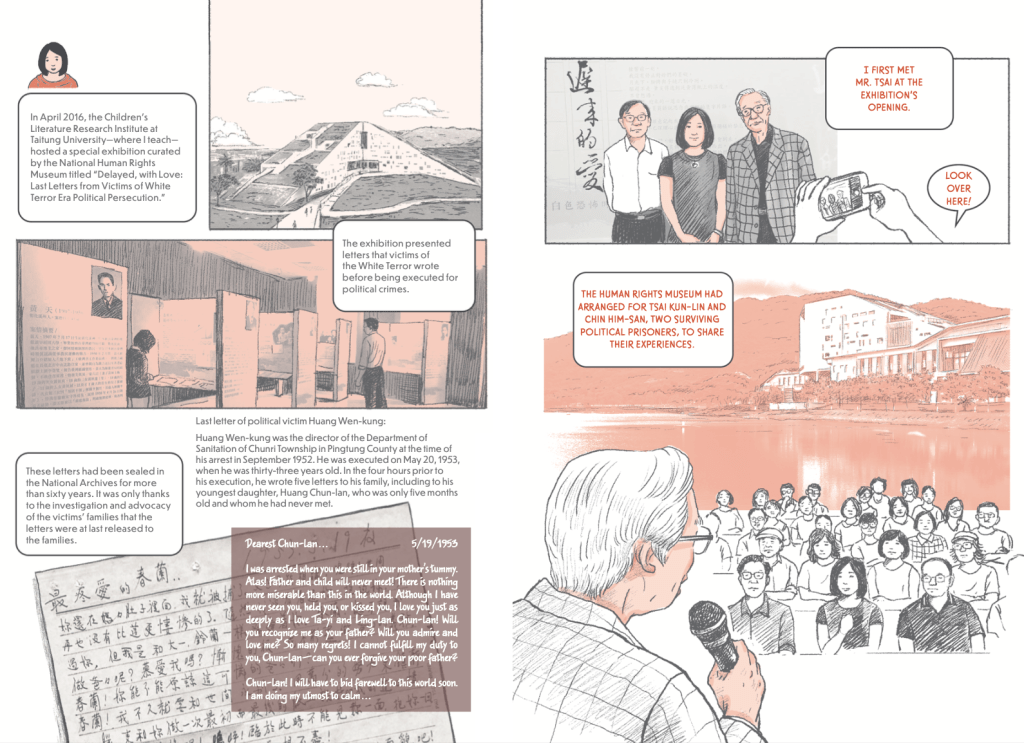
In The Boy from Clearwater, Volume 2, Yu Pei-Yun continues the true story of Tshua Kun-Lim, a slight, bookish boy from Taiwan with a passion for learning and a desire to teach. When Volume I ended, an informer had turned Kun-Lim and his teachers in to the KMT, alleging that they were studying and disseminating banned literature. This volume picks up after Tshua’s release from Green Island. How will he recover or move on from his losses? He wants to to find work as an educator, but his status as a former political prisoner makes that dream impossible, and he continues to be shadowed and occasionally challenged by secret police as he goes about his life. He reconnects with his teacher and mentor, and he makes it known that he has feelings for the man’s daughter. Finally, he finds work in a small company that reworks Japanese manhwa and translates it into Korean. Tshua’s fluency in Japanese, Cantonese, and Mandarin makes him uniquely qualified for the work. He puts in long hours and develops strong relationships with artists and printers. The manhwa business rises and collapses, and rises again, but Tshua never stops hustling. Always an educator at heart, he begins producing a number of illustrated comic-book-style science magazines, first for teens, then for girls and children. He is involved in venture after venture, and over time his strong work ethic and his skill as a communicator and translator allow him to find work in more established businesses with international ties. Eventually, a wealthy boss shares with him his passion project: he believes that all great nations create encyclopedias, and he taps Tshua to lead the creation of an encyclopedia of Taiwan. Yu Pei-Yun uses Tshua Kun-Lim’s long and productive life to illustrate Taiwan’s history from it’s emergence from the post-war chaos of the Republic of China era and the Koumintang‘s White Terror, to mainland China’s reclamation of Taiwan as part of the People’s Republic of China in 1971. Tshua witnessed the end of martial law in 1987 and the beginning of the democratization process which culminated in the first direct presidential elections in 1996 and in 2000 the Taiwanese Democratic Party’s efforts to advocate openly for Taiwanese independence. In some cases, Tshua Kun-Lim’s life and the history of Taiwan are closely linked, such as Tshua Kun-Lim’s involvement in the rise in popularity of manhwa as entertainment and later as a tool for educating a generation of Taiwanese youth, or when Tshua convinces his boss to bankroll a bus for the Red Leaves, an indigenous Taiwanese little league team to play in a national game in 1963, sparking baseball fever in Taiwan and triggering a longstanding sports rivalry with Japan. Tshua is also at the right place and the right time to be directly involved in the creation of the Encyclopedia of Taiwan. In 2001, Green Island Prison was reinvented as the Green Island Human Rights Culture Park. In 2016, while volunteering as a guide and docent at what was then known as The National Human Rights Museum, Tshua had the good fortune to meet the author, Dr. Yu Pei-Yun of Taitung University, who interviewed Tshua about his life and began to imagine creating this marvelously inventive manhwa that is The Boy From Clearwater. Historians and history teachers will appreciate the brilliant graphics used to illustrate Taiwan’s modern political history as well as the clever way the editors use color coding of text to indicate whether characters are speaking in Mandarin, Hoklo Taiwanese, or Japanese. Reading this multi-layered, dynamic text, I felt as if I were encountering one of the most creative, remarkable, and historically significant books I have ever read.
 East Asian Literature in Translation