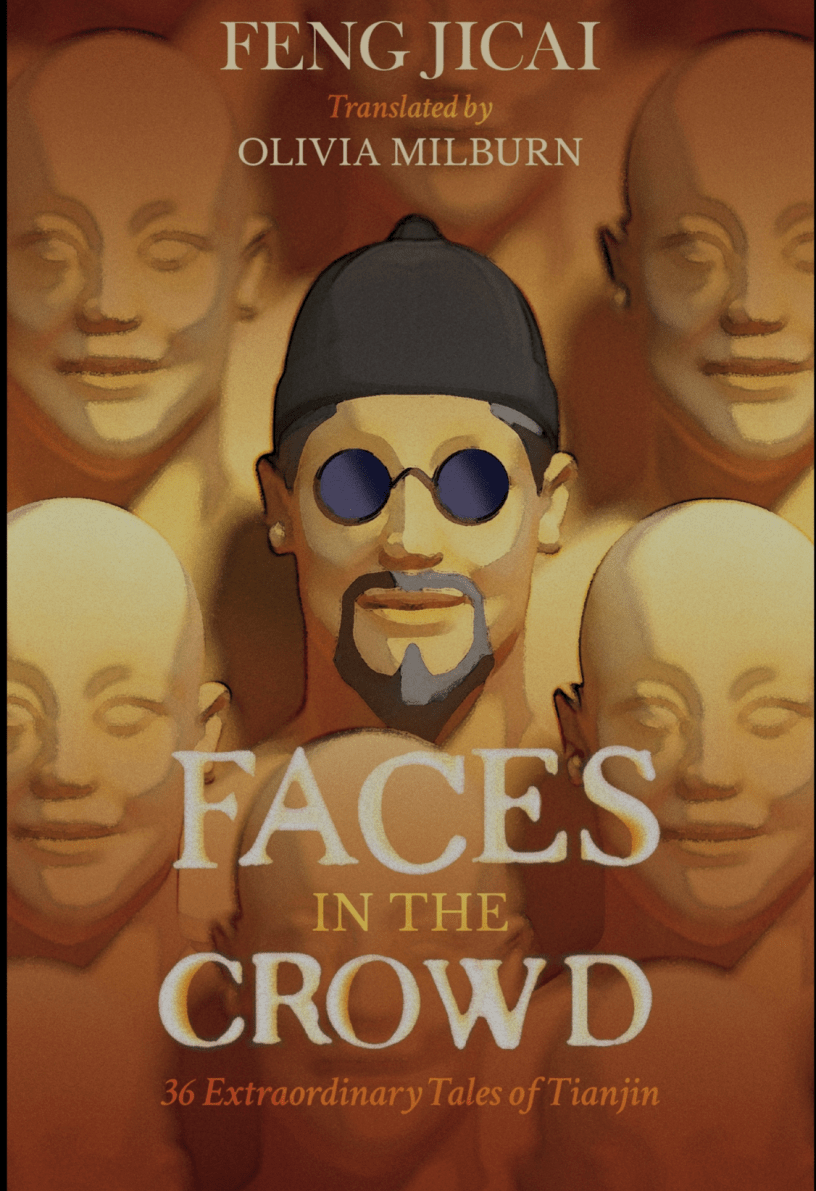
Faces in the Crowd: Thirty-Six Extraordinary Tales of Tianjin
By Feng Jicai
Translated by Olivia Milburn
(2015, trans. 2019)
Sinoist Books
Feng Jicai is one of the great voices of “Scar Literature,” the short stories and novellas that emerged in response to the suffering and loss experienced during the Cultural Revolution. He is also a documentarian, interviewing, recording, and publishing the stories of everyday Chinese citizens in a style similar to Studs Terkel. A passionate scholar dedicated to preserving China’s cultural history from the 19th century to the present, he was the driving force behind “The Project to Preserve China’s Folk Cultural Heritage and served as its first director. His work focuses on documenting and preserving what life is like in traditional villages and urban areas lost to rapid development and the progress that comes at the sharp end of a bulldozer. In his introduction to Faces in the Crowd: Thirty-Siix Extraordinary Stories of Tianjin, Feng explains that the book is his attempt to capture the personality of the people of his beloved Tianjin, including the foreigners living in the foreign concessions. He argues that geography and history have molded a people of extraordinary resilience, gumption, and directness, noting that so many of the great catastrophes that beset China came through by land and sea via Tianjin, fashioning a population of tough, irascible, and admirable survivors. He begins with stories dating from the Boxer Rebellion and introduces us to a memorable cast of characters including artists, counterfeiters, and swindlers. He tells tales of lotharios, noble virgins, and abusive husbands. Chicken sellers and chicken thieves cross paths and corrupt local officials expose their greed in taverns and brothels. Expect to encounter a fabled strongman, dedicated scholars and musicians, and a talking bird. The stories are short, light, and instructional; collectively, they conjure a vivid portrait of a time and place. Feng is also an accomplished artist; he presents pen and ink portraits for each character in his collection, reminding me of Kipling’s Just So Stories. Even the titles are a delight–consider “Boozing Granny,” “Liu Dayan Goes Into His Coffin Alive,” and “Aping a Foreigner.”
The following quotation is from “The Yellow Lotus Divine Matriarch,” which focuses on the female Boxers – the mysterious “Red Lanterns” who haunted the city in 1900.
“With this, the inhabitants of Tianjin were left to speculate wildly about the identity and appearance of the Yellow Lotus Divine Matriarch. Some people said that her real name was Lin Hei’er and that she was a local girl who’d grown up where the river met the sea. Her father had taught her martial arts, and they’d worked together as acrobats and performers, but somehow or other her father had angered a foreigner who’d had him thrown into prison where he died, and she was determined on revenge. Other people said that she wasn’t human at all–she was the Queen Mother of the West born into human form, who could call up a magical fire to burn up Zizhulin and make the seas run dry so that no foreign boats could sail. Of course, there were all sorts of people who worked at the Tianjin docks: some of them said that she was a shaman from the other side of the river who could summon the really important gods, but even more said that she was a local whore with a terrible temper who had worked in one of the brothels in Houjiahou. Naturally, it was the most unpleasant of these stories that everyone believed.
 East Asian Literature in Translation