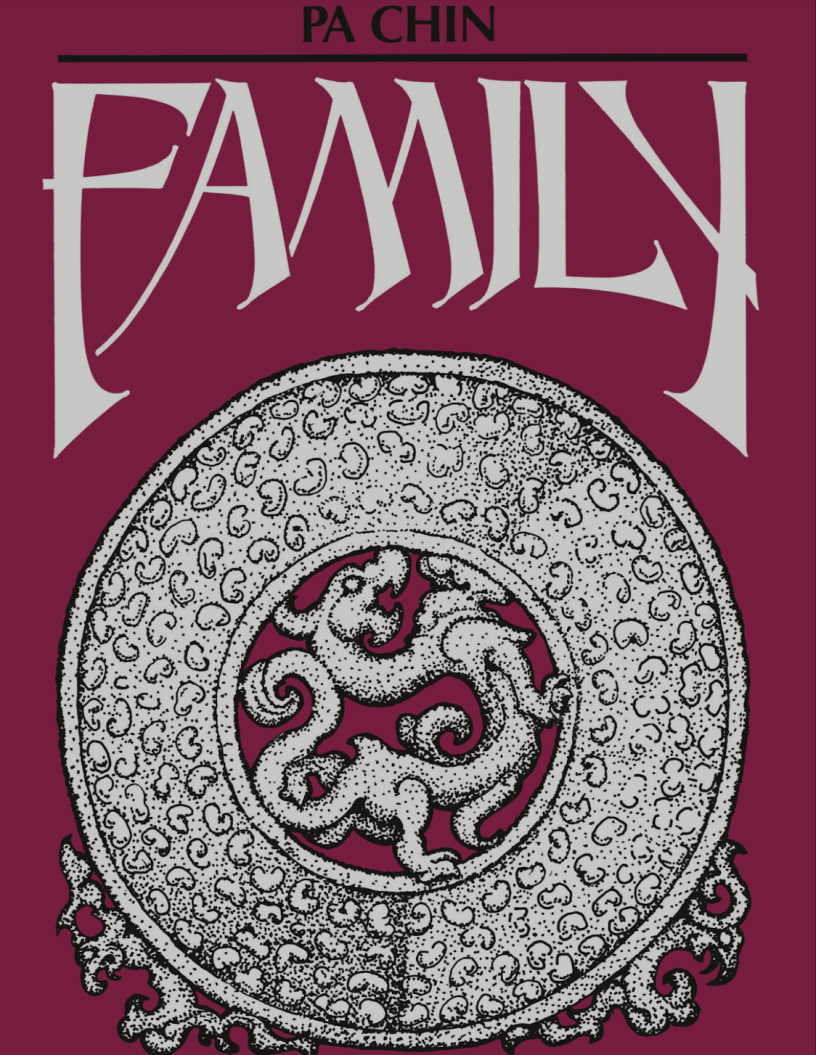
Family
By Ba Jin
Translated by Sidney Shapiro
(1931, translated 1972)
Waveland Press
(Novel)
Ba Jin’s Family is a work of extraordinary significance in Chinese literature. Published in 1930, the novel captures a younger generation’s frustration at the old ways and a yearning for independence and agency. Set in Chengdu in the 1920s, the story focuses on the clash between the patriarchal Master Gao who governs his family according to Confucian principles: his grand vision is to secure the integrity, strength, unity, and social connections of the Gao clan for perpetuity. Master Go sees his sons as soldiers in a campaign to acquire alliances, influence, and guanxi or connections through arranged marriages. The three brothers, Juexin, Juemin, and Juehui are of a new generation. They are well-educated, modern, steeped in the work of European thinkers and writers (everyone in this story is reading Ibsen), and they imagine a New Culture movement and reforms that might break free of the iron bonds of feudalism. The Gao sons are romantics at heart, but powerless before Master Gao’s decrees. The oldest and most filial son, Juexin, is in love with his cousin Mei, but old Gao forces him to marry Li Ruijue. He submits to Gao’s influence and watches from a distance as his beloved Mei is married off to a man in a distant town. Within a year, Mei’s husband dies and she returns to Chengdu. She is dying of tuberculosis and still in love with Juexin, whose wife has accepted that her husband will never love her as he loves Mei. Having suffered so cruelly under Gao, Juemin finally begins to take a stand. Likewise, middle brother is motivated to make revolution because of his desire to marry Qin. Like Juemin, Qin is an intellectual and a person of action. She sees herself as Ibsen’s Nora and hopes to join her lover at school when they begin educating women. When Master Gao sends word that Juemin must marry another, Juemin flees the Gao compound, signaling that he would rather end his relationship with the family than submit to old Gao. The youngest brother, Juehui is the most radical. He valorizes the ideals of the May Fourth Movement. Not surprisingly, he also is in love, and perhaps predictably, he is involved with Ming Feng, a servant in the Gao compound. As fixated as he is on being an iconoclast, Juehui may be the most disappointing of the brothers, as he wishes that his beloved were from an upper-class family. Perhaps it is more rewarding to focus on Ba’s heroic women, who are each unforgettable. Ba’s writing is fast-paced, heartbreaking, and inspirational. He does not shy away from melodrama, but he skillfully avoids the maudlin and succeeds in creating some deeply affecting scenes of private tragedy. And as much as this is a story of intellectuals and philosophers, the real world is always at the gates. The brothers encounter soldiers who disrupt public gatherings and there are frequent reports of student protests, confrontations with the military, violence, and death. Even the Gao compound comes under fire. Will the clan survive? Will it suffer its own revolution?
“Jue-hui gazed at his grandfather stubbornly. He examined the old man’s long, thin body. A peculiar thought came to him. It seemed to him that the person lying in the cane reclining chair was not his grandfather but the representative of an entire generation. He knew that the old man and he–the representative of the grandson’s generation–could never see eye to eye. He wondered what could be harboured in that long thin body that made every conversation between them seem more like an exchange between two enemies than a chat between grandfather and grandson. Gloomy and depressed, Jue-hui shook himself defiantly.”
 East Asian Literature in Translation