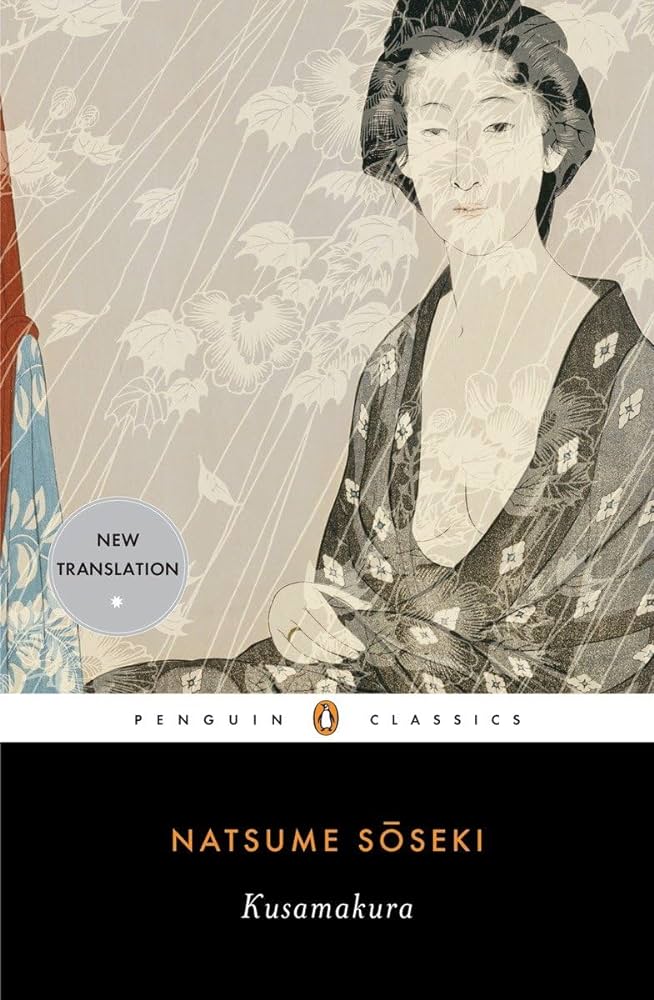
Kusamakura
By Soseki Natsume
Translated by Meredith McKinney
(1904, translated 2008)
Penguin Books
Kusamakura is translated as “grass pillow,” signaling that for Soseki, this is a traveller’s record, a pathless, wandering novel of observations, ruminations, and ineffable experiences or emotions. Soseki referred to Kusamakura as his “haiku novel.” The narrator is a thirty-year-old painter we first meet approaching a mountaintop. He reports on vistas and the problematic loose rock that threatens to slide from under him, imagines ways to improve the views, and then, on hearing the call of a skylark, muses on Shelley’s poem “To a Skylark.” He ponders the relationship between the English Romantics and the natural world and then speaks of the transcendent realms achieved by the classical Chinese poets, citing Wang Wei. Soseki himself had returned from a course of studies in England, and much of Kusumakura is the author’s effort to develop a cohesive way of dealing with the glories and tensions between Eastern and Western art and philosophy, while also addressing his own anxieties he experiences as the Meiji period passes away and modernity and its noisome and noisy machinery comes crashing in on his aesthetic reveries. The debates that pepper his internal monologues and conversations are extraordinarily literate and provocative, though the sheer volume and variety of discussions about ways of being in the world can come off as forced and artificial. Soseki is nevertheless earnest and consistent, never more so than when the narrator apologizes for the suicide of a student and eulogizes him as a hero of philosophy. Kusamakura is also a love story. The narrator takes a room at a remote inn managed by a beautiful woman. Intelligent, literate, and direct, she is an interesting foil for the narrator. Far from demure, she challenges his philosophical pronouncements, keeping him both destabilized and at bay with a wit that is certainly equal and possibly superior to his. In these moments Soseki seems to be satirizing the artist so consumed with accumulating and deploying points of view that he can’t put a brush to paper. The problem is never more explicitly on display than when he first encounters this woman at the inn: without any sense of self-awareness, he reports that she looks exactly like the Pre-Raphaelite John Everett Millais’s painting “Ophelia.” The object of his desire, Mori, is confidently aware of her beauty and the hold it has over her wordy idolater and behaves so unlike the passive maiden he imagines her to be that she can mock him to his face. Though he is all but undone by her he can’t help but forever regard her through the adoring and pitying eyes of a 19th century British Romantic. As intellectual as this short novel is, it never becomes tedious. The narrator’s arguments, counterarguments, and moments of calm “in the moment” observation nor does he ever arrive at a fully realized new aesthetic. Eventually, the thinker must leave the timeless mountains and return to the city, carrying his incomplete sketches. Soseki, no doubt aware of his hero’s fate, shows him departing at twilight aboard a roaring steam engine that hurtles him forward into the unknown night of the 20th century.
I suppose you could say that the artist is one who lives in a three-cornered world, in which the corner that the average person would call “common sense” has been sheared off from the ordinary four-square world that the normal inhabit.
For this reason, be it in nature or in human affairs, the artist will see the glitter of priceless jewels of art in places where the common herd fears to tread. The vulgar mind terms it “romanticizing,” but it is no such thing. In fact, the phenomenal world has always contained that scintillating radiance that artists find there. It’s just that eyes blinded by worldly passions cannot see the true nature of reality. Inextricable entanglements bind us to the common world; we are beset by obsessions with everyday success and failure and by ardent hopes—and so we pass by unheeding, until a Turner reveals for us in his painting the splendor of the steam train, or an Okyo gives us the beauty of a ghost.
 East Asian Literature in Translation