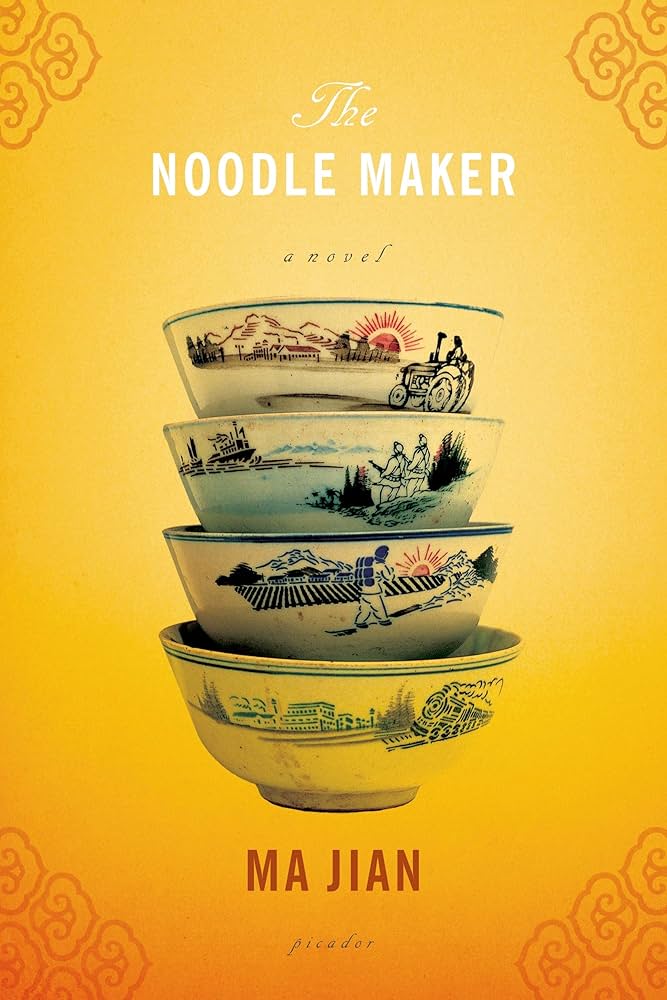
The Noodle Maker
By Ma Jian
Translated by Flora Drew
(1991, translated 2004)
Picador
Ma Jian is internationally famous for his blistering political satire. The events in the short stories take place after the death of Mao and during the period of economic reforms championed by Deng Xiaoping. Many of the nine linked stories in this collection focus on what is valued in the new China. Ma’s characters are bewildered, enraged, and paralyzed by the rapid, capricious, and often contradictory fiats leveled by the Party. Having survived the large-scale physical and psychological trauma of the Cultural Revolution, Ma’s characters struggle to adapt to rapid changes that alters their relationship to their fellow citizens and to the new leading class. Those who benefit most from the opening up of China’s industry are fueling lightning-speed development and displacing citizens from their neighborhoods and homes, while the people of China’s great cities continue to struggle under long hours and low wages. Ma sees the Party’s inscrutability, totalitarianism, disregard for the individual, and violence as an inescapable force that replicates its own psychosis on the most intimate scale, poisoning sexual relations, marriage, and the family unit. The stories emerge as two long-time associates, “the professional writer” and “the blood donor“ exchange stories, get drunk, quarrel, and call each other out as failures. The professional writer is in the employ of the Party. After an early success, he was promoted to a leadership role as a chief editor and publisher. Since assuming that position, he has used his authority and influence to bed a wide variety of young female writers he uses until they no longer please him. Though prolific in his sexual conquests and competent as a penny-pinching bureaucrat, he has lost his ability to write anything with meaning. As a result, he puts up with the Blood Donor because he tells good stories and may bring the writer’s moribund genius for creation back to life. The blood donor considers himself a key member of society as he makes his living literally selling his lifeblood for the Party in the notoriously corrupt plasma economy. By doing nothing, he has become a millionaire. They share stories about a mother-son entrepreneurial relationship that inspires them to get into the business of cremation and end-of-life rituals, a woman so neglected by her lover that she makes her suicide a public expression of her unseen values and courage, and a beauty whose life is undone at the age of fourteen when she develops breasts that meet the party’s standard for motherhood but make her the target of criticism and desire by men and women. Another woman abandons her life as an artist when she discovers the thrill of selling and marketing. Ma sees the sexual relation and love in China as something that is inherently broken, and the marriage bed as a place of tyranny, abuse, and humiliation. The humor is dark, often grotesque, desperate, and laugh-out-loud. As much as he satirizes the Party, Ma saves some of his hardest-hitting criticism for the professional writer, using a proxy to reveal his own failure to stand up against oppression and resist its corrupting influence. Fortunately, amidst this bouquet of black roses, Ma places the unexpectedly uplifting “The Abandoner or the Abandoned,” the story of a father who believes it is in his family’s best interest to abandon his first child in order to give them a better chance at happiness under the One Child policy.
“In his mind, the professional writer sees the street writer squatting on a pavement in the new part of town, which a few years ago was open fields. It is a brand new district by the sea, built of concrete and cement. The local peasants who were evicted from their land and rehoused in the new three-storey concrete blocks are not yet accustomed to their new way of life. They still keep their timber and mouldy raincoats outside their front doors, even though they will never again have to burn wood or labour in the fields. The women continue to tie black scarves around their heads, although they no longer need to shield themselves from the sun. The men wear Western suits now, but still smoke their water pipes every afternoon. They always stand at an angle, as though they were leaning on their hoes in the fields. The children continue to shit in the streets rather than use the new toilets in their bathrooms. The flat roofs are pierced by a clutter of television aerials. Farmers from the hinterland who have found work in town but have failed to secure a residency permit, flock to this new district to rent private rooms. The local peasants have become wealthy landlords overnight, and the residents of the old town have been forced to take notice of the ‘cabbage-faced bumpkins’ they have previously preferred to ignore.” – from “The Street Writer or The Plastic Bag in the Air”
 East Asian Literature in Translation