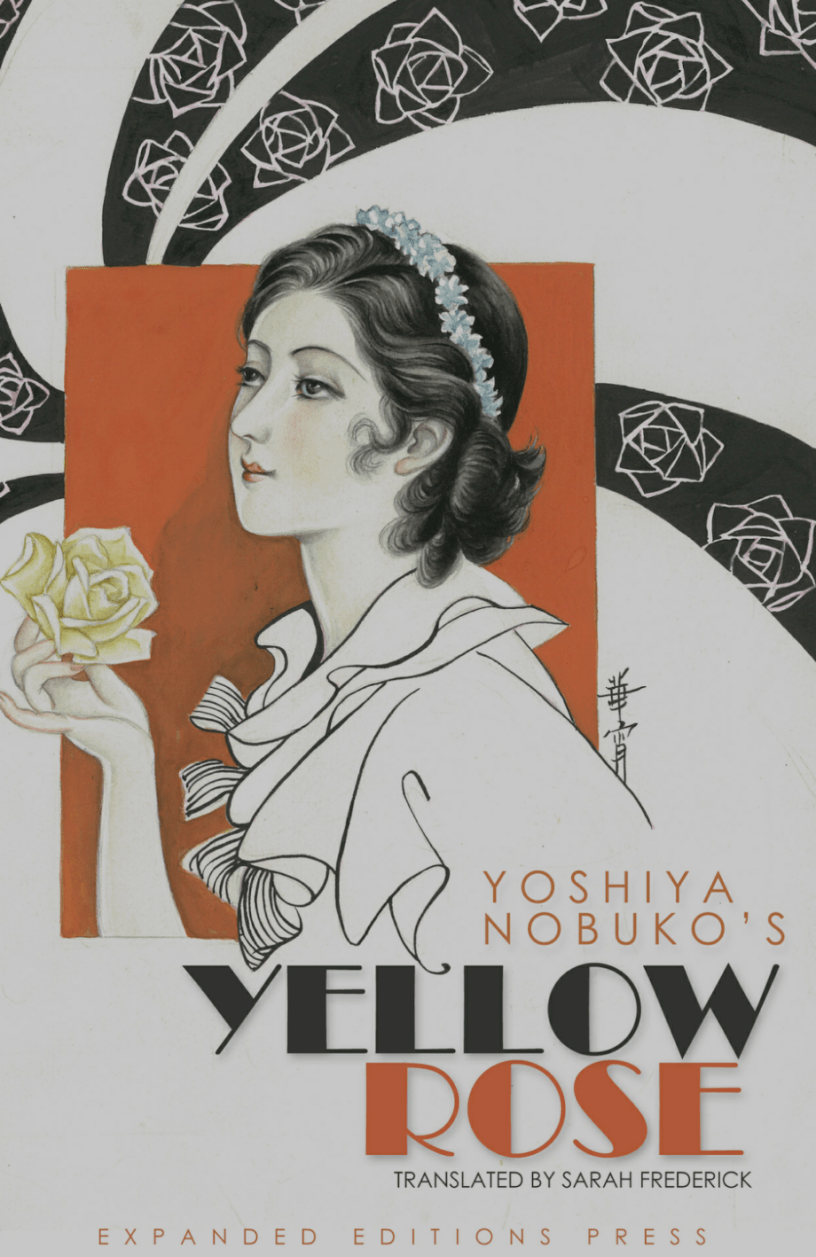
Yellow Rose
By Nobuko Yushio
Translated by Sara Frederick
(1923, translated 2016)
Expanded Editions
Nobuko Yushio grew up reading about the emotional lives of modern, young, Japanese women in the popular Girl’s Pictorial magazine. As a teen, she submitted poetry to Girl’s Pictorial and eventually became one of the most popular and successful writers on its staff. In Girl’s Pictorial, readers could find stories of city life and heroines who were independent, outgoing, and curious about life. A Girl’s Pictorial protagonist was a charismatic adolescent, well-educated, and in no hurry to embrace arranged marriages. They were capable of deep philosophical introspection and passionate emotional and spiritual attachments to women who understood their hearts as no one else could. Nuboko popularized this genre (Shojo romansu or “girls romance”), in her long-running series Hana monogatari or “Flower Stories.” “Yellow Rose: is a short story about a young woman, Katsuragi Misao, who has just graduated from Tsuda English Language Academy. She heads off to a distant town, thus avoiding an impending marriage arranged by her parents. While teaching English to a group of seniors at a school for girls, she is struck by an encounter with one of her students, Urakami Reiko. The two discuss their love of literature, including Yeats, Ibsen, and Shaw. Katsuragi also introduces quotes from Sappho, whose work was only recently translated into Japanese. They imagine a life together, but their dreams are dashed when Reiko’s parents call her home to get married. This publication runs to just fifty pages; almost half is dedicated to the translator’s account of Nobuko’s remarkable life and career, her own deep analysis of the text, and an excellent account of Japanese literary criticism of the short story since its publication. Frederick’s discussion of Nobuko’s use of ellipses and idiosyncratic use of punctuation marks makes for surprisingly outstanding reading. If you are interested in LGBTQ+ literature in Japan, use this extraordinary little text as your starting point.
“But people who had a more perversely skeptical attitude to trends might be able to feel grateful for a face displaying such a classical, aristocratic shape. And those eyebrows. Today, when the thin, Buddha-like arches made fashionable by the beauticians of Paris have made their way to Japan and compete for attention with Marcel waves and long shawls, these luxuriant and girlish eyebrows pleasantly stretching out horizontally over her eyes were yet another thing for which one could feel grateful. Under the protection of those lovely eyebrows lay her cool pupils that hinted at a heart within that was a fount of emotions but nevertheless gave her face a serene and imperturbable expression. Rather unfortunately, over them shone the glint of a pair of glasses. But in their favor, they were round with delicate frames and, of course, gold-rimmed. Although the effect was not unpleasant, the shadow of her glasses fell near her cheekbones, on skin that was so pale as to make her seem almost unhealthy. And yet as one drew closer to speak to her, the eyes behind the glasses–—so beautiful and sad as to be melancholic–—softly opened, giving silent voice to the thoughts of this person of so few words and reaching out such that one found oneself drawn even closer to this girl who never gazed directly on the crowds but rather pursued the infinite eternity of space as though beholding a dream, which is how people came to call her “the philosopher.””
 East Asian Literature in Translation