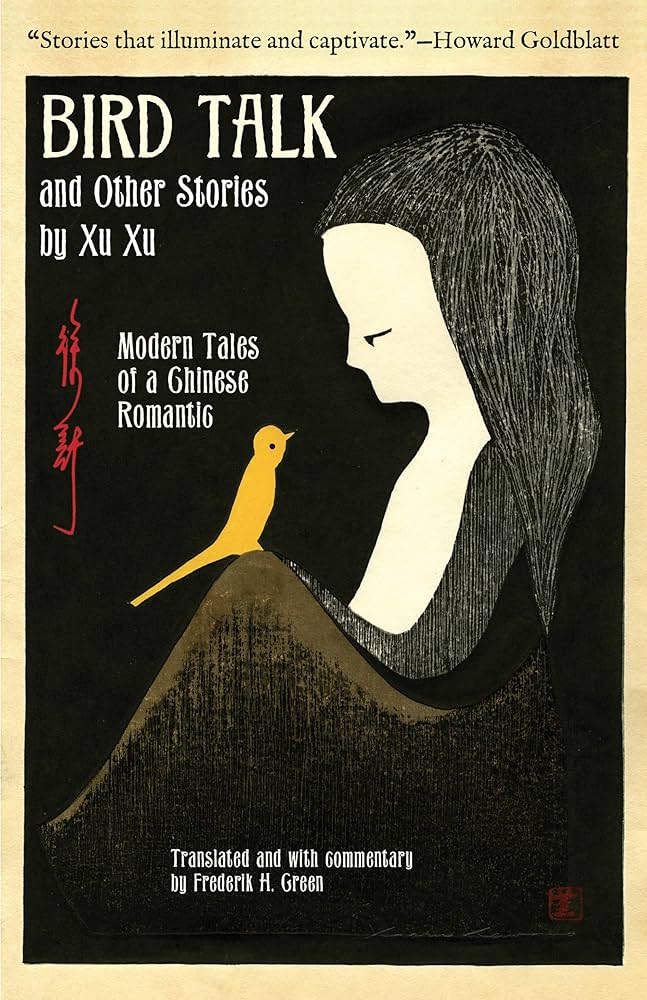
Bird Talk and Other Stories by Xu Xu: Modern Tales of a Chinese Romantic
By Xu Xu
Translated by Frederick H. Green
(1930s, translated 2020)
Stone Bridge Press
As a writer, Xu came of age in Shanghai in the 1930s. He contributed poetry to literary magazines, explored the Anglo-American International Settlement and the French Concession, and read translated books from Western novelists and philosophers. He chose aesthetics over politics, writing in a romantic vein about pursuing mysterious, exotic foreign women who ultimately elude his heroes after dramatically exposing and reconfiguring their understanding of the world. Xu’s stories take place in recognizable locations in China and Europe, but his characters invariably find themselves in an atmosphere influenced by dreams, uncanny phenomena, phantoms, and the inexplicable. The stories featured in this collection include “Ghost Woman,” “The Jewish Comet,” “Bird Talk,” “The All-Souls Tree,” and “When Ah-Heung Came to Gousing Road.” “Ghost Woman,” which enjoyed great success in Shanghai, is Gothic in tone and setting and features a man who becomes obsessed with a lonely woman who will address him only as “Human.” Xu wrote “The Jewish Comet” while studying in Europe. The story introduces readers to the Jewish population of Shanghai, an ocean cruise, and endless nights in Spain. He returned home in 1937, continuing to write under the Japanese occupation. In 1945, a Marxist critic attacked Xu Xu’s best-known work, “The Ghost Woman,” claiming that the work of fantasy was incompatible with Marxist thinking and urging loyal readers to “throw it into the cesspool.” Xu took this as his cue to flee Shanghai for Hong Kong. Assuming that he would return after this incident blew over, he left his new wife and child behind. Tragically, he was unable to return for some time and it was ultimately necessary for him to divorce his wife to protect her from being denounced. Xu wrote the final three stories in Hong Kong. “Bird Talk” and “The All-Souls Tree” feature contrasts between the natural world and the modern city; Buddhism plays a strong role in the former and folklore in the latter. The final story, “When Ah-Heung Came to Gousing Road” is a surprising rags-to-riches story with an interesting take on the modern Chinese woman.
“Her face was round, and her eyes shone brightly. She bore a happy smile. The sounds she was making were beautiful. They neither sounded like te trillig of birds, nor did they sound like singing. The girl and the two birds seemed like old acquaintances. The birds flew back and forth between the fence and her shoulder and then landed on the fence and chirped affectionately. By then, the morning haze had already disappeared and the sun shone onto the dewy grass. I was able to see the girl’s face clearer now. Her chin was pointed, and she had thin lips, a delicate nose, and a broad forehead. Her eyes were radiant.” – from “Bird Talk”
 East Asian Literature in Translation