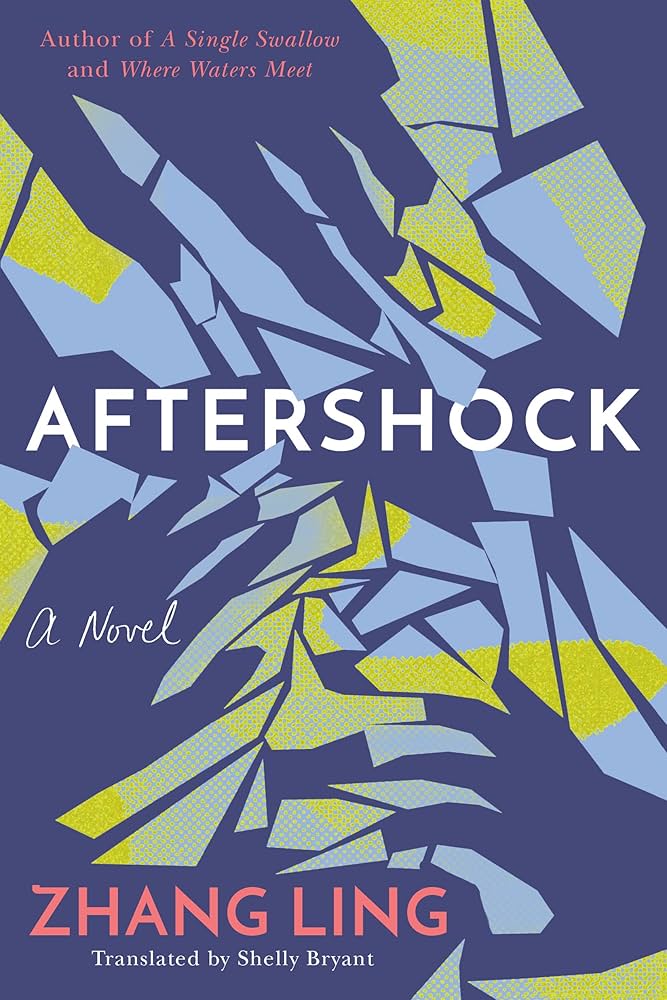
After Shock
By Zhang Ling
Translated by Shelly Bryant
(2009, trans. 2024)
Amazon Crossing
In After Shock, Zhang Ling takes us back to 1976, when Zhou en Lai, Zhu De, and Mao – all three leaders of the People’s Republic of China – died. In July of that year, hundreds of thousands of Chinese lost their lives in the Tangshan earthquake. Zhang tells the story of Li Yuanni, a teenage dancer whose dreams of becoming a ballerina are crushed when she suffers a career-ending injury. When the Party assigns her a position in a bookstore, she resigns herself to a life of tedium. Yet, with a good marriage and the birth of twins – the girl, Xiaodeng, and the boy, Xiaodo – Li Yuanni rediscovers joy and purpose. However, her happiness is short-lived. When the earthquake strikes, a wall collapses, threatening the lives of both children. Xiaodo is visible and responsive, but the villagers warn Li Yuanni that if they shift the debris to free the boy, the girl will be crushed, and if they move the wall to rescue the girl, the boy will die. The mother anxiously deliberates and finally commands the rescuers to free the boy. Three days later, the impossible happens: another team discovers Xiaodeng is still alive. She is just holding on to life; she has only the slimmest recollection of her family and does not know her name. After an earnest attempt to reunite her with her family, a husband and wife who lost their children in the quake agree to adopt the young girl. Using a deft touch, Zhang opens windows into the lives of the surviving family members, revealing the paths they take after the defining moment of the Tanshang disaster and documenting the way that trauma continues to shape, haunt, and scar them. When we meet Xiaodeng again, she is a writer living in Canada. She is married and has a child, but her always fragile emotional life is collapsing on itself. She still has no recollection of what happened to her before she was adopted, and by all indications, her new family suffered its own disaster when her adoptive mother died young, leaving her in the care of a many times bereft father who only adds to her trauma. Xiaodeng is all but walled off from humanity, descending deeper into the void that is her past. With great understanding and grace, Zhang gives her tragic victim two lifelines. The first is a therapist with whom she can speak about the slow disintegration of her current family, the blows she suffered in her adoptive family, and her longing to reconnect with the family that exists beyond the blackness of her memory. The second line of relief is her career as a writer, which itself is bound up in severance and pain.
“Sometimes, she felt as if her writing career was a direct result of her headaches. While others’ thought processes were peaceful and continuous, hers was chopped into incoherent fragments by bouts of pain. She lost peace, but she found impulsion. She lacked the tenacity needed for continuity, but she had gained an abrupt, unpredictable explosive power. While others grew drowsy with the inertia of daily life, she could only pick up fragments of clear thought in a sober moment, working frantically in the gaps between headaches. She had only two states of existence: pain and no pain. Pain was the end of painlessness, and painlessness was the beginning of pain. Such beginnings and endings were like rings of high-quality iron, linked one to another, locking her life in shackles. The little bit of feeling squeezed out of these iron rings was like powerful water rushing through a small faucet, giving it unexpected sharpness and strength. She did not know what to do with this momentum but be a writer.”
 East Asian Literature in Translation