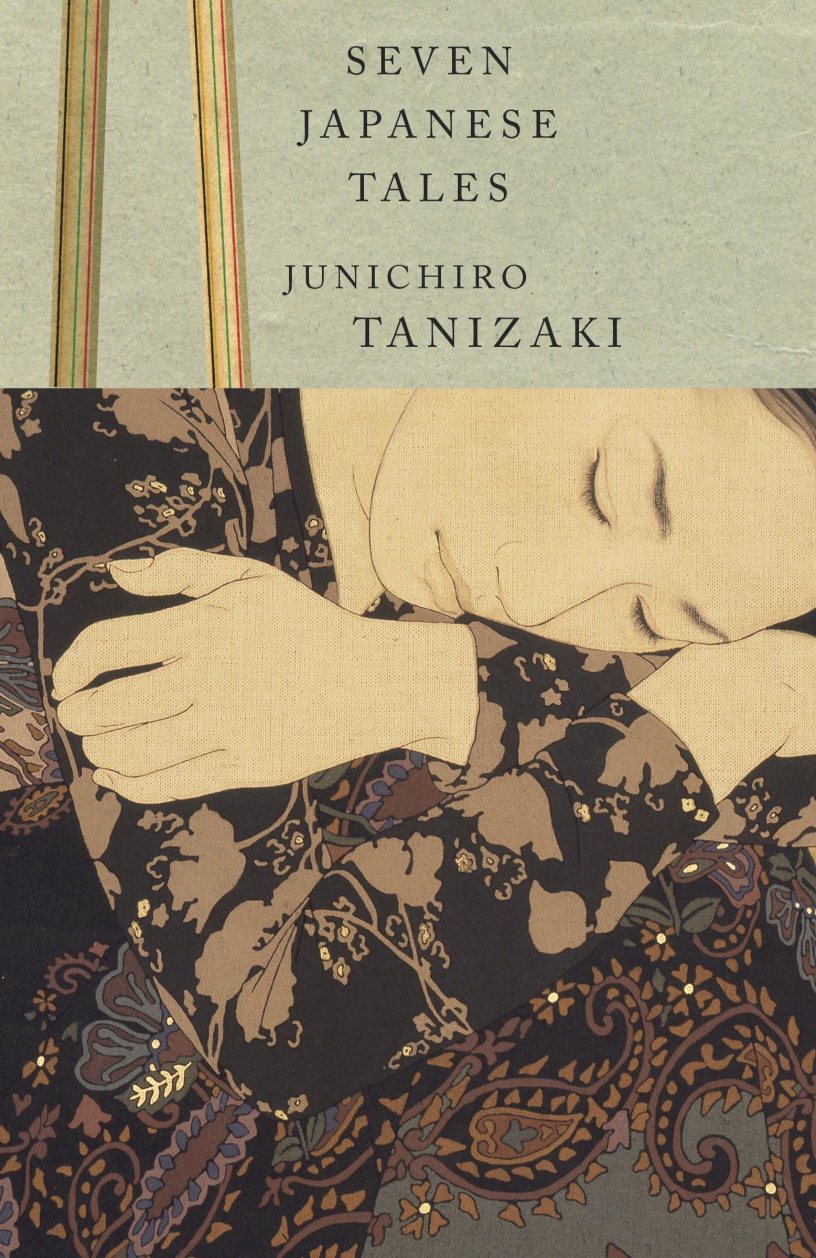
Seven Japanese Tales
By Tanazaki Junichiro
Translated by Howard Hibett
(1920-1950s, translated 1963)
Vintage International
Of the seven stories in this essential collection, the first and last, “A Portrait of Shunkin” (1933) and “A Blind Man’s Tale” (1931) are the richest and most rewarding, each running to novella length–about one hundred pages–and evocative of Japan’s feudal past. “A Portrait of Shunkin” tells the story of a girl born to a family of fading influence who makes her way in the world based on her prodigious skills as a musician. Blind from an early age, she masters the samisen and soon begins performing and teaching. In her early teens, a young boy, Nikui Sasuke, known as Kindae, is commanded to be her servant, guiding her and accompanying the young beauty wherever she goes. A keen observer of her every mood, he becomes enchanted with her instrument and craft. He submits himself completely to the service of his wilful and casually cruel sensei, becoming her lover, student, and servant. “A Blind Man’s Tale” is another journey into obsession and forbidden love. Set in 16th century Japan and featuring historical figures like Nobunaga and Hideyoshi, the story unfolds in the court of Nobunaga’s brother-in-law, Nagamasa. The narrator is a blind masseuse who works on the samurai of the castle. But he is also an entertainer skilled in performing folk and popular songs on the samisen, talents which soon make him a favorite of Lady Oichi and her eldest daughter, Ochacha. He thus enters the realm of the ladies, massaging them, performing on his instrument and singing, and eventually becoming a trusted sounding board for Lady Oichi. When Nobunaga eventually betrays her lord, sacking his castle and killing her male children, the masseuse accompanies her in her new life, witnessing some small moments of joy and happiness before his lady suffers new tragedies as a result of Nobunaga’s unrelenting and perpetual anarchy and violence. The collection’s short works include “Terror,” a disturbing yet beautifully nostalgic study of Oedipal longings, “The Bridge of Dreams,” “The Tattooer,” and “Aguri,” yet another tale of obsessive desire and a fetishization of (unexpectedly) the West.
“One can easily imagine how spirited Shunkin’s manner must have been. Although Sasuke was often brought to tears by her, he felt immense gratitude whenever he heard her talk like that. His tears were in part tears of gratitude for being spurred on so vehemently by the girl who was at once his mistress and his teacher. That is why he never fled from her maltreatment: even while weeping, he kept on with his lesson until she told him he could stop.”
 East Asian Literature in Translation