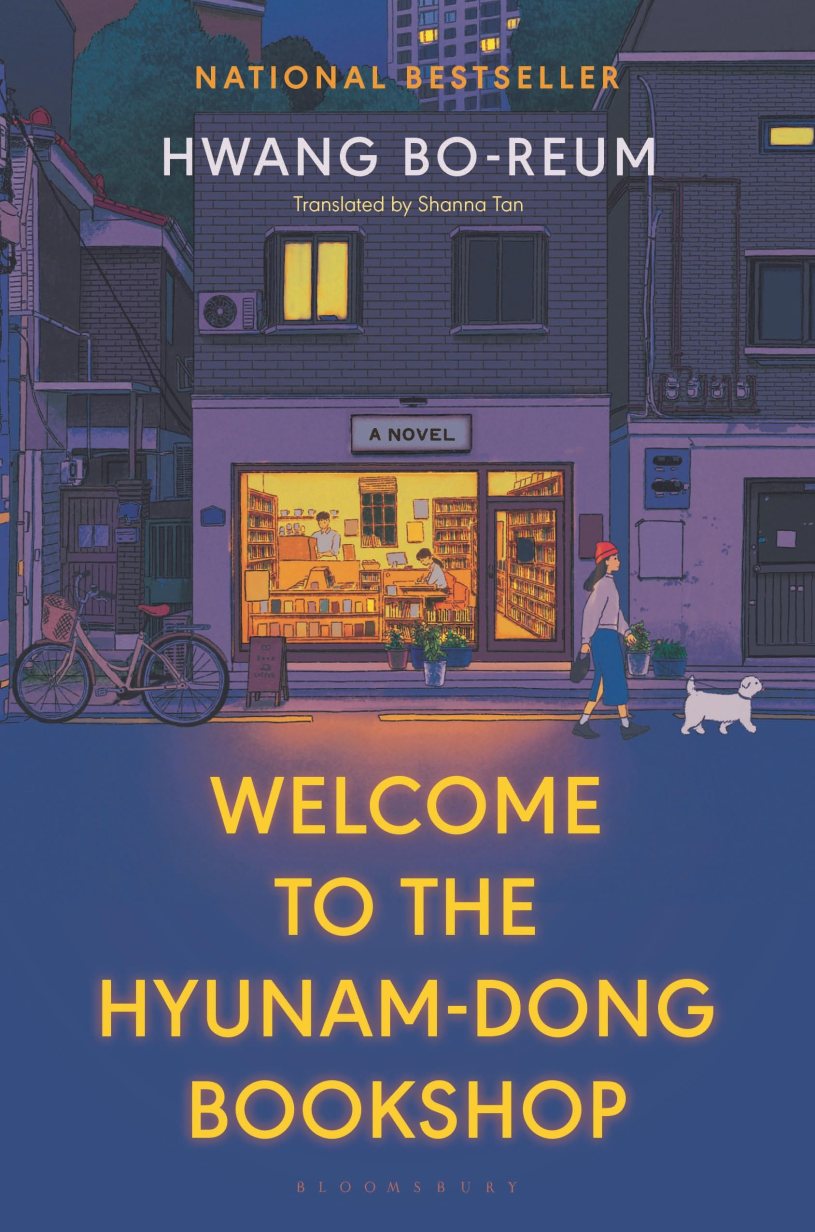
Welcome to the Hyunam-dong Bookshop
By Hwang Bo-reum
Translated by Shana Tan
(2022, trans. 2024)
Bloomsbury Publishing
Welcome to the Hyunam-dong Bookshop was published in Korea in 2022, joining the burgeoning genre of “healing fiction,” which has been capturing so much attention on the peninsula and internationally. Sometimes called “unharmful novels,” they address issues relating to loneliness and isolation, the pressure to work ever harder at a top-rated school or company, or the pain of a lingering breakup. When a novel of this genre opens, the crisis has reached its peak, the protagonist has withdrawn from the arena, licks his or her wounds, and begins finding their way again in the world. Many of these healing novels involve a person who abruptly exits the corporate world and begins investigating alternate careers. Interestingly, many of these novels are centered around what Americans are currently missing: a “third space” that is neither home nor work where one can enjoy quiet, reflective, free-range socialising without alcohol or conversation-killing sound systems and intrusive sales pitches. Yeongju has left her draining corporate environment, divorced her husband, and moved to a small apartment that is as distraction-free as a monk’s cell. She begins researching small businesses in pursuit of her long-suppressed desire to open a bookstore. She learns that many entrepreneurs are opening bookstores and that few succeed; many don’t make it past their third year. Nevertheless, Yeonju commits to buying a storefront and setting up the Hyunam-dong Bookshop. For the first months, she finds herself in an almost always empty shop. Change is incremental but steady. She hires a university school dropout with barista skills and a passion for flavor and a zen-like commitment to ritual to help her set up a coffee shop within the store. Local Olympic-level readers install themselves at tables and begin to share their book recommendations with Yeongju. A quick study, she becomes an expert at finding just the right book for a growing number of customers. One woman sits for hours, simply knitting and sharing her experiences and advice for anyone who listens; her constant presence makes the store look busy, and eventually, Yengju begins selling her creations. One reading mom arranges for her withdrawn, depressed, and angry high-school age son to visit with Yeongju once a week to just “hang out.” Business is good, and it explodes when she clears out a storage area and opens a small area where she can have local authors speak to her customers. Some “healing fiction” can be cloyingly rosy, but Hwang Bo-reum gives us characters who find relief from their troubles but not escape. This is most evident in the protagonist’s growing interest in a writer she admires. Like her, he shies away from or downright flees from any opportunity to begin a romantic relationship. Will Hwang give us a fairy-tale ending? Will her protagonist risk new love, or will she continue to do the hard work of healing?
“In the beginning, she left the front door open and did nothing else. People walking by strolled in, drawn by the seemingly gentle atmosphere. But in fact, the bookshop was like a wounded beast, wheezing feebly. The footfall soon turned to a drop. It was the sight of Yeongju sitting on a chair, her face so ashen you’d wonder if she still had a drop of blood in her: stepping into the bookstore was like an intrusion of her private space. She welcomed everyone with a smile, but none of them returned it.
Mincheol’s mother, a good-looking lady with a flashy sense of fashion, was one of the rare few who felt the sincerity in her smile.
‘Who would come into a shop like this? Bookselling is also a business. Here, look at you slumped in that chair. Do you think money will fall from the sky?’”
 East Asian Literature in Translation