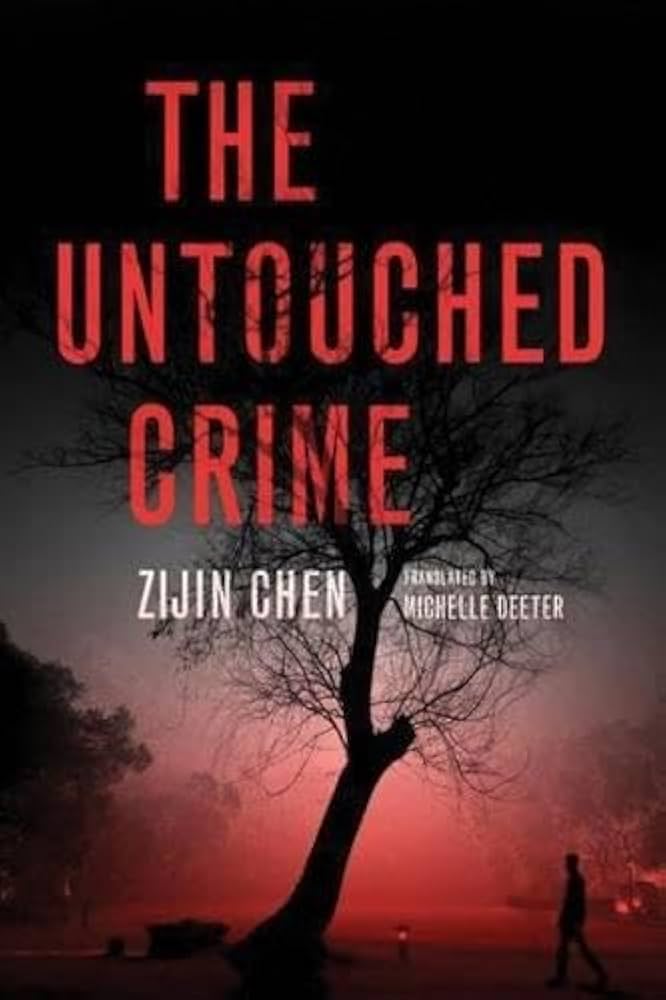
The Untouched Crime
By Chen Zijen
Translated by Michelle Deeter
(2014, translated 2016)
Amazon Crossing
The Untouched Crime is a Chinese police procedural centered on the search for a serial killer operating in Hangzhou. Over the past three years, someone has been strangling citizens using the exact same modus operandi, posing the bodies, and erasing all evidence. Despite the killer’s successful efforts to conceal their identity, they openly taunt the police by leaving a note challenging the police to solve the crime and arrest them. Each new killing explodes in the press and escalates the pressure on law enforcement to put more resources into solving the case and heightening the public’s criticism of the local government and police force. Chen highlights the power imbalance between the local police who do the leg work and are personally invested in stopping the murders and the inspectors and higher-ups who helicopter in only when a spectacle demands their attention. As the search ebbs and flows, Chen highlights the routine cruelty and injustices inflicted on citizens. Teen gangs walk the streets with impunity, exploiting shop keepers, beating the defenseless, and sexually harassing young women. Someone is sexually assaulting women on an almost weekly basis. Local newspapers clamor for action, but the police, despite their efforts, are unable to catch the perpetrator. That changes when a sexual assault occurs not far from the location of a new crime by the serial killer. At this point, Chen shows his hand: an “untouched crime” is a crime that eludes solution because initial investigations turn up few clues and exhausts manpower in fruitless searches; when new, solvable and insolvable crimes inevitably appear, police must turn away, abandon the case, and move on, leaving the injustice unresolved and “untouched.” Meanwhile, the victims of crime continue to suffer. Chen suggests that crimes against women often follow this path; unwanted touching, sexual harassment, and physical assaults are a bass line drone at the heart of the culture, a poisonous behavior that persists underneath everything, an endemic societal illness that no one takes the time to address. Chen’s elite crime force reaches out to a college professor and former forensic scientist, and before long they bring in another legendary forensic master to aid in solving the case. Chen puts the readers into the shoes of the local police, investigators, and crime experts while also revealing the precarious position of everyday citizens lacking in resources and clout. He brings these people into the light–especially the women–and illustrates how poorly they are served by society. Chen tends to overwrite and overexplain in wooden prose, especially when law enforcement is speaking. Dialogue often reads like exposition. Although the story unfolds in Hangzhou, we see little of the city or even the locus of the crimes. One wishes for more reflection.
“The two officers braced themselves; they could tell that something important was coming. “What happened?” Song asked.
Huiru spoke reluctantly. “He was drinking all by himself in a park, and he had a plastic bag with beer in one hand. After he saw me, he came . . . came towards me and told me to have a drink with him. He even . . .” She trailed off.
“What did he do?” Li asked, his tone urgent.
“Nothing.” Huiru lowered her head.
Song looked sternly at her. “Madam, we need to investigate every detail of this case. Please tell us exactly what happened.”
Huiru hesitated before stammering, “He pulled my arm and wanted me to drink, and—and he groped me.”
“How could he!” Song shook his head angrily. “And then what happened?”
“I wanted to get away from him, but he wouldn’t let me go. He kept pulling me and saying I had to drink with him. I don’t know how drunk he was. I shouted for help and he tried to cover my mouth. I finally managed to escape and run away. He stopped chasing me, but right before I reached the road, I fell and my leg started bleeding. I twisted my ankle and couldn’t walk. My friend happened to pass by, and he picked me up and carried me home on his back. It scared . . . scared me to death.”
 East Asian Literature in Translation