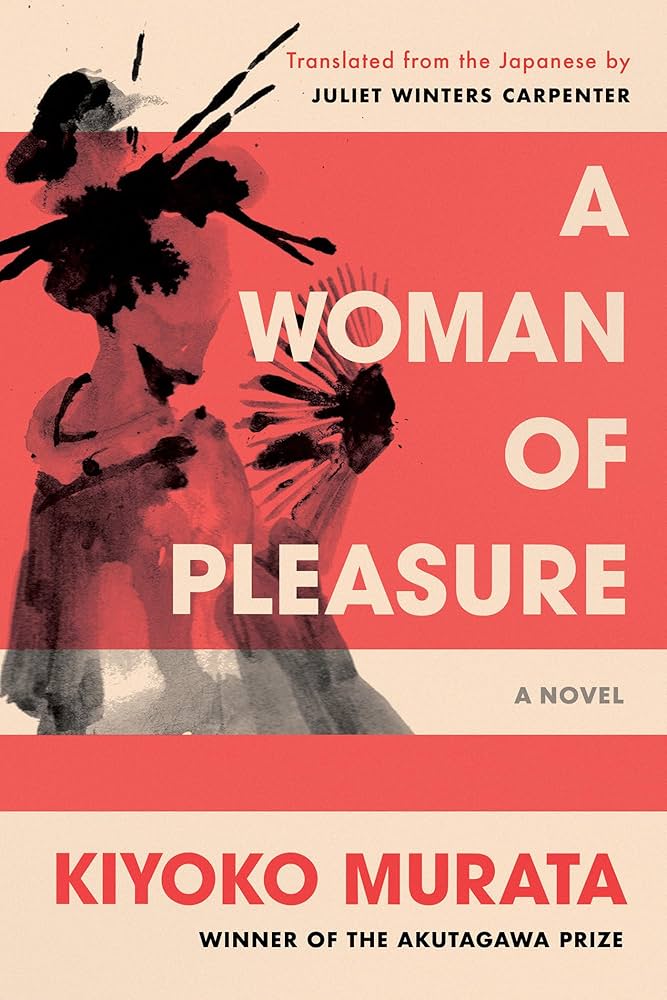
A Woman of Pleasure
By Kiyoko Murata
Translated by Juliet Winters Carpenter
(2013, translated 2024)
Counterpoint
Kiyoko Murata’s A Woman of Pleasure is a work of historical fiction depicting the early life of a young woman sold into sex work at the age of fifteen. Murata sets her tale in 1903 in a well-reputed okoya, a training ground for young sex workers in Kumamoto on the island of Kyushu. Under the influence and favor of the house’s oiran, the chief courtesan Shinonome, Aoi Ichi undergoes instruction in the art of pleasuring male customers. By presenting a courtesan’s tale in late Meiji-era Japan, Murata positions her hero in the waning days of the culture of sexual enslavement. Japan is changing rapidly, and women in particular are enjoying exceptional new freedoms. However, despite the 1872 Prostitute Liberation Law, the banal cruelty and dehumanizing conditions of the Japanese culture of sex trafficking persist, yet Murata offers Ichi experiences and opportunities to make choices that are uniquely modern. For example, while continuing to train courtesans in the traditional arts of music, conversation making, and the performance of waka poetry, Shinonome sends her charges to attend classes at a nearby vocational school where the instructor, Tetsuko, is a former prostitute who has bought her freedom. Beyond teaching the students to read and write, she encourages them to write about their feelings and their goals, enabling Ichi, who is socially isolated because she speaks an island dialect, to put her experiences into words. Ichi’s memories of her life on the island allow Murata to provide a broader discourse on how sex and sexuality are shaped by contrasting the cultural knowledge of women’s bodies, sexuality, and reproduction shared by indigenous women of Ichii’s tribe and the institutionalized practice and performance of femaleness and femininity demanded of Japanese courtesans. Tetsuko also encourages the girls to learn mathematics so that they can keep their own accounts of their earnings, the money they earn for the brothel, and the charges they incur for clothing, food, instruction, medical examinations, etc. Her schoolteacher, who has converted to Christianity, also offers glimpses of the rapid growth of the religion among Japanese women, as well as writing from contemporary proto-feminists and Fukuzawa Yukichi, whose apparent support for a reevaluation of the status and role of women in Japanese society becomes a point of inspiration for Ichi. Tetsuko instills a yearning for justice and female agency in the young women, and when she tells them of the success of a strike by dockworkers, Ichi and her friends weigh the benefits and costs of making their own demands. Again and again, Murata shows the women of the brothel sharing knowledge and engaging in small acts of resistance that inspire them to keep pushing and pulling at the strictures that bind them.
On her way downstairs from one of her dizzying lessons, Ichi caught sight of the blue sky. If she could fly over the rooftops, she might dive deeper and deeper into that sky as into the sea and swim all the way to her island. But Ichi was not a bird, so she could not take wing into the freedom of the sky.
Without permission, the girl could not go through the enormous gate at the end of the street in front of the licensed quarter. Ichi sometimes thought she might be living in Ryugu-jo, the underwater palace of the god of the sea–-a strange Ryugu-Jo– where no sea bream or flounder danced.
 East Asian Literature in Translation