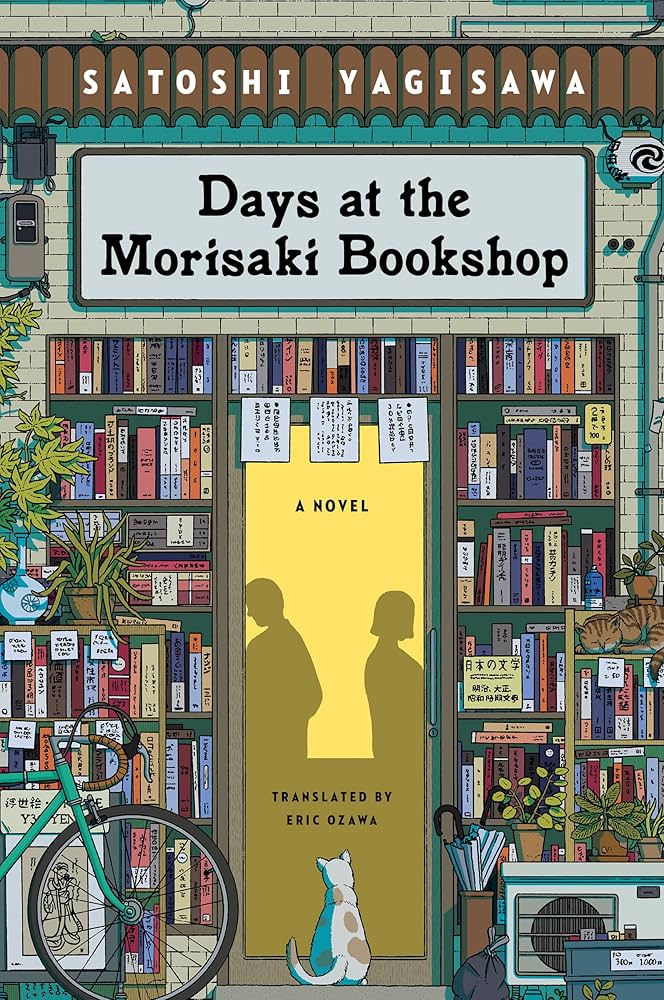
Days at the Morisaki Bookstore
By Satoshi Yagisawa
Translated by Eric Ozawa
(2010, translated 2023)
Harper Collins
Days at the Morisaki Bookstore features many elements of the popular healing novel genre while remaining firmly rooted in reality. Yagisawa introduces us to Takako, a young woman in her mid-twenties who is happily involved in an almost year-long romance with a work colleague when he announces that he is engaged to be married to another woman employed by the same company. This sets our narrator into a spiral of depression; she quits her job, takes to her bed, and might have disappeared from the life she described formerly as “adequate” had she not received a phone call from her uncle Satoru. He invites her to come to Jimbochu and work at a used books store that has been in the family for generations; to sweeten the deal, he explains that she can live in a spare room above the shop. “Healing” novels often feature the broken-hearted or those exhausted and unsatisfied with their career or relationship. We meet characters at their lowest and watch admiringly as friends and mentors appear to prop up their spirits and give them opportunities to discover themselves in slow-paced, often analog occupations where they interact more with the public than cubicle-bound computer monitors. In this genre, the path to recovering a sense of purpose can be too pat, and it is not uncommon for authors to add elements of fantasy and the supernatural to speed along the pilgrim’s progress. Yet Yagisawa’s Takako is a very real person, and her uncle’s bookshop is far from magical. They are both the worse for wear and tear. Her healing comes slowly, and she suffers many setbacks. She is intoxicated by the novels she finds in the shop and chooses one, Saisei Muro’s Until the Death of the Girl, as a kind of talisman. However, she struggles to understand the relationships of those who frequent the shop and fails to sense the intentions of those who may be interested in her; she reads voraciously yet can’t seem to read people. In the second half of the novel, having gained some strength, Takako turns outward to consider the life of her uncle Satoru, the man who gave her the opportunity to rebuild herself. She admires him greatly, and when she learns that he was married and his wife walked out on him many years ago, she makes it her business to learn more about that relationship and the woman who left him. That quest leads her into the heart of Satoru’s romance, his wife’s dissatisfaction with the marriage, and a journey to a monastery. Why Takako chooses to leave the cozy shelter of the bookstore in pursuit of a woman she never knew is a mystery. Satoru himself appears to have no questions for the wife who walked, but Takako must confront her, perhaps hoping that she will discover an insight that will help her comprehend and navigate the very complex hopes and fears she has about love and marriage, and inspire her to live a life more than adequate.
“… maybe it takes a long time to figure out what you’re truly searching for. Maybe you spend your whole life just to figure out a small part of it.”
“I don’t know. I think maybe I’ve been wasting my time, just doing nothing.”
“I don’t think so. It’s important to stand still sometimes. Think of it as a little rest in the long journey of your life. This is your harbor. And your boat is just dropping anchor here for a little while. And after you’re well rested, you can set sail again.”
 East Asian Literature in Translation