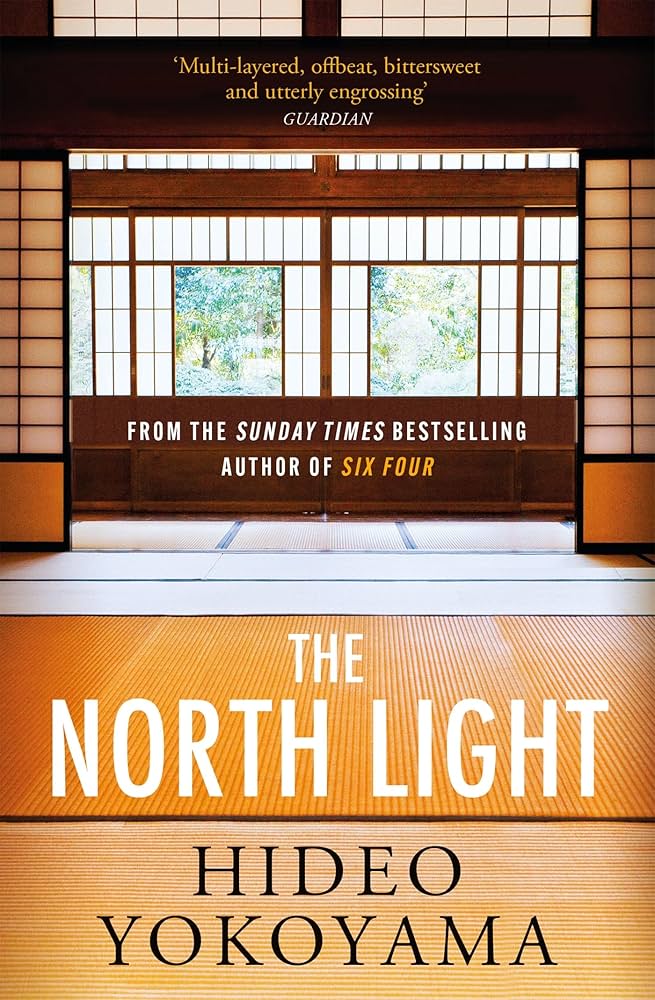
The North Light
By Hideo Yokoyama
Translated by Louise Heal Kawaii
(2019, translated 2023)
Riverrun
Hideo Yokayama is most well known in the west for his successful police procedural Six Four and the four short crime thrillers in his collection Prefecture D. A reporter by trade, his novel Seventeen revisits a tragedy that happened seventeen years earlier and how reporting on that horrific event forever changed the lives of the journalists who covered that living nightmare. In The North Light, published in 2019, Yokayama heads in an altogether different direction while including a strong throughline of investigation and an acknowledgment that journalists may sometimes cause great harm. He takes us into a world of architects and designers who soared high in the heady days of the 1980s and crashed hard after the Bubble Economy collapsed in the mid-90s. That collapse hastened the dissolution of the marriage of Yokoyama’s hero, Minoru Aose. When we first meet him, he has only recently been rescued from mindless temp work and alcoholism by an old acquaintance who hires him to work at a small architectural firm. Aose carries deep wounds. As a consequence of his father’s constant moving to rebuild key infrastructure after the war, young Aose grew up with few friends and no sense of having had a home, and he lost his father early in life due to a tragic accident. He blames himself for his divorce, struggles to connect with his teenage daughter, and, though he yearns to resolve issues with his wife, can’t bring himself to speak to her. But his professional life explodes when he is commissioned to create a private home. The design he offers is inspired, the owners are enthusiastic, and a photo of the house is featured in a collection of contemporary architectural design. However, Aose and his firm’s confidence is shaken when the architect calls the couple who commissioned him and discovers that they never moved into the building. When he finally manages to enter the house to investigate, he sees two sets of muddy footprints and only a single piece of furniture: a hand-made chair that faces the great north-facing window that gives the home its name. Aose suspects the family may have come to harm, but he also can’t escape the fear that he created a building that was so focused on artistic ideals that it could never satisfy anyone as a home. Yokoyama uses Aose’s soul searching to ask important questions about Japanese culture, Western influence, and the nature of the beautiful. For example, the architect balks at building a traditional-style Japanese home, but he is clearly at his best when he includes local materials, capitalizes on the natural environment, and incorporates elements of vernacular architecture. Yokoyama complicates the discourse on Japanese-ness, globalism, and a universal concept of beauty by introducing deep dives into the works of an ex-pat Japanese artist who produced a prodigious volume of paintings while living in a small studio in Paris and Bruno Taut, the German architect who is credited with revealing the inherent beauty of the work and sensibilities of Japanese craftspeople, both to the world and to the Japanese themselves. Aose seems to embody an inability to feel confident in his own skin; he struggles to make decisions that are uniquely his own, and though he and the men of his ilk embrace the ego-focused role of the architect as creator and visionary, the first step the members of his firm take when undertaking their make-or-break assignments is by collectively researching building designs from across the globe. Will Aose be able to bring his art and his life into a reintegrated or newly formed whole, or will he continue to be dazzled and distracted by what might have been and esoteric ideals?
“However, as he approached, that initial impression of shabbiness changed to one of simple beauty, from meagreness to modesty. It was an old but distinctive residence in the style of a traditional Japanese house. The doors and shoji screens were open, as if someone had gone in to clean, and Aose could see what appeared to be two rooms. The engawa porch was L-shaped, connected to the two sides of a six-tatami room. That room also had a tokonoma alcove. In the centre of the back room was a hole dug in the floor to make an irori sunken hearth.
It was soothing to the eyes. In a word, the feeling it brought to him was nostalgia. He’d experienced something similar when he’d sat in Taut’s chair at the Y Residence. It was as if the touch of the chair had reawakened something and he was back designing the Y Residence. He revisited the moment that he came up with the concept of a wooden deck with rounded edges and felt a sense of serenity return to him.”
 East Asian Literature in Translation