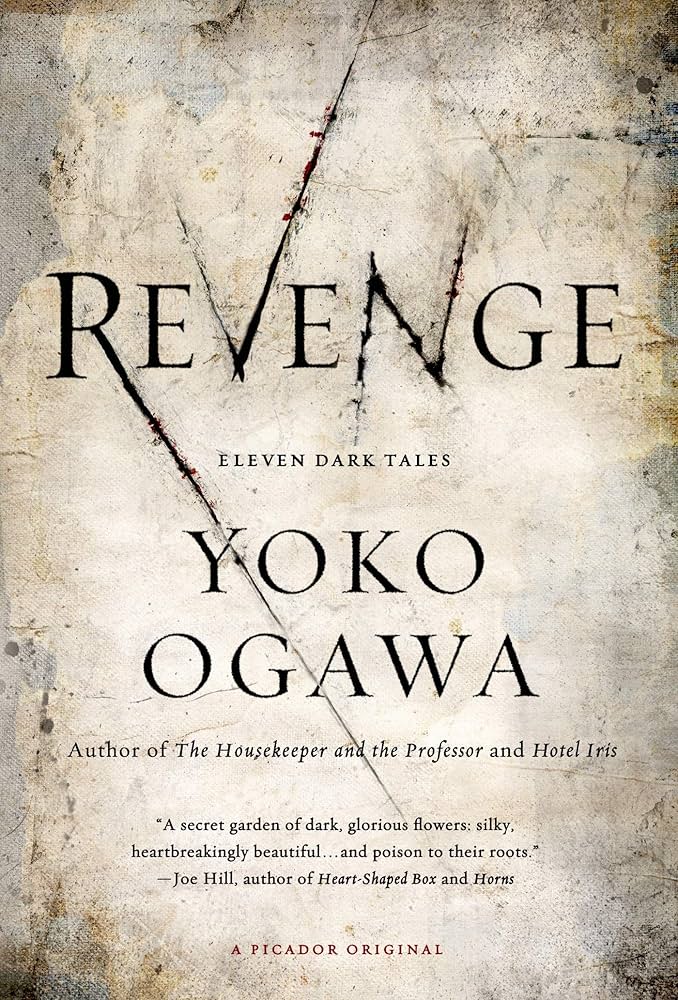
Revenge: Eleven Dark Tales
By Yoko Ogawa
Translated by Stephen Snyder
(1998, trans. 2013)
Picador
Here is a puzzle: of the eleven short stories in Picador’s publication Yoko Ogawa’s Revenge: Eleven Dark Tales, few–if any–are about revenge. The stories are macabre, surreal, and include acts of savage violence, both real and imagined. But many are about human beings struggling to make sense of personal tragedies. Ogawa’s characters have lost children, partners, and dreams. In response, they strike out at others or themselves in destructive and ritualistic ways. Speaking and observing in beautiful prose, Ogawa’s narrators are mad or mad-adjacent, unreliable, ultra-possessive, and attached to someone or something in a wholly unsettling manner. A mother persists in celebrating the birthday of her deceased son, and lovers who have lost their beloved attempt to repossess or replace them by any means. Several stories feature artisans and writers who live shrinking, ghost-like lives because a career-defining masterwork is rejected not because it is not perfect but because modern technology offers a simpler, cleaner solution, or after a stunning debut, a writer loses their faith in their ability to create art. Each of the stories is somehow connected to others in curious and enigmatic ways. A secondary character in one story emerges as a central character in another; a peculiar sentence in story B appears in stories E and G, and there are tomatoes, so many tomatoes. The interconnectedness of the stories suggests alternate versions or readings of scenes and inspires a repeating course of rereading and reinterpretation. Ogawa’s themes are reminiscent of Poe’s “Ligeia,” where the hero’s desire for his deceased lover turns into something obsessive and unholy, and that returns us to the English title Revenge, which is a misnomer. The Japanese title Kamoku na shigai, Midara na tomurai, which can be translated as Silent Corpses, Improper Funeral or Silent Corpses, Obscene Mourning.
“But somehow the sight of all these instruments of torture, all of this pain, seemed to fit right in with thoughts of my boyfriend.
“This was brought to us by a bag maker.” The old man pointed at another object.
“It’s like a corset,” I said, peering into a cabinet he had opened in the living room.
“It is indeed. It’s cowhide stretched over a whalebone frame. The device is fitted over the torso and gradually tightened until the ribs crack and the internal organs are crushed. It was designed specifically for use on women.”
“May I touch it?”
“Yes, of course.”
“It doesn’t look particularly old,” I said.
“You’re quite right, it isn’t. It’s actually something that the bag maker designed himself. But my testing revealed traces of human flesh on the inside of the tube, so I found it worthy of being exhibited.”
 East Asian Literature in Translation