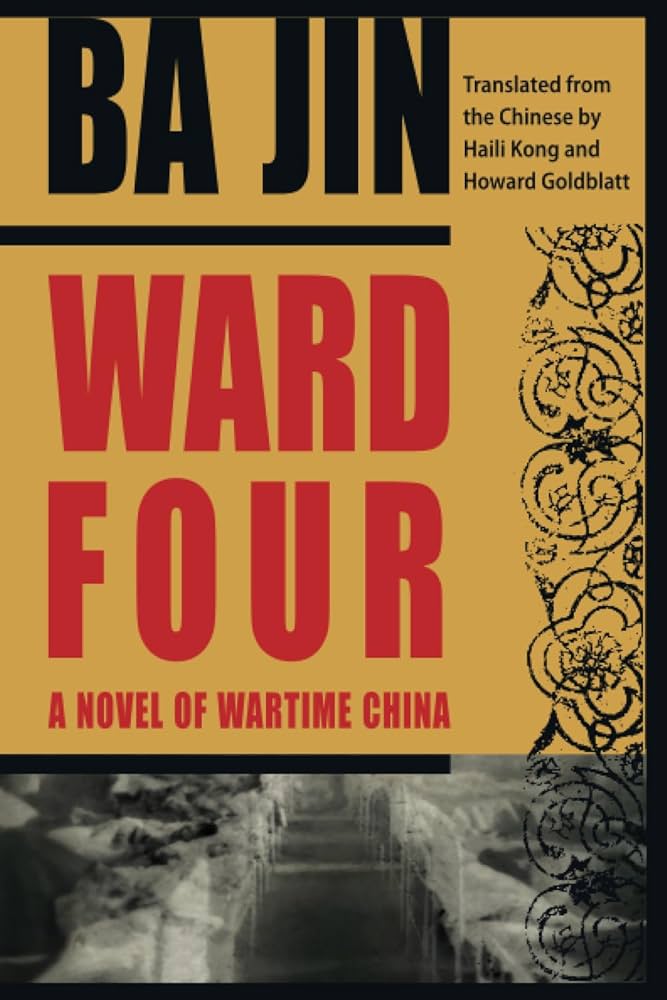
Ward Four: A Novel of Wartime
By Ba Jin
Translated by Haili Kong and Howard Goldblatt
1946, translated 1999
China Books
In 1931’s Family, Ba Jin presented readers with a narrator, siblings, and lovers unified in their outspoken passion to break from the old ways and embrace radical ideas about freedom and free will. Marked by their intense commitment to reinvent Chinese society and rooted in righteousness and optimism, they risk all to become “modern.” Readers will be hard-pressed to find such optimism in Ward Four: A Novel of Wartime. Published in 1946, Ba Jin portrays a claustrophobic world where men who have been robbed of their agency by injury or disease are bedridden, and humanity and compassion are in short supply. Ward Four is one of three novels Ba composed during the war of Resistance against Japan and while living in Chonqing, and it may be inspired by a months-long hospital stay in Guiyang in 1944. The narrator is a young man diagnosed with a disease of the gallbladder. Ba assigns his speaker the role of observer or witness to the casual cruelty, injustices, and tragedies that occur in the understaffed and undersupplied hospital. The most beautiful descriptive passages take place as the speaker approaches the hospital entrance and wanders through its courtyard and in moments when, still able to walk, he is able to make his way outside and stare at the night sky. Most of the time, however, he observes the mechanical routines of caregivers and records the conversations, gallows humor, and cries of pain that punctuate the tedium of their status as invalids. The ward is full of injustices. The narrator learns that this wing serves low-status men and that the patients in other wards enjoy significantly better care. One of the more interesting plots involves two men who work as orderlies while also running a pay-per-meal delivery service at a local restaurant. While most of the staff are never available when needed and combative when present, Ba portrays the nursing staff and the doctors as tireless and genuinely concerned about their patients. In particular, the narrator attributes a god-like purity to a female physician. His encounters with her revitalize him and his hope soars. From her own collection, she brings him a book of classical Chinese poems and reassures him about the quality of his surgeon and his clear path to recovery. Throughout, she and a few other doctors and nurses shine like fires in the cold and darkness of the ward, where birds fly and roost overhead and the air is filled with the pungent smell of urine. Despite being a novel of wartime, the ward is not near the front lines and there are no signs of wounded or recuperating soldiers or civilians. News of the war trickles in via old newpapers, anecdotal reports from nurses, orderlies, and visitors. Trapped in a kind of purgatory and despairing of ever leaving the ward, the patients take little interest in the War of Resistance. Ba Jin was known as “the conscience of China,” and in Ward Four we see a fatalistic portrait of inhumanity, selfishness, and personal greed, and the light burning in the darkness: the selfless work of women and men who still hold to the classical ideals of the Chinese people.
“I didn’t need to be told that during my stay in the hospital, only these things were mine to use freely. I glanced at the mud floor, noting that it was dark and dank, badly stained and not very smooth. Then I looked up and saw there was no ceiling, which made the bare roof seem very high. Two windows way up high on the two ends provided ventilation. Each of the wood-framed walls above the white plaster was equipped with two rows of windows that could be raised and lowered. The white paper on the windows was torn, and no one had bothered to mend it, allowing sparrows to fly in and out with ease. The place couldn’t compare with Dr. You’s private hospital. But I had no reason to be disappointed. The daily charge for a bed in the third-class ward was only thirty yuan, which included meals and basic medication (which made it cheaper than the shabbiest room of the lowest-class hotel in town. I could handle the expenses of a two-month stay in this hospital, and I owed Dr. You a debt of gratitude for recommending it.”
 East Asian Literature in Translation