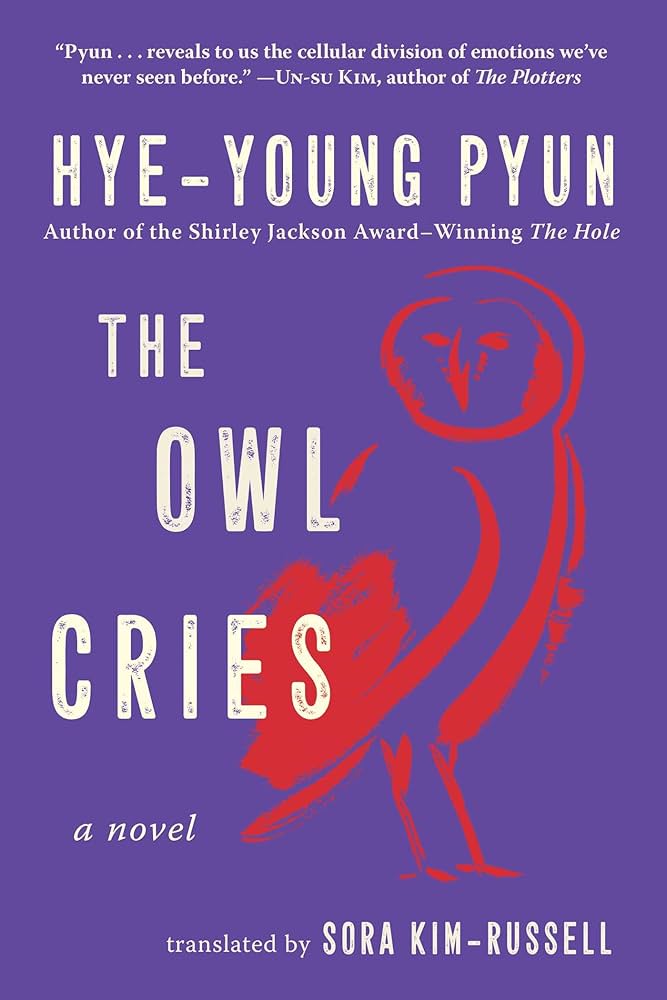
The Owl Cries
By Pyun Hye-yong
Translated by Sora Kim-Russell
(2012, Translated 2023)
Arcade Publishing
Readers familiar with Pyun’s Shirley Jackson award-winning tale of revenge, The Hole, will not have forgotten her taut control over paranoia, paralysis, and claustrophobia as well as her peculiar ability to embody suburban landscaping with menace. Pyun returns to these themes in The Owl Cries. While in The Hole, her lens focused tightly on the aftermath of a car accident and the relationship between a husband, wife, and mother-in-law, Pyun’s Owl travels farther away from society’s core, to the end of the road and the beginning of a forest whose scale diminishes all who approach it. She also introduces us to a much richer and more complex cast, which is made up primarily of the male of the species; true to form, communication is not a strength and silence is a way of life. The story takes place in a remote lumber town that has attracted three distinct groups: hard-drinking migrant loggers, a dwindling group of scientists who manage a once state-of-the-art forest research station, and the year-round residents who provide food, lodging, and alcohol to the seasonal workers who disperse once the snow starts to fall. The story begins when a lawyer comes to town looking for his missing brother. Inquiries lead him to believe that his sibling was posted to a remote ranger station. Like everyone who enters the forest’s domain, its seemingly impenetrable wall of trees overwhelms him in ways he never suspected. Pushing past his sense of paranoia, he makes quick progress in his investigation only to come face to face with a cipher: the current ranger, who despite his cheerful desire to please, not only has no knowledge of his predecessor, but also seems to have no idea how he ended up in his current position. This everyman/no-man is Bak Insu, a recovering alcoholic. A married father of a young boy, he’s fallen on hard times. Having repeatedly failed his public service exams, he’s sleepwalking through his life when he is tapped by a character known only as “The Colonel” to man the remote station. He has no experience at all and is unclear of what his job entails, but he jumps at the opportunity to earn a steady paycheck and install his family in company housing. But he is running from something. Hoping to prove his mettle by taking up the lawyer’s search for the previous ranger as well as his suddenly urgent need to fully comprehend the town, the research center, and the ranger station, he begins his own amateur investigation. His primary motive appears to be to penetrate the layers of mystery and menace that float like a miasma over the town, but when his need for information requires him to participate in social drinking, he starts down a dangerous path. Fueled by alcohol and transfixed by suggestive barroom confessions, he makes exciting connections and comes painfully close to comprehending all. But he also becomes increasingly paranoid; is he hallucinating? His wife, neighbors, and bar owners discover him blackout drunk, and though he tries to justify his conduct to his devastated wife, even he isn’t sure whether he did not dream overheard conversations and sounds emanating from the forest and below the station. Having lured us deep into the heart of a forest that seems to consume men and plopped us down in a company town entangled in powerful lines of corruption, Pyun exposes Bak as an unreliable witness and narrator. He and the people of the town on the edge of the forest inhabit a space of shifting loyalties, elastic morality, and breathtaking shifts between cold-hearted manipulation and soul-rending self-doubt. The Owl Cries is confounding in the depths of its mysteries. As in The Hole, Pyun is a master at building and sustaining tension, but as with many modern novels, a resolution is evasive. Incidentally, the Korean title of the novel is “서쪽 숲에 갔다” (Seo-jjok sup-e ga-tta), or “Went to the Western Forest,” which throws emphasis on the forest as a destination of choice: a site for steady work, or a place of contemplation, refuge, , or self-discovery. It also sounds like a note posted by at least three characters in the novel whose journey to the forest ends in catastrophe. Sora Kim-Russell chose her English title based on a cryptic phone call in which a missing son tells his distressed mother, “The owl is crying and the forest is attacking,” and a journal entry from the ranger station that simply reads: “IN THE FOREST THE OWL LIVES.”
“IN THE FOREST THE OWL LIVES.”
The more times he read this very obvious sentence out loud, the more he began to feel unbearably lonely. He was that owl, holding its breath in the pitch-black shadow of trees. An owl forced to lift its heavy wings with each stir of the wind. An owl rotating its head and rolling its eyes to keep watch over its surroundings. An owl waiting for prey that was very close to hand, yet was always far off and hard to find.
 East Asian Literature in Translation