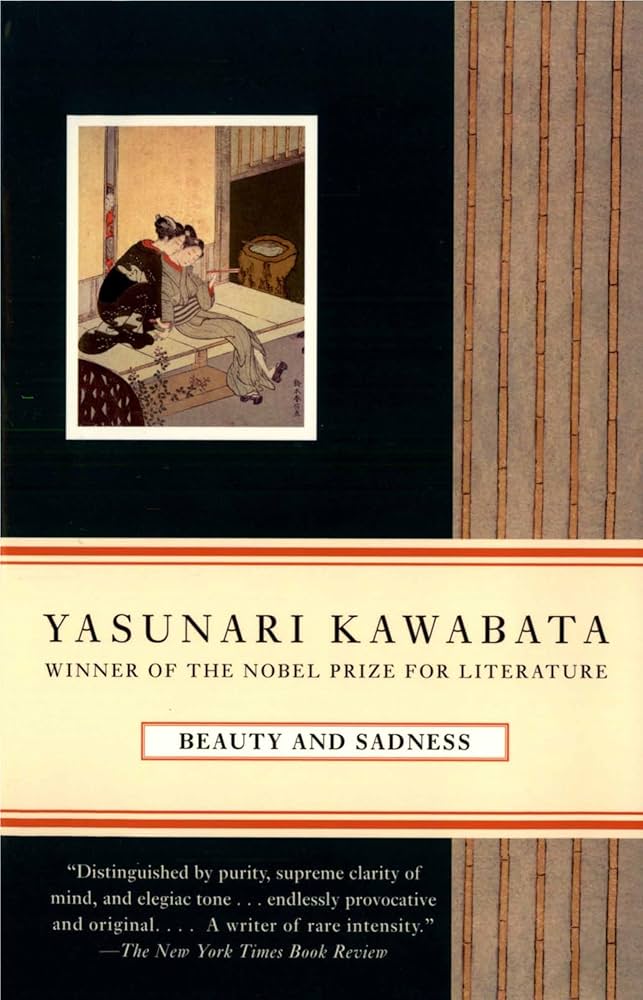
Beauty and Sadness
By Kawabata Yasunari
Translated by Howard Hibbett
(1961, translated 1975)
Vintage International
Beauty and Sadness presents us with a deeply troubling and problematic story set in motion by a married man, Toshio Oki, who at the age of thirty, violates a fifteen-year-old girl, and carries on a relationship with her for almost a year before abandoning her and returning to his wife confident that he has forever ruined the life of both the former object of his desire, Ueno Otoko, and her mother. Toshio goes on to write a popular novel about his relationship wth the child, and though he writes several more, his account of that conquest and his subsequent sense of sadness and loss continues to enrich him. Twenty-four years later, the writer sees a photograph of the woman he perceives as his muse in an arts magazine: Otoko has arrived as a painter of some note. Perhaps hoping to recapture his experience of long ago, he travels by train to meet with her. Their interaction is complicated by Otoko’s unbroken longing for the man she thinks of as her first love. Furthermore, Toshio’s wife knows that her husband is going to meet his sexual and artistic muse. As the person who typed out her husband’s novel, she knows every detail of her husband’s desire for the child, and having seen the photo of Otoko in the magazine, she is aware that even at thirty-nine, her rival’s beauty continues to dazzle. As if Kawabata were not satisfied with this cocktail of mid-century Freudian psychological angst, he adds a femme fatale, the unhinged Keiko, who pursues Otoko first as a teacher and then as her lover. Kawabata gets caught up in his imagined fantasies of the relationship between Keiko and Otoko and perpetuates archetypal prejudices against same-sex, bisexual, or simply female desire. His portrait of Keiko dominates the latter third of the novel, and he floods some moments with entirely too many reflections on characters that read as cant Freudian labeling. Acknowledging its flaws, Beauty and Sadness succeeds in Kawabata’s depiction of yearning, loneliness, and unrequited love. The pain of the principal characters is deeply affecting, as are Kawabata’s beautiful set pieces, such as his description of a journey by train, a path from temple to temple and from grave to grave, a photograph of a tea plantation, and a studio shared by a classicist and abstractionist, both steeped in Japanese aesthetics yet laboring under European influence. It would be interesting to read this text along with Junichiro Tanizaki’s Naomi and Fumiko Enchi’s The Waiting Years, as they share similar themes.
“She could not say why these rather inconspicuous green slopes had so touched her heart, when along the railway line there were mountains, lakes, the sea at times even clouds dyed in sentimental colors. But perhaps their melancholy green, and the melancholy evening shadows of the ridges across them, had brought on the pain. Then too, they were small, well-groomed slopes with deeply shaded ridges, not nature in the wild; and the rows of rounded tea bushes looked like flocks of gentle green sheep.”
 East Asian Literature in Translation