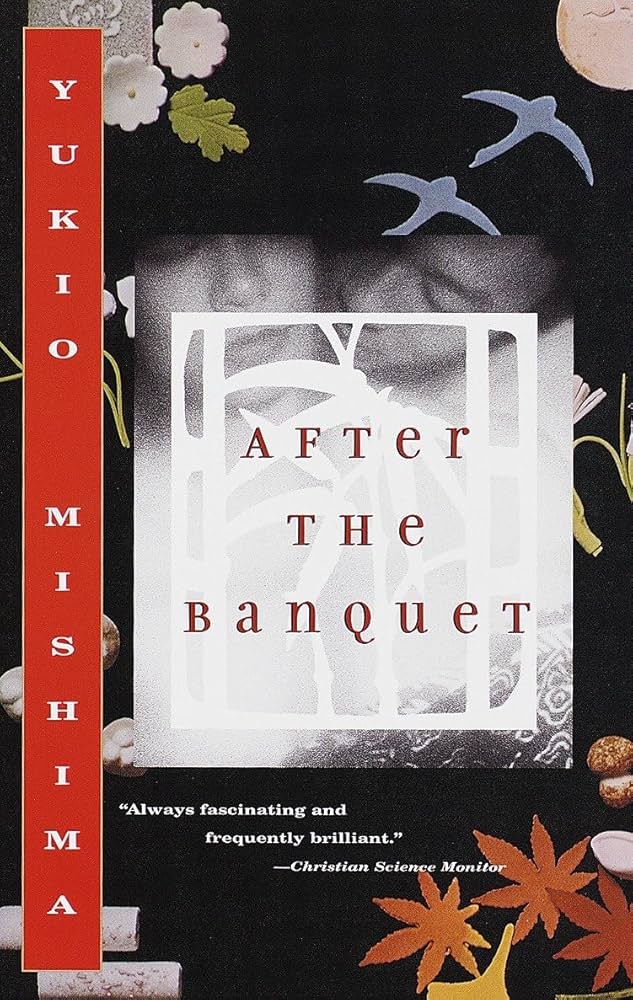
After the Banquet
By Mishima Yukio
Translated by Donald Keene
(1960, translated 1963)
Vintage International
Mishima sets After the Banquet in the years after the Asian War in the Pacific in a Japan recovering from its physical, emotional, and psychic wounds and on a path towards reinvention. His protagonist is the vibrant Kazu Fukuzawa, the owner and grand hostess of the Setsugoan, a restaurant catering to Japan’s current crop of up-and-comers, influencers, movie stars, power brokers, and politicians. Kazu is a sensualist and a romantic. Her restaurant, which somehow escaped the destruction wrought by the war, features a large-scale contemplative garden in the style of Kobori Enshu and incorporates shrines from both Nara and Kyoto. The Setsugoan hearkens back to the spirits of an old Japan and offers its guests the comfort of both modernity and the past. Mishima portrays Kazu as a woman of low background who has risen to the top by being all things to all people. Playing the part of the universal hostess, she’s drawn the attention of powerful men and used her luxurious sensuality, taste, and social intelligence to create a thriving watering hole for Tokyo’s movers and shakers. At the age of fifty, Kazu reflects on her personal history and her relationships, revealing that the Kazu she has taken great pains to create is a mask concealing her low status and the less-than-reputable strategies she used to establish, develop, and protect her restaurant. Her low birth and her many romantic entanglements haunt her, and her shame prevents her from truly feeling secure. When she makes the acquaintance of a newly retired international diplomat, the elderly and severe Yuken Nuguchi, she sees an opportunity to establish herself for both the present and for eternity. Her pursuit and conquest of the older, emotionally unavailable nobleman is at times both charming and ill-conceived; the two could not be more unalike. But just when Kazu accepts that she has sacrificed love for status, Noguchi is tapped to lead the Radical Party in a new election. The old man is a philosophical purist and well-reputed as a scholar and intellectual. His wife has her doubts about his electability–he is decidedly uncharismatic–but having found herself in a loveless marriage, she sees the election as an opportunity to exercise her social skills and influence. It also allows her to reenter the public sphere and drink in the attention she never stopped craving. On the campaign trail, we see Kazu moved to tears by the open hearts of Tokyo’s farmers, and in the next paragraph, scheming to conceal her pre-campaigning from a husband who lives by the letter of the law. As a political animal, she is naive, secretive, and wildly optimistic; how could she be married to the wooden, self-doubting, and legalistic Noguchi? Mishima uses this fascinating creature, Kazu, to investigate gender roles, the idealization of purity, the quest for fame, and even democracy. After the Banquet is essential reading for anyone interested in post-war Japan’s efforts to reinvent and reestablish itself at the end of the empire.
“Quivering like a piece of fruit inside a dish of jello, he waited impatiently for the moment when the gelatine would kindly harden. It seemed to him that the coagulation of the world would have to be completed before he could look up to the blue sky with an easy mind and admire to his heart’s content the sunrise and sunset and the rustling of the treetops. Noguchi, like many other retired politicians, had wished to save “poetry” for his declining years. He had never had the leisure to appreciate that desiccated storage food, nor did he expect that it would taste good, but to such men as Noguchi, poetry lay hidden not in poetry itself so much as in an untroubled craving for poetry; poetry in fact symbolized the unshakable stability of the world. Poetry would make its appearance—indeed, would have to appear—when there was no further danger of the world changing, when one knew that there would be no further assaults of uncertainty, hopes, or ambitions. At such a time, he expected, the moral constraint of a lifetime and the armor of logic would melt and dissolve into poetry, like a column of white smoke rising in the autumn sky.”
 East Asian Literature in Translation