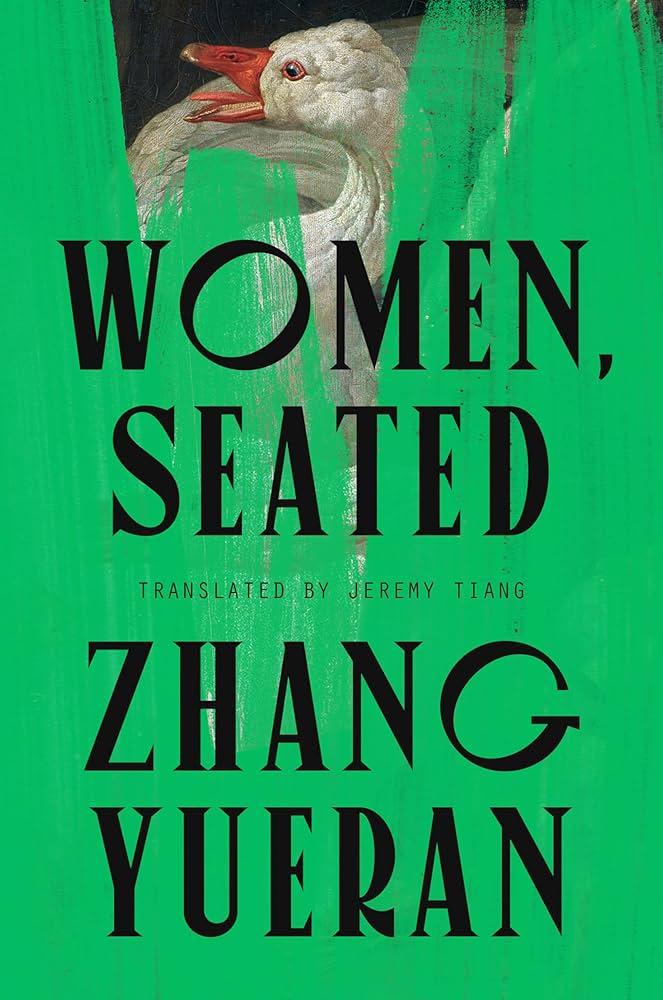
Women, Seated
By Zhang Yueran
Translated by Jeremy Tiang
(2024, translated 2025)
Riverhead Books
Zhang Yueran’s Women, Seated, is a novel about contemporary Chinese women, class, marriage, and small and large-scale criminal acts. The central character around which all others orbit is a Chinese child of privilege, the adorable and occasionally despotic seven-year-old Kuan Kuan, who is thrice fortunate: a male of the species, the pride of his elite parents and politically influential grandparents, he is destined to experience and accomplish greatness. He is very much a little prince and Zhang paints him as a delightful, curious, incisive, and eminently curious lordling. While she quickly sketches out Kuan Kuan’s male role models as self-involved, prideful, and emotionally unavailable, Zhang dives deeply into the worlds of the women who are defined by their relationship to the man Kuan-Kuan will become. We see into this silver-spooned world through the eyes of Yu Ling, a single, attractive woman who has fled her hometown and is unlikely to ever return. Kuan Kuan connects with Yu Ling in an elemental way; his clear preference for her as a person elevates her above the other servants and results in the dismissal of his original caregiver, a woman who is every bit as ardent to escape the fate of someone of her sex and caste as Yu-Ling. Yu Ling’s interactions with the child are sensitive, authentic, full of grace, and indicative of the type of parent she might have wanted for herself and of the parent she might one day become, and yet she participates in a desperate criminal scheme that puts her young charge in grave peril. Just at the moment it seems certain that Yu-Ling has stepped onto a path that will only lead to horror and self-destruction, Zhang effects a miracle that removes (temporarily) all the men from the novel save for Kuan-Kuan. Their absence, as well as the removal of their influence, allows Zhang to introduce Kuan Kuan’s mother, his grandmother, and his father’s mistress. Along with Yu Ling, each woman is given the opportunity to speak her truth and reveal their struggle to define themselves independently of the men they serve. Qin Wen, the mother of Kuan Kuan, serves as a foil for Yu Ling. Zhang presents her a uniquely conflicted modern Chinese woman. Educated abroad, she studied art and returned to China to paint. Her wealth and her husband allow her to own a studio and continue to paint–and even to own a painting by the 20th-century American artist Alice Neel: “Woman, Seated.” Not without talent, and though she knows the depth of the relationship between her child and her employee, she remains compelled to follow her muse and create something akin to “Woman, Seated,” a portrait of an unidentified woman, seated somewhat tentatively, alone and rendered as she is, simply and unadorned. Neel’s women appear to have been caught between emotions, often frank, alarmed, uncertain, or questioning. Zhang presents us with similar portraits, and the beauty is that they speak and act, embodying their uneasy place in the world.
“Bring a portable stereo so Kuan Kuan can listen to music along the way.” He had an inflated estimation of his son’s musical talent, and he was always nagging him to practice. Just a couple of days ago, the boy refused to go to his iano lesson, so her sir kicked his Lego castle until it lay in pieces–the one the boy and his grandfather had spent a full day building when he last visited. The boy had sworn never to forgive his father for it, and now he refused to turn around even when he called him several times when they were setting off.”
 East Asian Literature in Translation