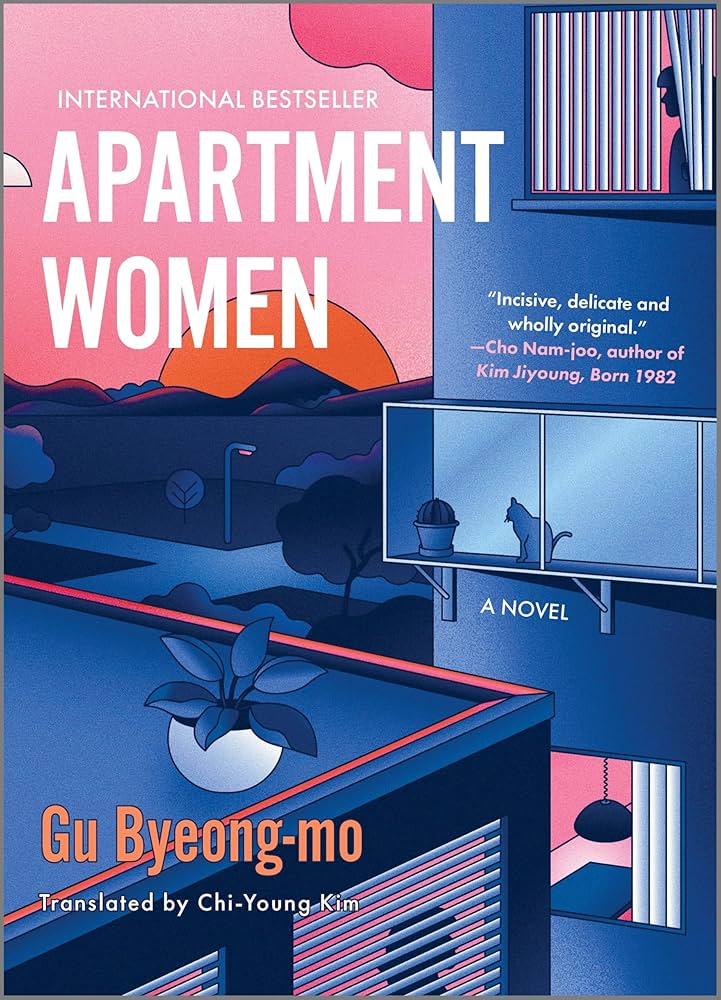
Apartment Women
By Gu Byeung-Mo
Translated by Kim Chi-young
(2018, translated 2024)
Hanover Square Press
Western readers may have first encountered Gu Byeung-Mo’s writing through her The Old Woman with a Knife, a thriller about a female assassin who, as she enters her sixties, is facing her own mortality while also coming face to face with emotions like love, a desire for personal connection, and a yearning for family, feelings she suppressed since her aptitude for killing was discovered in her early teens. In Apartment Women, Gu turns her attention to the emotional life of a younger woman, Seo Yojin, a married, thirty-something mother of a six-year-old girl. She is living a much more prosaic lifestyle, working 9-5 as an assistant to a pharmacist in Seoul while her husband, Jeon Euno, an unemployed creative seeking work in the film industry, stays at home. Their romance seems to exist only as a dim memory; already exhausted by the curse of being perpetually underemployed, groaning under debt, and paying far too much for rent, their tentative steps into child-rearing have all but broken them. Yojin, the primary caregiver and wage earner, walks through life in a perpetual daze, barely able to address her own needs and desires. She has surrendered herself to her role as mother and is resentful of her husband, who still dreams of becoming a director and is somehow unable to contribute much to the care of his daughter or his home. Their plight is not uncommon, especially in South Korea, where the birth rate continues to plummet, and the government is frantically trying to incentivise Koreans to have more children. Gu targets one of those schemes, a plan to construct commune-style housing units, bedroom communities, outside of Seoul. Couples with one child or more compete in a lottery to live in one of these reduced-rent, four-family units, with the only condition that they commit to raising at least one more child–as long as they continue to reproduce and raise children, they can remain in the homes for as long as they wish. Yojin quickly finds that life in the capitalist commune is as claustrophobic, exposed, and suffocating as a fishbowl. The four husbands quickly distinguish themselves by their selfishness and emotional detachment. And very quickly, a villain appears in the form of an overachieving organizer, a perpetual driver, Hong Danhui. She assigns duties, sets up calendars, and ratchets up expectations by convincing the four “stay-at-homes” to create a communal daycare center/school for the children who range from the ages of three to six. Of the four wives, three are clearly overburdened and in crisis, and the men are consumed with licking their own wounds. Only Danhui seems to thrive; openly critical of the other wives, she relishes her position of power as the author and enforcer of the house rules. In Apartment Women, which seems to be a misnomer, Gu noy only reveals the overwhelming challenges faced by contemporary Korean parents and the cultural and economic pressures that further complicate their lives, but also reveals the extent to which Korea’s high stakes, hyper-competitive school and work culture has produced a generation of citizens who don’t know who they are, what they want, or even how to function in the world. Some characters are consumed with monitoring their status and pinching pennies while making an outward show of “having it all,” while others are loudly exploding behind adjoining walls and ceilings. Gu’s writing reflects the cramped, trapped, and paranoid experience of her characters: the language is decidedly pragmatic as Yojin struggles to stop up the many holes that threaten to sink her marriage.
“Why did we move here if you’re going to be like this? Don’t you remember? You’re the one who wanted to apply to live here.”
It was true—Yojin had been the one to find the announcement, the one to gather the application materials despite her assumption that they wouldn’t get in. Euno had never cared to figure out what to do about housing, and his parents had thrown up their hands when it came to their creative son, who spent his days agonizing over screenplays, fated to be ignorant about the logistics of real life. Yojin, on the other hand, had been laser-focused on finding a place to live. She didn’t stop to wonder whether they would be able to fulfill their end of the bargain by having three kids and living happily ever after—she just needed a place for their little family to live without constantly worrying about the next step.
 East Asian Literature in Translation