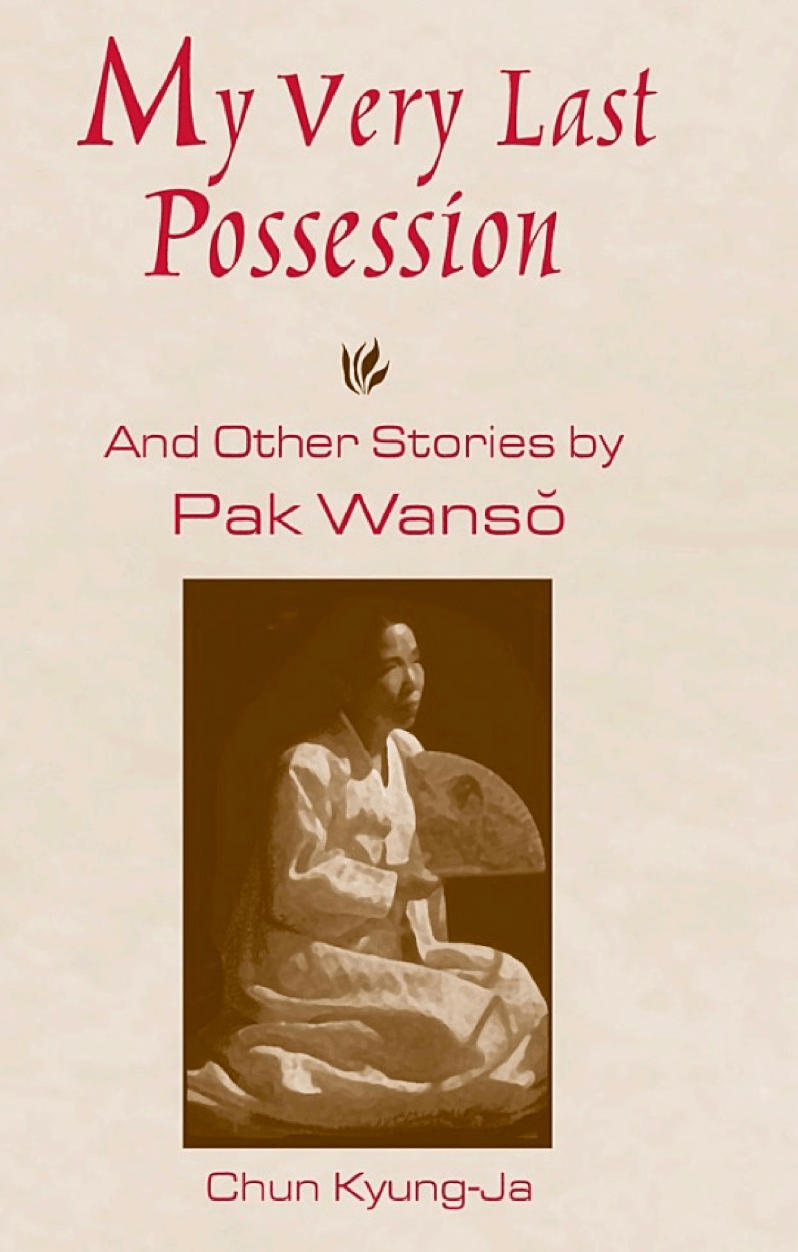
My Very Last Possession
By Pak Wan-so
Translated by Chun Kyung-Ja
(1970s-1990s, translated 1999)
Routledge
My Very Last Possession includes ten short stories by the much-beloved Pak Wan-so. Written between the 1970s and the 1990s, the stories take us from the post-war1 years through the industrialization of Seoul and explosive growth known as “the miracle of the Han.” Pak is a nuanced observer of the constraints, longings, and perseverance of Korean women who emerged from the trauma of war into a world where the traditional Confucian family values and roles had suffered a devastating blow. Though new opportunities open to women created the illusion of self-determination and agency, Pak illustrates that all-but-broken traditions can still hobble the lives of women, and the arrival of post-war fascism and capitalism brings with it a host of new obstacles for daughters, wives, and mothers. In “She Knows, I Know, and Heaven Knows,” Pak puts a new spin on the perennial subject of the often grim life of a Korean daughter-in-law. In this instance, the daughter-in-law is more sinning than sinned against, evading her obligation to care for her dying father-in-law by renting a room for him in another neighborhood and hiring a transient woman to care for him. Confucian obligation appears again in “Butterfly of Illusion,” where a young woman, a PhD in Korean Literature and a college lecturer, struggles to juggle her career and provide care for her widowed mother. Pak addresses the Korean diaspora in “Farewell at Kimpo Airport,” where an elderly woman seems too ready to leave her Korean-ness behind to flee to a fantasy of life with her daughter in America, and in “Encounter at the Airport,” a woman has a chance meeting with an old friend who worked with her in the American sector immediately after the war. Beyond a puddle-jumper flight to Jeju, the narrator has never left Korea. Her old friend, a larger-than-life hustler who out-earned everyone involved in smuggling from the American PX, is returning to Seoul from America, somewhat worse for wear and almost undone by her efforts to corral her three blonde American children. Pak opens up the wounds of living under martial law in “Thus Ended My Days of Watching Over the House,” revealing how the arrest of a woman’s husband for sedition overturns the order of her home and gives her the courage to finally strip away the silence that has defined their relationship. Pak visits one of the poorest neighborhoods in Seoul in “A Certain Barbarity, where poetry contrasts with the fetid reality of living in proximity to an open sewer. “Granny Flowers in Those Heartless Days” is set in a contested remote village during wartime. There have been very few Korean novels written about the war; Pak’s story is simple and something like a fairytale, a study in the healing powers of telling stories. “Three Days in that Autumn” is the darkest and most developed story in the collection. Pak is fearless as she makes the case that the destabilizing and morally corrosive effects of the war and its aftermath harmed and continue to harm the bodies and minds of the women of Korea; it is an unflinching chronicle of the pain that injustice writes upon the female body. In the final story, “My Very Last Possession,” we overhear a woman talking on a telephone to a friend, as she revisits the moment when she learned that her son had been killed during the suppression of a student protest in the lead-up to the June Democratic Struggle—a pro-democracy movement.
Her ears remained quite sharp, and so, in addition to her three regular meals, she would pipe up whenever the sound of eating was anywhere to be heard. And then she would shriek like a baby being ejected from the womb: “Now don’t go sneaking food, children. Give me some! Eating in secret when there’s an old woman around? You’ll get yours!” Still, her shrieks never struck me as being out of synch with the daily rhythm of our respectable, peaceful household. They had never even seemed an intrusion.
Just as everyone in the family took after my husband in his love for the dwarf trees, we all followed his lead in caring for my senile old mother-in-law. We worked together with as much devotion as we could muster and felt a certain moral superiority about this in our hearts. If her cries about lye in her stomach came even slightly later than usual, my heart would beat faster, and I would peek into her room to check on whether something was wrong. When she slept, I would prick up my ears in concern. Not until I heard the sound of peaceful breathing could I relax. That’s how deeply all in the family felt.
 East Asian Literature in Translation