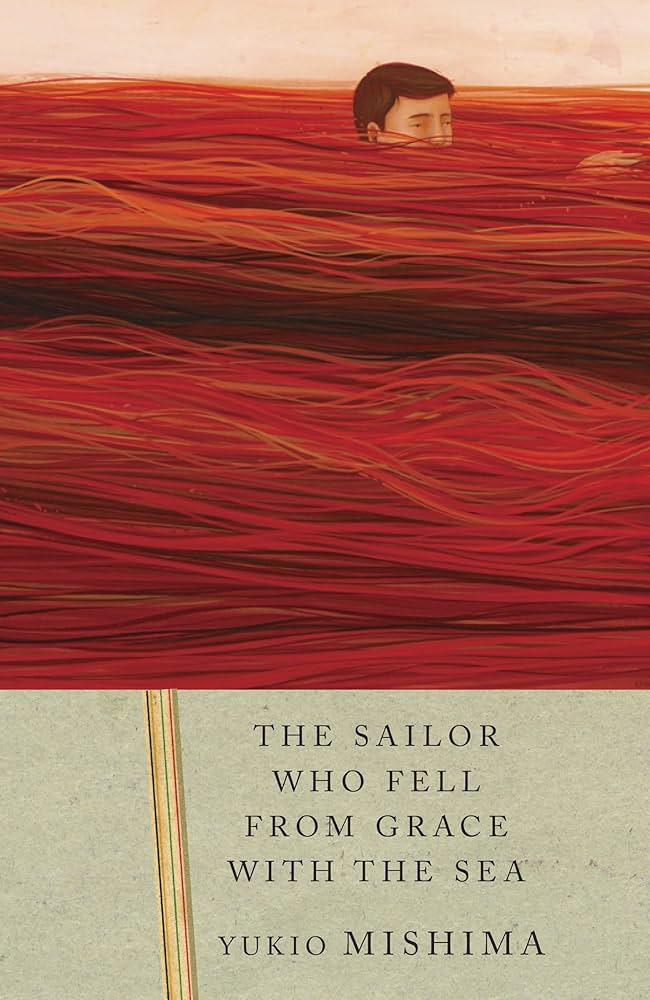
The Sailor Who Fell from Grace with the Sea
By Mishima Yukio
Translated by John Nathan
(1963, translated 1965)
Vintage International
The Sailor Who Fell from Grace with the Sea is a coming-of-age story and a romance set in post-war Yokohama. Fusaka Kuroda is a widow who manages a successful clothing store; her clientele includes the emerging middle class and even a movie star, and she happily and ably caters to their taste in au courant European styles. Her son, Noburo, is a man-child who is both over-attached to his mother and furious with her that he is without a father. He has fallen in with a gang of boys who loathe the feminine and construct their own masculine idol: unfeeling, wed to his own sense of righteousness and independence, ever menacing and fearless. Growing up in the shadow of a bustling port, Noburo studies the schedules, ships, sailors, and dockworkers, and he fantasizes about putting his mother behind him and leaving on one of those ships as soon as possible. Noburo has the opportunity to enter that world when his mother introduces him to her first lover since his father’s death, Ryuji Tsukazaki, off the tramp steamer Rakuyo. Ryuji is the living embodiment of the idol Noburo’s gang has created. He has left everyone and everything behind to pursue a vision of masculine independence and glory. Interestingly, his ship’s name, Ryuko, suggests “falling leaves” or “setting sun.” We meet the chiselled Ryuji at a crucial moment in his own pursuit of the masculine; when he encounters Fusaka and her son, he reimagines his future, a decision that young Noburo can not tolerate. Mishima offers a cold and deeply disturbing representation of the psychology of Japanese boys and men caught between two forces: the yearning to be part of a social order, become one of the masses, join in love and marriage, and participate in a western influenced capitalist society, and the compulsion to escape convention, reject love and parenthood and to pursue personal glory to the point of violence or self-annihilation. Mishima portrays the male of the species as a preternaturally aroused, disgusted by the weakness of its flesh, and determined to crush it while also longing for order, stability, and love.
“But the tears of joy had washed anxiety away and lifted them to a height where nothing was impossible. Ryuji was as if paralyzed: the sight of familiar places, places they had visited together, failed to move him. That Yamashita Park and Marine Tower should now appear just as he had often pictured them seemed only obvious, inevitable. And the smoking drizzle of rain, by softening the too distinct scenery and making of it something closer to the images in memory, only heightened the reality of it all. Ryuji expected for some time after he disembarked to feel the world tottering precariously beneath his feet, and yet today more than ever before, like a piece in a jigsaw puzzle, he felt snugly in place in an anchored, amiable world.”
 East Asian Literature in Translation