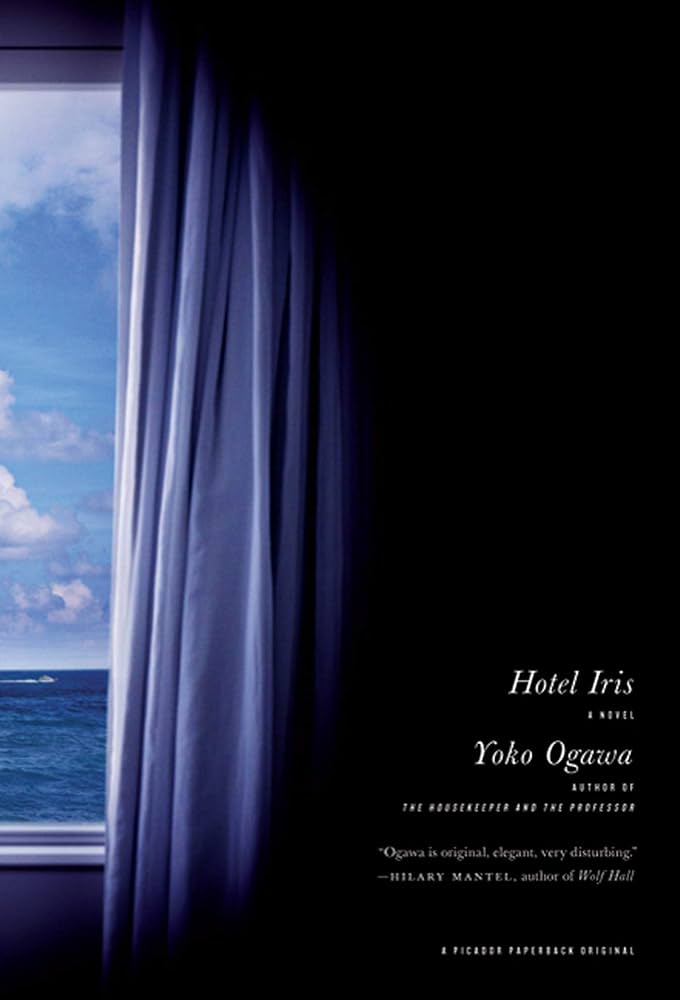
Hotel Iris
By Yoko Ogawa
Translated by Stephen Snyder
(1996, translated 2010)
Picador
In the 1930s, Japanese mystery writer Edogawa Rampo began to explore writing that involved or celebrated ero guro nansensu: forays into explicit and taboo eroticism, the grotesque, and the nonsensical–or that which defies logical explanation. In Hotel Iris, Ogawa leans into the world of ero guro nansensu by depicting a sexual relationship between a seventeen-year-old girl and a man “past middle age, on the verge of being old.” The girl, Mari, lives and works in the Hotel Iris, which has been in the family for over one hundred years. Having no view of the seashore, it sits well back from the seasonal attractions and across from a fish processing plant. Mari’s mother is a single mom who pulled her daughter out of high school two years before to help her manage the Iris. Although theIris is not a “love hotel,” specifically catering to those who are looking for a discreet sexual rendezvous, Mari regularly witnesses the comings and goings of prostitutes and at night listens to the noisy couplings of guests. Forever working, deprived of the high school experience, she finds herself among a sea of adults who are explicitly and aggressively aroused and on the make. She longs for a connection of this sort, but instead of seeking the attention of the local boys who, like her, make their money off the tourists, she pursues an elderly man who lives alone on a nearby island, “the translator,” who makes his living translating Russian manuals and product labels into Japanese. Watching her stalk the man and deliver herself into his trembling hands is deeply unsettling, especially as he has already revealed himself to be dangerous to women; Mari even heard a battered guest call him out for his perversion. Stranger still, Mari is not naive: the child tells us that her mother boasts to anyone who will listen of her daughter’s beauty and is fond of telling a story of an artist who, several years ago, expressed interest in sculpting a statue of her to grace the hotel’s entrance. In the flat, affectless tone that characterises many of Ogawa’s characters, Mari casually reveals that the so-called “artist” was in fact a pedophile who tried to rape her, a detail her mother somehow missed. One could then imagine that Mari would flee from a world where adult men feel so free to pursue their violent desires, but Ogawa portrays Mari as a willing partner in her own degradation, a moth that seeks its annihilation in the cruelest of flames. In so many of her novels, Ogawa presents her readers with women who pervert cultural representations of femininity. Like the deranged mother in Kono Taiko’s “Toddler Hunting,” Ogawa creates female characters who shatter taboos, expressing obsessive and violent desire that knows nether moral nor legal bounds; as in the two novellas in Ogawa’s The Diving Pool, Mari’s existence and her project is an affront to both traditional ideals of femininity and to 21st-century readers who come to the text as feminists. Interestingly, the translator reveals that he is working on a passion project, translating a Russian novel which, coincidentally, features a young woman named “Marie.” The novel-within-the-novel appears to be an example of Victorian sadomasochistic pornography. And that may be at the heart of my anxiety about Hotel Iris: I know that it is brilliant and essential reading, but do I want it on my shelf, where my wife or daughters may stumble upon it?
“And then it was grandfather’s turn. He died two years ago. He got cancer in his pancreas or gallbladder…
It was my job to empty the tube that came out of his right side and to empty the fluid that had collected in the bag at the end of it. Mother made me do this every day after school, though I was afraid to touch the tube. If you didn’t do it right, the tube fell out of his side, and I always imagined that his organs were going to spurt from the hole it left. The liquid in the bag was a beautiful shade of yellow, and I often wondered why something so pretty was hidden away inside the body. I emptied it into the fountain in the courtyard, wetting the toes of the harp-playing boy.”
 East Asian Literature in Translation