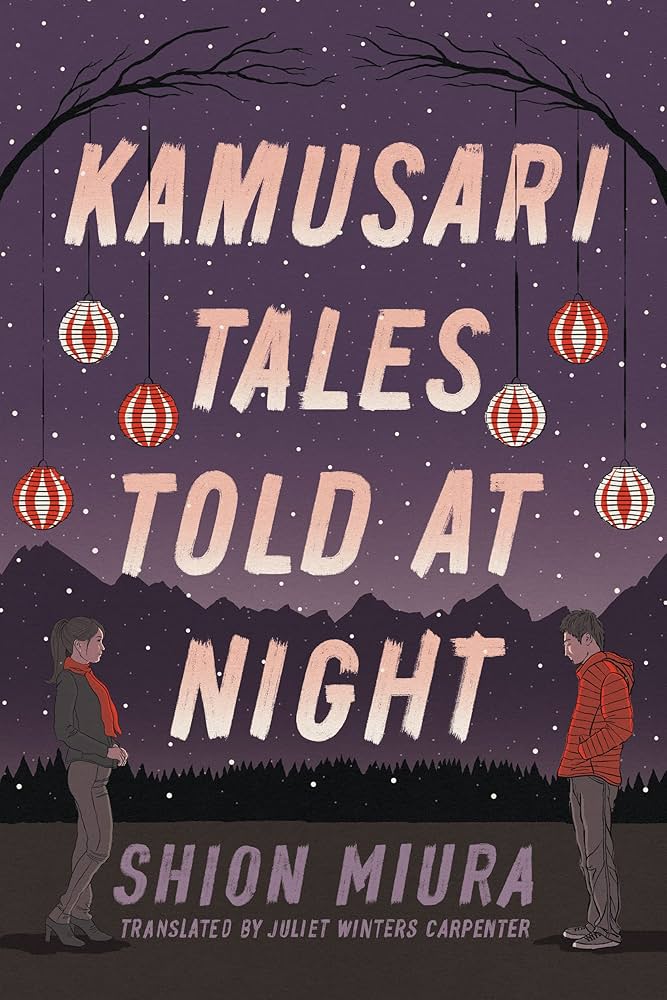
Kamusari Tales Told at Night is Shion Miura’s sequel to her best-selling Young Adult novel, The Easy Life in Kamusari. A year after the events in that story, she returns to the fictional town of Kamusari in Mie Prefecture to reintroduce us to the foresters and families of Nakamura Lumber and our young city-born hero, Yuki Hirano. He has adapted well to the exhaustive labor of caring for the trees and harvesting the lumber in the mountainous lands. Once an outsider and a painfully unskilled and weak crew member, he finds himself a welcome addition to the community and even envisions spending the rest of his life far from the modern world. He is also still pursuing Nao, a woman who went off to college in Yokohama and returned to teach grade school in a nearby town. They continue to meet from time to time, but their relationship progresses slowly. Kamusari Tales Told at Night documents their tentative romance, but the greater part of the novel is made up of Yuki’s effort to provide his imagined readers with more stories about the way the people of Kamusari revere the natural world and how their superstitions and reverences mark the course of the years and provide consolation, joy, and moral guidance. Throughout, Shion’s narrator, Yuki, directly addresses an imaginary reading audience, all the while partly suspecting that the only person reading his “record” is Granny Shige. He makes awkward jokes about his desires, appeals for understanding, and confesses his disappointment in himself when he feels he has let down the people around him, whether he can’t pull his weight on the mountain or he fails to respond with compassion when others are in pain. The older generation, people like Granny Shige, regale him with stories of the first gods of the mountains, and Mr. Yamane reveals to him his totemic “Devil Stinger” and escorts him to the shrine of the fox, Inari. Yuki, eternally eager to please and innocent, tries to be skeptical, but he confesses that he prefers to live in a world of spirits and embrace the romance of folklore. Shion Miura excels at revealing the wise folly of the old ways, creating beautiful moments of enchantment. Readers of the first novel may remember Santa (“Mountain Man”), who was “spirited away” on the mountain. He returns, fabulously, in Kamusari Tales, when he begs his father to celebrate the Western tradition of Christmas. The ensuing Kamusari Christmas Party is a delight, one that captivates our narrator as much as the child Santa. Yuki also continues to provide insight into the practical aspects of forestry, which include holding fast to old practices while also conducting multi-year experiments involving new strategies and techniques. If you were charmed by The Easy Life in Kamusari, you will enjoy Kamusari Tales Told at Night.
When I didn’t comment, Old Man Saburo said soothingly, “Things are different now. With more young folks like you coming to work in the mountains, times are better. Looking back, I think when my brother was young, society and I were both convinced the best thing you could do was work like a demon and make a pile of money.”
“I’d never fit in to that kind of society.”
“I didn’t see it at the time, but that kind of thinking was a straitjacket.” He shook his head. “But thanks to eager young folks like yourself, the business has changed. I’ve been in forestry during its heyday and its decline, and the way it is now is the best. Gives me hope that forestry can adapt and grow in the coming years.”
I hoped so, too. I hoped that a hundred years from now, the mountains of Kamusari would be unchanged, alongside the villagers. Unique festivals; Oyamazumi-san, O-Inari-san, and Nagahiko the snake god. A village where traditions were cherished and residents tended the forest, planting trees and cutting them down, all while falling in love and quarreling, living out their lives. That was the future I wanted for Kamusari.
 East Asian Literature in Translation