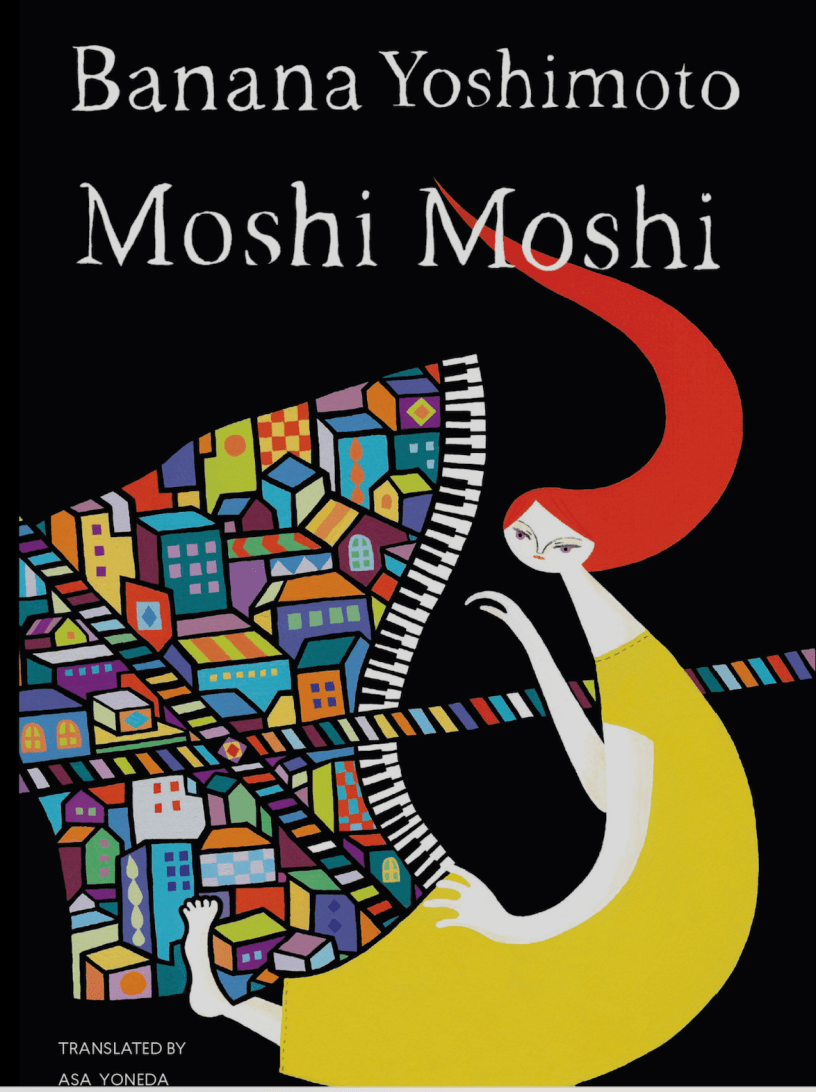
Moshi Moshi
By Banana Yoshimoto
Translated by Asa Yoneda
(2010, translated by 2016)
Counterpoint
When a Japanese person answers a telephone, they customarily say “Moshi moshi.” It corresponds to the Anglophone “hello;” it means, essentially, “I’m here, and I can speak.” Moshi Moshi is a ghost story and a record of a period of grieving shared by twenty-something Yoshie (Yocchan) and her mother. Some months before, Yoshie’s father, Imoto Mitsuharu, was found dead with his lover in a remote forest. Reeling from the betrayal and traumatized by evidence suggesting that her father was not a willing participant in a double suicide, Yoshie moves into a small apartment in the cozy, bohemian neighborhood of Shimokitazawa and finds work and an avocation serving and cooking at a local eatery. Shortly after she establishes herself, her mother appears at her door, carrying a suitcase. She announces that she can no longer live in the family’s large and well-appointed condominium, a gift from Imoto’s maternal grandfather, as she keeps seeing her deceased husband at the piano. Mother and daughter become roommates, and it is not long before Yoshie’s mother begins dressing years younger and establishes herself in the Shimokitazawa scene. As Yoshie’s mother transitions from the role of mother to friend and roommate, there are a few bumps, but they work well together, and Yoshie is happy to see that embracing the laidback vibe of the neighborhood is helping her mother find peace. Unfortunately, Yoshie continues to experience nightmares where she receives calls from her father via his mobile phone, and she finds herself back in the forest where his body was discovered. She tries to escape these horrors by embarking on a slow-burning relationship with a handsome man-about-town, but the nightmares persist. A former bandmate, her father’s closest friend, shares what he knows about her father’s relationship with the woman with whom he died, leaving her with a set of new questions. Her anxiety reaches a peak when a stranger appears, a woman whose husband had also been in a relationship with the same femme fatale but who managed to escape her grasp. The woman’s desire to reassure Yoshie and share her experience reopens old wounds and drives Yoshie to take action about the phone calls that haunt her nightmares. Moshi Moshi is an engaging chronicle of the grieving process. It is also a love song to the real-life Shimokitazawa neighborhood: the Japanese title of this novel is Moshi Moshi, Shimokitazawa.
“Another thing that felt new to me was how Mom, with her slightly tubby figure, took to dressing in a small selection of T-shirts and sweatshirts with jeans, her belly perched on the waistband of her jeans. At home, she wore a matching set of thick men’s sweatshirts and sweatpants that she’d bought at a boutique catering to young people, halfway down the main street. Some days it seemed like she lay about at home all day, while on others she seemed to go out eagerly, although I had no idea what she got up to during the day.
This was our new normal for a while.
Aside from her new wardrobe of youthful clothing, and a vintage Fire-King mug with a picture of Snoopy from Peanuts that she’d bought in the neighborhood, she didn’t even seem to be shopping much.
I’d expected her to struggle with all that free time, and be constantly coming in Les Liens, so I was a little taken aback.
I was seeing Mom outside of her role as mother for the first time. For instance, she only bought one of the Snoopy mugs, for herself. That would never have happened before. She would have purchased a set of three, one for each of us, or a pair at the very least.
Was this what she was like when she was younger? I wondered. In college, falling in love, working part-time, had she lived frugally in a friend’s cheap apartment, and sat by the window looking up at the sky?”
 East Asian Literature in Translation