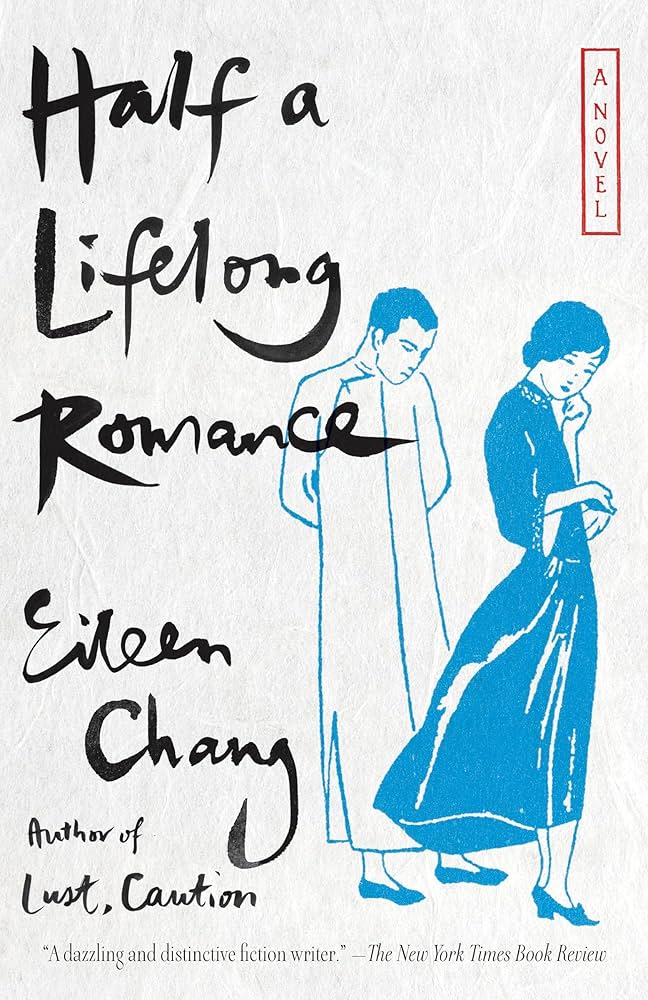
Half a Lifelong Romance
By Zhang Ailing
Translated by Karen S. Kingsbury
(1951,1969, translated 2016)
Anchor Books
Zhang Ailing’s Half a Lifelong Romance has a complex origin story. Zhang acknowledged that she adapted the synopsis, characters, themes, and even some dialogues of John P. Marquand’s 1941 novel H.M. Pulham, Esq. Interestingly, Marquand, a Bostonian, was the creator of the popular Mr. Moto detective series, which featured the international adventures of a Japanese detective and spy; the perpetual foreigner, Peter Lorre, played Moto in the Hollywood films about the time that other Europeans began playing Charlie Chan. Later, Marquand began to critique the brutally rigid classicism endemic to New England of the 30s and 40s, and Zhang transferred Marquand’s study in privilege to Shanghai, publishing her adaptation serially in a newspaper in 1948 and novelizing it under the title Eighteen Springs in 1950. Zhang eventually moved to the United States, and in 1960 edited the novel and published it in Taiwan as Half a Lifelong Romance. She made no effort to publish the work in translation in the US, perhaps because of her significant borrowing from Marquand. Karen S. Kingsbury translated the novel into English in 2014, partly due to the growing awareness of Zhang’s artistry and her brilliant, influential contributions to Chinese literature. The plot centers around young Gu Manzhen, the daughter of a poor family who works in a Shanghai factory. Her life is more than hard: her older sister, the primary earner for the family, chose to become a taxi dancer and likely prostitute to keep food on the family table. Despite that horrific shadow, a charming, almost fairy-tale romance develops between demure Manzhen and shy Shen Shijun, a handsome young man who works in the factory’s offices. The lovers are exquisitely pure and ardent, and though both are aware of the gap between the relative poverty of the Gu family and the wealth of the Shens, they pursue their relationship, fully planning to marry. Unfortunately, their insecurities and doubts lead to misunderstandings, and both well-meaning and villainous parties create havoc when they inject their own wishes into the communication between the unfortunate couple. When her fiancé leaves the scene, Manzhen’s mother panics, fearing that Manzhen has lost her value and will never marry. Then, from the wings, the lascivious older gentleman, the profligate drunk who has been leering at Manzhen from the start of the novel, negotiates with the mother to take the young innocent as his bride. In Zhang’s capable hands, missed connections and misunderstandings baffle the innocent and lead to broken hearts and tragedies. The novel is rewarding in itself, but Half a Lifelong Romance is especially useful for those interested in the tradition of arranged marriage concubinage, and the origins of the “New Woman” in China in the first half of the 20th century.
Shujin didn’t know what to say. “Thanks” was beside the point, somehow. He smiled at her, a little too intensely. To avoid his gaze, Manzhen turned and faced outward, over the balcony. This restaurant was an old, Western-style building, well-lit on both floors. Out here on the balcony, the surging din of the upper-story hall faded away, and instead they heard the rhythmic chant of drinking games, the sultry voice of a singing girl, the scraping melody of a huqin, the one-string fiddle. Manzhen looked at him, over her shoulder. “You said you weren’t coming tonight,” she said with a smile. “What made you change your mind?”
She was the reason, but he couldn’t tell her that. He smiled back, searching for something to say. “Well, since you and Shuhui were both coming, I thought I should too.”
 East Asian Literature in Translation