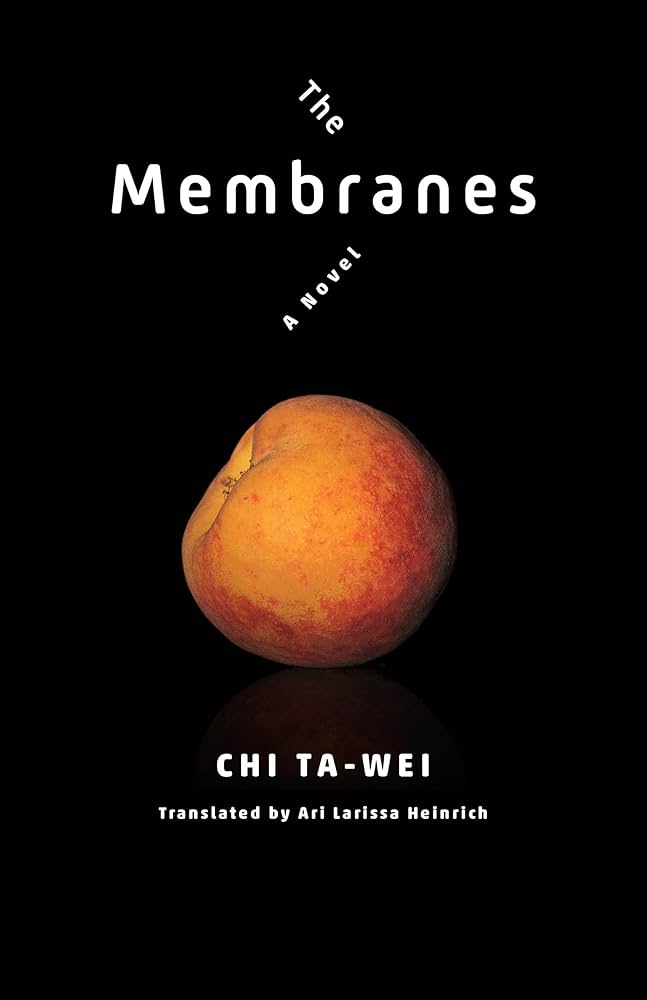
The Membranes
By Chi Ta-wei
Translated by Ari Larissa Heinrich
(1996, 2011, translated 2021)
Columbia University Press
Chi Ta-wei is a Taiwanese author known internationally as a queer author and scholar of queer fiction. Membranes is a work of science fiction set in a not-so-distant future when war and the effects of climate change have forced all surviving humans to take shelter deep under the sea. Chi’s world-building is comprehensive and unique. Society is dominated by large conglomerates. The military industrial complex is most powerful, as are the fields of robotics and medicine. Perhaps unexpectedly, two other commercial powerhouses are the entertainment and beauty industries. Print media all but died out, but a hunger for infotainment and ever-fresh content led to the manufacture and promotion of disczines, which are ubiquitous. Though undersea life eliminates damage from UV rays, it contributes to conditions that are especially harmful to human skin. A new industry came into being devoted to preserving and augmenting human beauty. It is also a world that is remarkably feminine; readers will be hard-pressed to find male characters. Chi’s narrator, Momo, is an elite-level skin care specialist and stylist. She’s just turned thirty. She is single, much sought after, and though she has just had surgery to replace the middle finger on her right hand, she believes she remains at the height of her powers as an aesthetician. There are only two anomalies in her perfectly ordinary and satisfying life: someone has gifted her an exceedingly rare creature, a live dog, and her mother has invited her to lunch. Momo had never even considered owning a robotic dog, and the thought of taking on the care of a living creature almost overwhelms her, were she not already completely alarmed by her mother’s contacting her after twenty years of silence. Daughter and mother have maintained an oppositional relationship since she was ten years old, which was when she demanded to be sent away to continue her education and training at a series of boarding schools. She has had one disastrous relationship with a young girl while in her teens, and though she finds herself attracted and aroused by clients who pay top dollar for her all-over body treatments, she flees from her admirers. Part of the “queerness” of the novel is that Momo’s parents are two women, a relationship that must have been cause for the clutching of pearls in 1996 Taiwan, more so when young Momo uses a scanner concealed in her mother’s bedroom to spy on her parents. In her youth, her mother explains that Momo’s name means “peach” and that she chose this name because Momo did not have a normal birth but emerged from a split peach. The adult Momo finds this story childish, but the truth of Momo’s origins, her continued life, and her sexuality is increasingly more complex. Chi’s story of the rift between Momo and her mother and the moment of their fateful luncheon is exciting enough, but when Momo discovers a prodigious collection of her mother’s own writing, the novel steps away from the city under the sea and into entirely new territory. Translator Ari Larissa Heinrich includes an excellent afterword titled “Promiscuous Literacy: Taipei Punk and the Queer Future of The Membranes.” They remind readers of the significance of the timing of the release of Chi’s novel, just nine years after the end of martial law in 1987 and the opening up of communication with the West. They also link The Membranes to Taiwan’s punk movement, which was as vital as that of Europe and America, with an important difference: Taiwan’s punks embraced intellectualism. Finally, according to Heinrich, “The Membranes is also arguably the first work of modern fiction in Chinese to feature a protagonist who is, or could be understood to be, a transgender woman.”
“Battling … In the most primitive sense, a battle is when a couple of insects or wild animals or humans go head to head to see who comes out on top.
But Momo’s war was more complicated than that. The combat stretched out indefinitely. She couldn’t stand that her opponent dismissed all her hard work, so even though Momo knew it was absurd to keep fighting, she held her ground. Momo wasn’t trying to show off; she didn’t stage this ongoing battle to intimidate her enemies. She battled to reinforce her self-worth. She believed that if she just stood her ground, she would surely win … or at the very least—given that her opponent had a wealth of resources and this was a war without weapons—she wouldn’t be the loser.
If Momo gave up, on the other hand, then the combat would come to an end. Victory and defeat would mean nothing, and all her effort, all her persistence would have been in vain. A bubble rising to the surface of the ocean, bursting in the light of the sun.
It all sounded ridiculous when you said it out loud, even to Momo. Yet she felt she couldn’t think of it in rational terms. This was personal.
Her adversary was her own mother, after all.”
 East Asian Literature in Translation