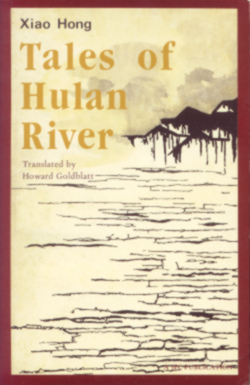
Tales of the Hulan River
By Xiao Hong
Translated by Howard Goldblatt
(1942, translated 1988)
Joint Publishing (H.K.) Co., Ltd.
Tales of Hulan River is a semi-autobiographical tale told through the eyes of a young girl of three to six years of age. The child is precocious, at ease in her isolation, largely ignored by her parents–especially her father–, and doted on by her grandfather. Xiao creates a portrait of life in a small town in remote Manchuria early in the 20th century. There is very little plot; Xiao instead focuses on the idiosyncrasies of a rather worn-out and uneventful town and the stories of its people. The plain-spoken child describes her home, daily routine, and education with a cheerful directness, but truly comes alive when describing the long hours she spends each day in the company of her grandfather and how she contributes to and or impedes his efforts to grow vegetables. The child punctuates her account with moments of wonder and quiet joy, sharing the beauty of the evening sky, the caress of a breeze, and the action of an insect’s anatomy. She imagines herself a spy, and for a period of time, she raids a large trunk in a storage room, pulling out treasures from a bygone era. When her parents catch on, instead of punishing her, they lovingly run their hands over the largely worthless items while remembering to whom they belonged or from whom they received these articles. The child also witnesses the lives of individuals who rent run-down outbuildings on the family compound. One is a perpetually filthy miller, Harelip Feng, who becomes the center of a scandal when a high-status town beauty, Big Sister Wang, falls for him and has his child. The narrator documents the love shared by the couple as well as the savage public criticism of the young woman, the course of her pregnancy, her child, and the short-lived happiness of their loving family. Second Uncle You, a garrulous drunkard in his 60s, is a regular comic character. Impoverished, yet clinging to dignity, he tells tall tales of his heroism in the face of “The hairy ones,” implying that he was a witness to the Sino-Japanese War. The narrator also describes the affair of a child bride, the dance of a sorceress, a store where mourners can buy all manner of gifts for the deceased, and the performance of an opera. Tales of the Hulan River is the last work of Xiao Hong; she died at thirty years of age. She was keenly influenced by and welcomed into the New Literature writing community, and she enjoyed a lengthy relationship with Lu Xun. The Communists had no use for the nostalgia of this lovingly backward-looking piece, but the charming and sensitive narrator and her portrait of ordinary life is engaging and rich in its sepia-toned reflections of an ordinary life at the edges of empire.
“Then, too, on Road Two East there are a few ornament shops, which are there to serve the dead.
After a person dies this soul goes down to the nether world, and the living, fearing that in that other world the dear departed will have no domicile to live in, no clothes to wear, and no horse to ride, have these things made of paper, then burn them for his benefit; the townspeople believe that all manner of things exist in the nether world.
On display are grand objects like money-spewing animals, treasure-gathering basins, and great gold and silver mountains; smaller things like slave girls, maidservants, cooks in the kitchen, and attendants who care for the pigs, and even smaller things like flower vases, tea services, chickens, ducks, geese, and dogs. There are even parrots on the window ledges.”
 East Asian Literature in Translation