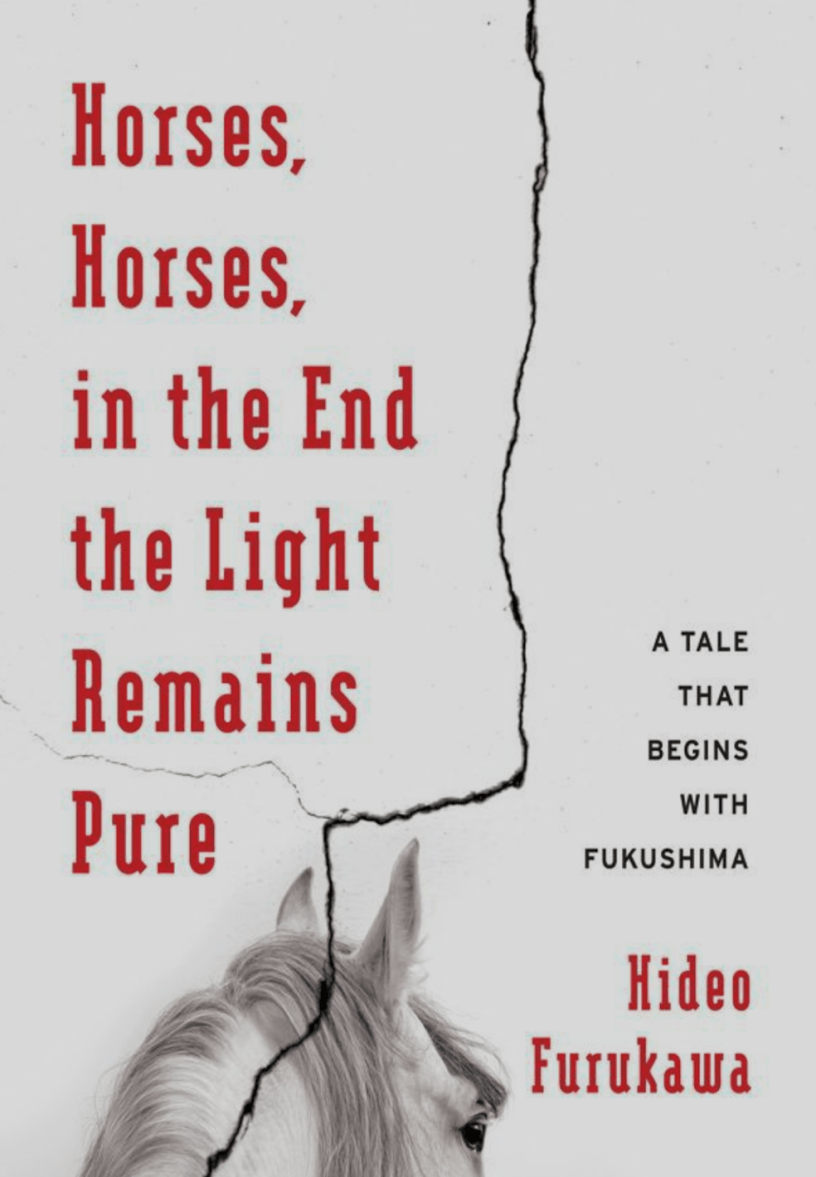
Horses, Horses, in the End the Light Remains Pure: A Story that Begins with Fukushima
By Furukawa Hideo
Translated by Doug Slaymaker with Akiko Takenaka
(2011, Translated 2016)
Columbia University Press
Horses, Horses, in the End the Light Remains Pure: A Story that Begins with Fukushima was first published in July of 2011 and is thus one of the earliest literary responses to the 3.11 tragedy or Japan’s triple disaster: the day an earthquake off Japan’s northeastern coast triggered a tsunami that killed close to 20,000 people and breached the Fukushima Daiichi Nuclear Power Station, causing the meltdown of thre of its reactors and irradiating miles of farmlands, forests, and dwellings. Furukawa is from Fukushima; his most popular novel, 2008’s Holy Family, was inspired by the author’s experiences growing up there in a farming family, his yearning to break tradition and seek his fortune in Tokyo, and his guilt about leaving his family and their traditions behind. Furukawa was not in Japan when the disaster struck, and one of the recurring themes of Horses, Horses is the guilt he feels of not having been present when the disaster struck. Furukawa’s offering is not a novel, but a travelogue written from the point of view of humans who are putting themselves at considerable risk to explore a toxic, unimaginably transformed, and eerily empty landscape. For much of the project, we are in a cramped car with the author, three other journalists, camera equipment, overnight packs, and a store of filtered water and convenience store snacks. Their central task is simply to observe and record what they see. As Furukawa notes, they are often unable to find words for the scenes of destruction they encounter. At times, Furokawa reflects on fate, Japanese history, and modernity. He seeks answers in place names, wondering if the symbols, the language attached to the landscape, can be read as warnings from the past or indications of a path forward. He sees the symbol of horses in many locations and recounts the history of the region’s long relationship with the animals. Not surprisingly, almost all of the stories involve accounts of how warring clans used horses to dominate their enemies. Then, Furukawa makes a powerful claim: the traumas experienced by the region’s horses, the violence they witnessed at the hands of man, are passed down and shared by every living horse, and now the horses they see in abandoned corrals will carry on the horrors of what they have seen far into the future. As Furukawa struggles to make sense of the destruction he witnesses,, he begins to converse with a character in The Holy Family, a fictional brother figure who teases out Furukawa’s guilt at having left his family behind in Fukushima. Horses, Horses also includes several poems, dialogues, and an almost surreal anecdote about what it is like to be dubbed a “Fukushima author” and the voice of the region and the survivors.
“…A round propane gas tank somehow standing at attention. Painted on the gray of the tank’s surface was a cheerful character, the gas company’s mascot. A typewriter. Also destroyed. No surprise in that. Someone had typed, pounded on this, but now, with this, no more typing, no more pounding, I thought. Even in the midst of this brain freeze I substitute words for the reality. With words. By words. I am a writer. And here we are, as writers, as editors, walking through the scene of the disaster, on the earth’s surface, in the sand, we leave footprints. And that—as soon as we do, there is no way but to feel that that is a violation; no way but to feel that we are sullying things.
Then, after standing transfixed in front of two vending machines that had not been toppled by the tsunami (I was staring at the address written on its side; city, ward, street, number), after one slight step onto the plot of a half-destroyed house (and the small shrine that I assumed commemorated the family’s clan god; it was undamaged), after looking over the swaying white lace curtains, the swaying hangers now without clothes to dry (had the wind been blowing on that day? Were there sea breezes?), after that, it was after that, that we returned to the car.
Had to wonder why they had not been crushed.”
 East Asian Literature in Translation