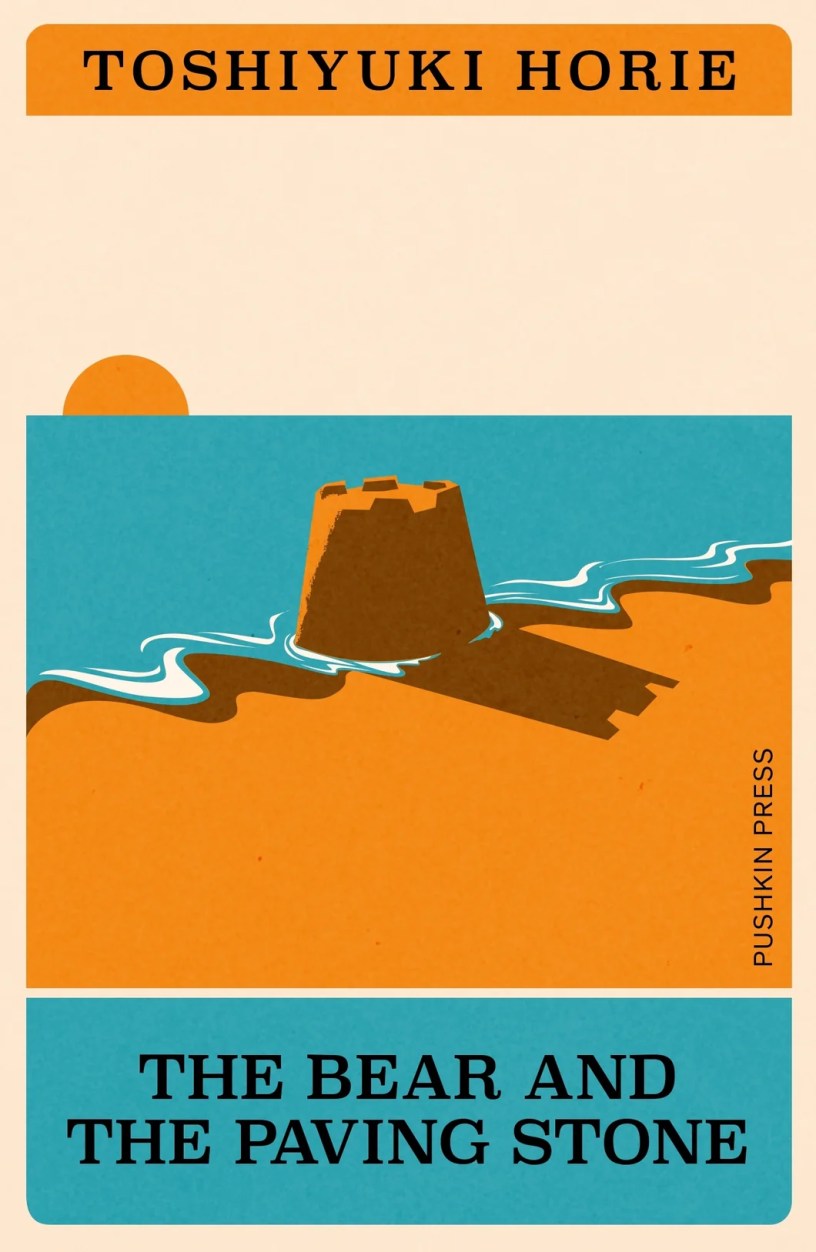
The Bear and the Paving Stone
By Horie Toshiyuki
Translated by Geraint Howells
(2000, translated 2018)
Pushkin Press
The Bear and the Paving Stone is part of Pushkin Press’s Japanese novella series. It includes the novella “The Bear and the Paving Stone” as well as two short stories, “The Sandman is Coming” and “In the Old Castle.” Horie is a professor of French literature, and perhaps not surprisingly, the stories often involve the experiences of a Japanese man abroad in France. In the title story, he is aware of his otherness and even agrees that were he in Japan, he would likely be a misfit there as well. A loner, an academic, and a dreamer, he lives an unfocused and drifting life, earning a living translating French non-fiction into Japanese. He is working on translating a biography of Émile Maximilien Paul Littré, the author of a comprehensive and lauded 19th-century French dictionary, when he receives a phone call from his erstwhile and unreliable friend Yann. Yann is leaving for Ireland soon, so they agreed to meet up in Normandy. The narrator reflects on the origin of their unique friendship. He observes that Yann selected him, perhaps because he too was an outsider, to confide that he was a Jew and to reveal intimate stories from his family’s experiences in Auschwitz during the war. Yann also shares his art with the narrator. A photographer, he reveals armfuls of black and white photos of solitary figures, empty barnyards, stone walls, and empty windows. The photographs resonate with the narrator, but the mood overwhelms him. Finally, Yann makes a strange request: he asks him to take a photograph of an abandoned shed he came across in the nearby fields. Yann is not giving the photograph as a gift, but confessing that he cannot bear the burden of possessing the image, which, for reasons known only to him, embodies the tragedy of his family as well as the simple misunderstanding that led to his father’s surviving the camps. Although the photo, laden with Yann’s dark and indelible significance, disturbs the narrator, he latches onto the linguistic and transcription errors that allowed Yann’s father to escape death. Likewise, he is in awe of Littrés work, will, and vision, but hung up on an unfortunate truth: the polymath was a short and unattractive man, so much so that schoolboys who should cheer his achievement would prefer not to look at a painting of the tragically odd-looking scholar. There is little plot in Horie’s tales. Photographs, castles, forests, dreams, and darkness play significant roles. Many of the moments he captures feature an uncomfortable, pained nostalgia and a sense of missed opportunities to communicate our thoughts authentically. And in the title story especially, there is a deep sense that even words are not true enough to allow us to connect with one another.
“Did you have a reason for taking me there?” I asked.
“I don’t really know. It’s not because you’re a foreigner or anything. I can’t really put it into words… but there’s something about you, I knew you wouldn’t take it the wrong way. I know you don’t do judo or anything, but you know how to take a knock or two.”
I wasn’t sure, but I thought I understood when he said there was “something about me”. That “something”, whenever I met someone new, gave me a clue whether or not we’d be able to get to know each other. Usually, if I don’t feel a connection with someone, I’ll conclude that they’re probably not someone I need in my life, and I’ll stay away. But when I do connect with someone, the connection lasts, and it’s a bit like the shell fire in that Kenji Miyazawa children’s story. You don’t fiddle with the flame. The flame has nothing to do with nationality, age, gender, status. When it’s lit it’s lit, and when it goes out it goes out, though its warmth might remain for a while. This “something about me”, however, lent itself to other things. With Yann, I was his blank slate, someone in whom he had no stake, no self-interest to protect. So he could let his guard down.”
 East Asian Literature in Translation