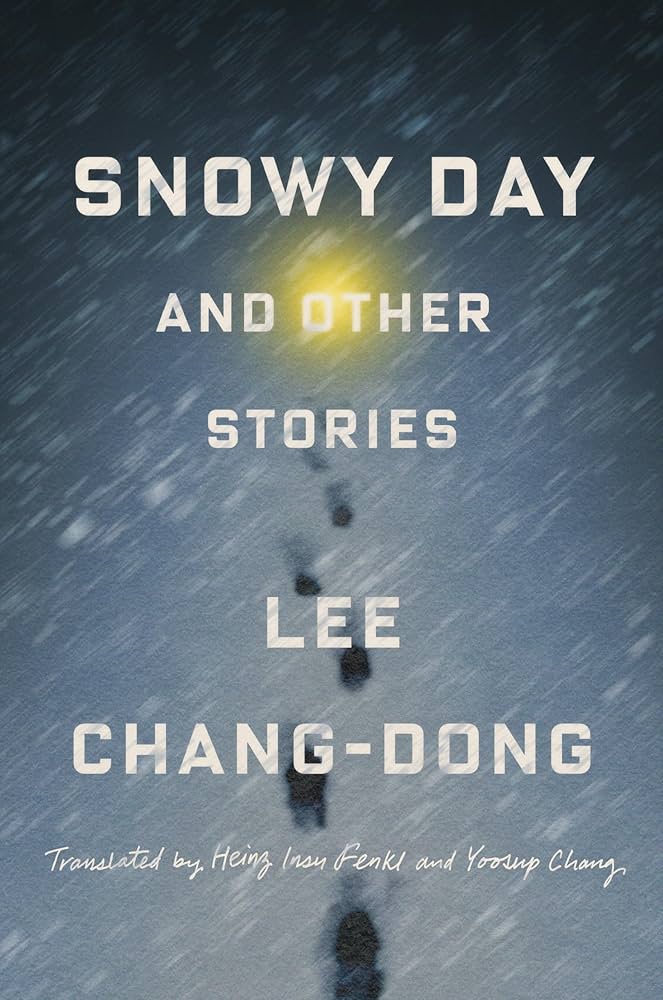
Snowy Day and Other Stories
By Lee Chang-dong
Translated by Heinz Insu Fenkl
And Yoosup Chang
(2025)
Penguin Press
Lee Chang-dong is best known for his work as a screenwriter and director. From 1997 to 2010, Lee directed Green Fish, Peppermint Candy, Secret Sunshine, Oasis, and Poetry. Lee was involved in left-leaning politics; he was the Minister of Culture from 2003 to 2004, yet created controversy by boycotting the powerful Blue Dragon Film Awards and clashed with the conservative newspaper, The Chosun Ilbo. From 2009 to 2017, Lee was blacklisted under the presidential administrations of Lee Myung-bak and Park Geun-hye. His return to film in 2018, Burning, became an international success, earning a nomination for the Best Foreign Language Film at the 91st Academy Awards. In Snowy Day and Other Stories, translators Heinz Insu Fenkl and Yoosup Chang present seven of Lee’s works, including three novellas and four short stories published in the 1980s and 1990s. Fenkl and Chang’s translation of the short story “Snowy Day” appeared in The New Yorker in March 2023. Set in a military camp close to enemy lines, it features a young, naive, “college boy” who is all but hopeless as a soldier, and an abusive, misogynist corporal with whom he shares lonely and bitterly cold patrols. “Fire and Ash” takes place in 1986; a couple struggles through the anniversary of the death of their child, while people on the street wonder about the status of two students who set themselves on fire as part of a political protest, or whether Seoul will be affected by the fallout from a nuclear accident in a faraway place called Chernobyl. In “The Leper,” a teacher is charged with being a communist. Although he makes a rational and eloquent defense of his politics, he is nevertheless in real danger, as his political bona fides have been fatally tainted by his father’s arrest in a round-up of suspected communist activists. Just as father is pitted against son, brother is forever at war with brother in the novella “There’s a Lot of Shit in Nokcheon.” One of Lee’s most famous works, this is a dark satire of the corruption and cruelty that abounded in post-war housing and urban renewal projects and a critique of the internecine conflicts that played out within Korean families, and like the war, were never resolved. As in “Burning Paper,” decisions made and acts committed during wartime continue to harrow survivors; they live their lives oppressed by the judgment of others and haunted by their own self-doubts and self-loathing. Lee’s realism is unflinching, political, and in many ways, cinematic. The stories in this collection are often inspired by specific historical events; a reader may benefit from reading about Korea’s brutal attempts to eradicate communists from the peninsula, and the violence under the dictatorships of Rhee Syngman, Park Chung-hee, and Chun Do-hwan.
“Don’t even say a word about this,” Granny said. “They might hear you.”
“I just can’t understand why you’re being so stubborn. Didn’t we see him when he was being loaded onto the truck in front of Daegu Prison? And later we heard the rumor that everyone on that truck was found dead, buried in the same hole.”
“Who did we see? The crowd shouting and shoving each other in front of that prison, looking for their husbands and sons? Were we even in our right minds then? There was a man with a long face and pointy chin, so I called out ‘Sungguk’s Father!’ but he didn’t even turn around. I still don’t know if it was him or not.”
“You still don’t believe me,” Sister-in-Law said. “When Brother came to visit me last night, he was wearing green army pants and a white shirt. I’m sure that’s what he was wearing the last time. The pants didn’t have a belt, and his shirt was stained black from grime or dried blood.”
“Will you please just shut your mouth!” Granny shouted without realizing it. She pushed her needlework aside and slumped against the wall. Her tooth ached mercilessly as if she were biting down on a needle.
“No matter what you say to me, I deserve it and more,” Sister-in-law said, sobbing, as if she were talking to herself. “You can even call me the bitch who killed her own brother.” With her handkerchief, she dabbed at the bags under her eyes—shiny from tears or sweat.
Granny clicked her tongue, wondering how she could still have tears left, at her age. In good times and bad, they’d lived by relying on each other. After struggling for so long, when her sister-in-law was just getting to the point where she could barely make enough to feed herself, she’d lost her mind and now lived surrounded by ghosts, night and day.”
 East Asian Literature in Translation