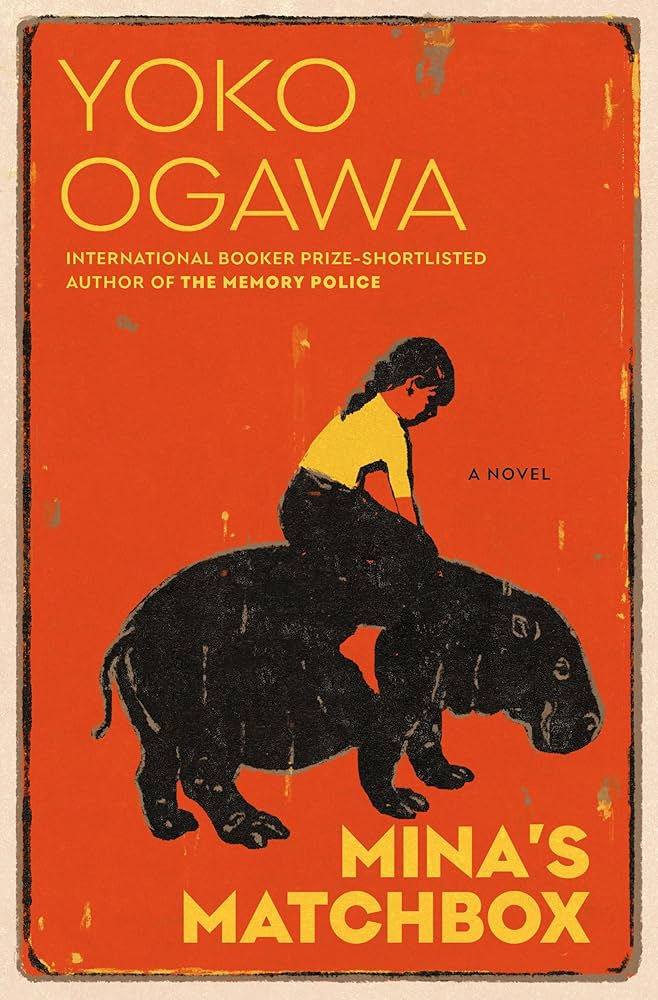
Mina’s Matchbox
By Ogawa Yoko
Translated by Stephen Snyder
(2005, translated 2024)
Pantheon Books
Ogawa has written a number of short stories, novellas, and novels that have established her as a master of modern psychological horror. In works like Hotel Iris, Revenge, The Diving Pool, and The Memory Police, Ogawa explores the minds of characters who are victims or victimizers motivated by perverse desires, those who desire complete control over another or seek to be controlled themselves. Ogawa’s characters violate all expectations of acceptable behavior toward family, sisters, and children in the name of love and caring. In Mina’s Matchbox, however, Ogawa steps well back from the edge of madness to create a warm reflection on friendship and family expressed through the eyes of a twelve-year-old girl, the narrator, Tomoko. She is a self-described country girl in a family of limited means. Her father has passed away, and though her mother tries to make ends meet, she struggles. Tomoko’s mother reaches out to her well-to-do sister, who offers to take Tomoko in for a year while providing the financial support to send her younger sister to technical school to learn to become a professional seamstress. From 1972 to 1973, Tomoko lived in an extraordinary household in Ashiya. Tomoko’s aunt married into a family that made its fortune in manufacturing and distributing a line of refreshing beverages. The house is a mansion, a museum, a medicinal spa, and a zoo, and to Tomoko, it is a world of wonders. It is also a uniquely blended household. There is a great matriarch, Madame Rosa, the German-born widow of the founder of Fressy beverages, her son and Tomoko’s uncle, Tomoko’s aunt, two servants, the maid Yoneda and Kobayashi, the gardener, and eleven-year-old Mina, the precious spirit around whom family life revolves. Tomoko and Mina are fast friends, and she takes great comfort in learning that she will become an essential member of the team caring for the frail and asthmatic Mina. Through her interactions with Mina, Tomoko discovers a love of storytelling, reading, and books. Sensitive, observant, and precociously curious, she also investigates shadowy areas of the household, obscure mysteries, and open secrets that her host family is committed to never acknowledging. She also becomes Mina’s legs, expanding her own horizons by leaving the family compound and her school to explore on her own. And because of television, Tomoko and the family can be part of the excitement surrounding Japan’s volleyball team in the 1972 Summer Olympics in Germany and the Giacobini-Zinner meteor shower, two of several historical events that occur that year and pierce the very protected and cocooned existence inside the Ashiya house. Readers familiar with Ogawa may be especially sensitive to moments of interaction between children and adults; there are several moments where Ogawa injects a simmering menace into the children’s experiences of first love, and Tomoko’s desire to protect Mina and her family from pain exposes the naive “fixer” to danger. Overall, though, Mina’s Matchbox is delightful and warm, a beautiful and unforgettable coming-of-age story
“Mina’s face appeared even lovelier and fresher when seen from so close, so vivid it seemed to bear down on me, seemed almost frightening to look at. Her eyes were wide, and a light shone from deep within her pupils. The bridge of her nose cast a rich shadow on her face. Her cheeks, full in proportion to her slender body, were flawless. Her brow had an air of intelligence, her lips of complete innocence. It was enough to cause anyone to wonder how such a beautiful girl could ever have been born.
Still, this perfect face seemed completely out of keeping with her immature body. Perhaps because she’d suffered from these attacks since she was very young, her back was bent—to allow her to cough more easily?—and her ribs seemed sunken. Even when she was relatively healthy, if you listened carefully, you could hear a sound like the winter wind blowing at the back of her throat—a troubled sound, as though her body were bewildered at the prospect of having to support such a beautiful face.”
 East Asian Literature in Translation