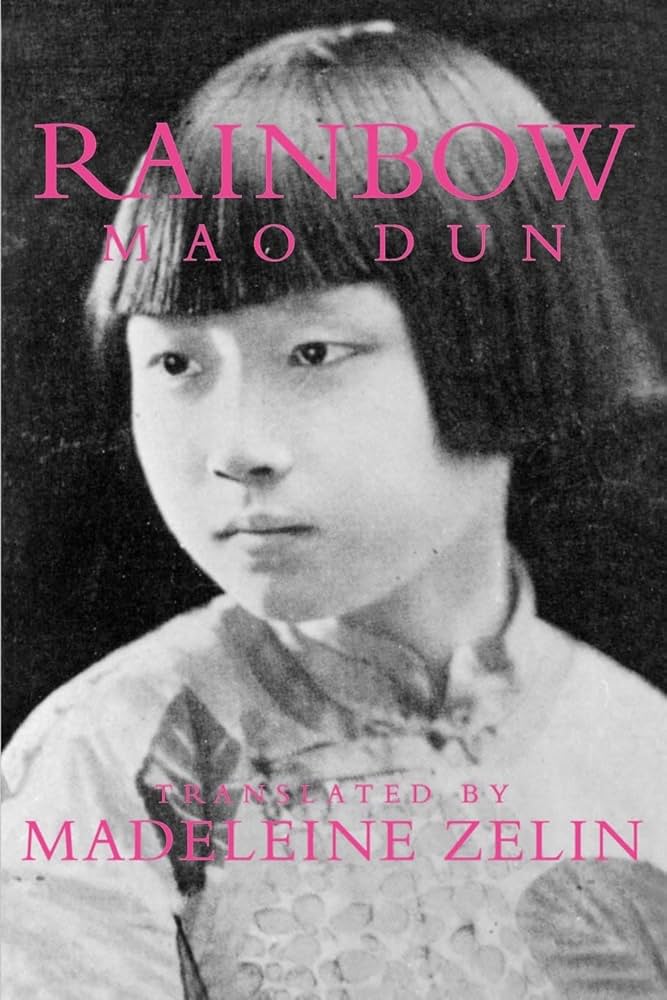
Rainbow
By Mao Dun
Translated by Madeleine Zelin
(1929, 1930, translated 1992)
California University Press
Mao Dun participated in the May Fourth Movement and was a proponent of the New Thought Tide. He championed New Literature and was instrumental in publishing and popularizing literature written in modern vernacular prose, including his own influential novels, Eclipse and Midnight. In Rainbow, Mao creates the unforgettable character of Mei. When we meet her, she is eighteen years old, and she has just returned from witnessing the May Fourth protest at Shaocheng Park. Already excited by the principles of the New Thought Tide and eager to embrace radical reform in education, literature, equality of the sexes, self-determination, and individualism, Mei is electrified by the possibilities that lie ahead for her and her fellow citizens. At the same time, she is paralyzed with anxiety and frustration; her father, a Confucian patriarch to his core, is arranging a marriage between his daughter and a local merchant. A model of grasping capitalism, he is also a man of low morals. Meanwhile, Mei has given her heart to a cousin, a beautiful young poet who has contracted tuberculosis. Though attached to both men, Mei believes that marriage will become a prison for her and prevent her from achieving her goal of living an authentic and meaningful life. She cuts her hair in the iconic bob of the New Woman and flees from Chengdu to Luzhou, where she and other men and women are preparing to teach at a progressive normal school. There, she finds herself shunned and mocked by her female colleagues and the target of unwanted attention from the men. She becomes disillusioned by the work of her so-called fellow revolutionaries, discovering that the energy of New Thought Tide has been subsumed by the vicissitudes of daily life, petty infighting, and shallow love affairs. In the end, she determines that she and her comrades are merely putting new clothes on old forms. Four years later, Mei risks all to challenge herself in the political crucible of Shanghai. The path of Mao’s female heroine and her deep uncertainties about the practical aspects of reform and political change reflect Mao’s own geographical and philosophical journeys. No surprise, then, that in May of 1925, we find Mei distributing anti-colonial flyers at the Wing On Department Store on the Nanjing Road, and inciting crowds of fellow communist protesters to riot against the police and avenge the deaths of those killed on May 30. Rainbow is an important book for those interested in the culture and mythology of the New Woman and the complex role of women in China in the first half of the 20th century.
Mei lowered her head and said nothing. The words, “inspect the dry goods store,” pierced her like a knife. The earthshaking patriotic cries at Shaocheng Park, which had seemed so remote to her this afternoon, now turned out to be directly related to her personal problem. In the future, she would have to be the proprietress of a store that secretly sold Japanese goods. This prospect intensified her misery. That day when she heard people shout “Patriotism,” she hadn’t given it a second thought, for she knew she had never sold out her country. Now her complacency was gone. Suddenly, she felt like a notorious traitor.
 East Asian Literature in Translation