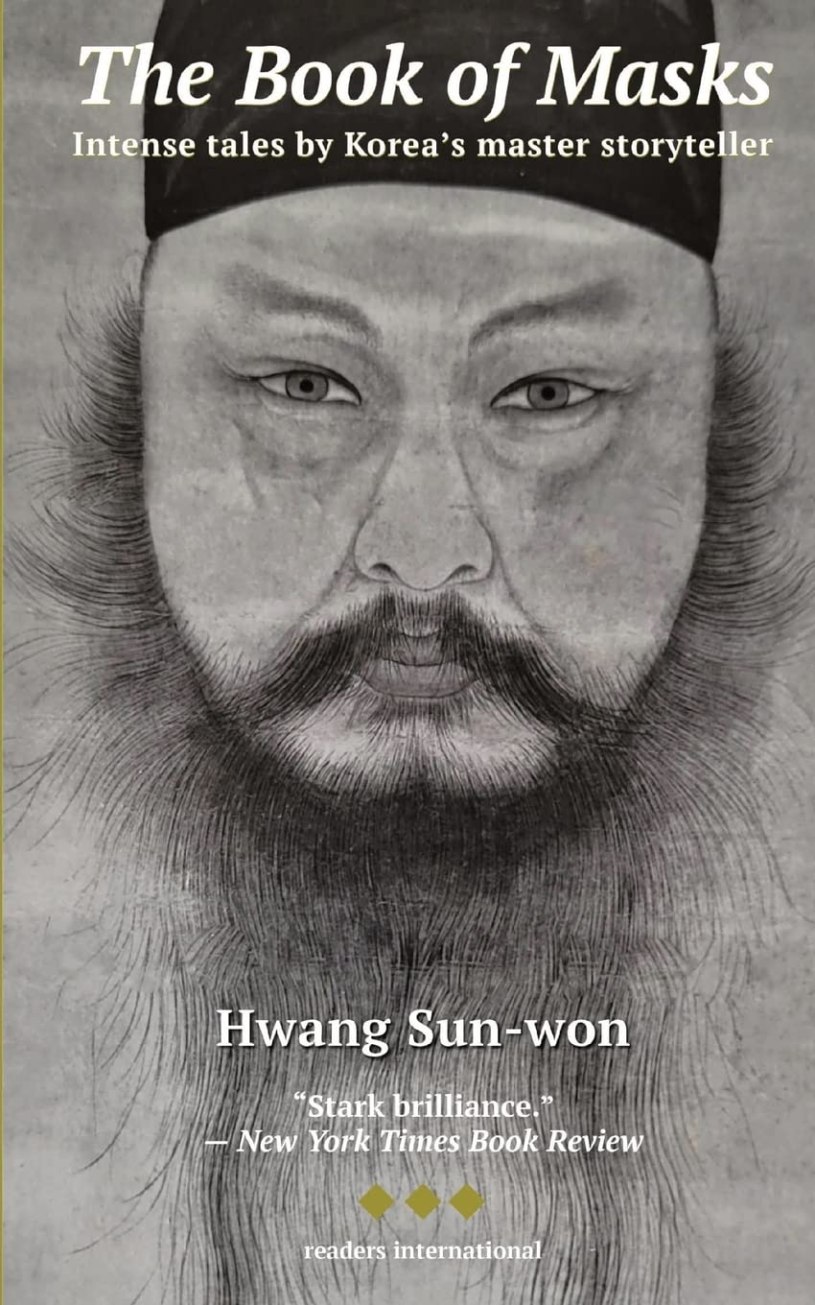
The Book of Masks
By Hwang Sun-won
Translated by Martin Holman et al
(1976, translated 1989)
Readers International
Although some may be familiar with Hwang Sun-won through his Korean war novel, Trees on a Slope, he is most well-known as a writer of short stories; his “Sonagi” or “Rain Showers” is a beloved work in the Korean canon and widely anthologised. The Book of Masks is a collection of short stories spanning his 58-year-long career. Hwang’s earliest works were composed during the Japanese occupation while the colonizers were actively working to eradicate the Korean language and replace it with Japanese. During this period, he and other Korean artists were writing and sharing their work at considerable risk. His stories reflect the lives of refugees, the poor, single mothers, soldiers, the elderly, and other marginalized people. Though the stories allude to flashpoints in 20th-century Korean history, such as the Japanese Occupation, the end of World War II, the Korean War, and the Gwangju Democratization Movement, they are not overtly political. Instead, they focus on the tragic experience of individuals who have lost family members or friends, or single, isolated men who yearn for love but are paralyzed by their conflicted, tortured preconceptions about women. Strong women loom large in many of the stories. Idle, aggrieved, and purposeless men critique them, but Hwang’s female characters are pragmatists, doers, and heroes. Some examples of Hwang’s regard for the power of the feminine and maternal appear in standout tales like “Conversation in June About Mothers,” “The Night He Came Late,” and “The Weighted Tumbler.” “For Dear Life” tells the story of a young man who was wounded while fleeing soldiers in the Gwangju Uprising. Two of the stories, “A Numerical Enigma” and “The Curtain Fell, But Then…” are experimental. In the former, an accountant fixated on a female office worker realizes he alone perceives the truth concealed behind dissembling numbers. In the latter, a playwright initiates a conflict between two characters who refuse to play their parts as written. Two of the most lyrical and memorable stories are about childhood friendship, understanding, and aging: “Shadows of a Sound” and “A Tree, A Rock, and…”
“Yeah. As a soldier, I was severely wounded during the War. It was the thick of battle, and there was no telling when the medics would arrive. My wound hurt terribly, and I was bleeding hard. My consciousness was growing dim, and I thought I was going to die. At that moment, out of nowhere, I saw my mother’s face. But I rejected her. I rejected her concern even on the brink of death.
How did you know the face was your mother’s, if she left you when you were seven?”
It’s true I don’t remember her face, and I didn’t ever try to dig up a picture to see what she looked like, but somehow, I knew it was my mother.
– “Conversation in June About Mothers”
 East Asian Literature in Translation