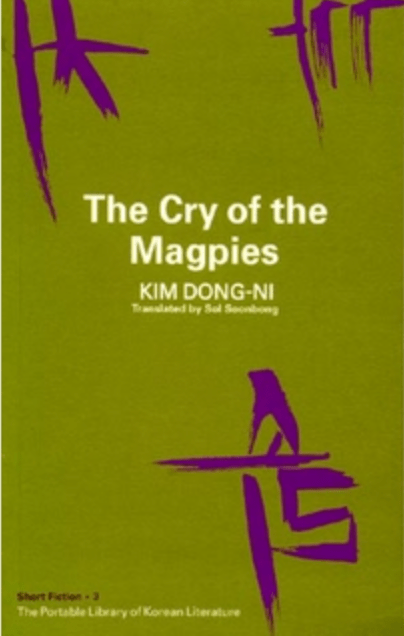
The Cry of the Magpies
By Kim Dong-ni
Translated by Sol Soonbong
1961, translated 2002
The Portable Library of Korean Literature
Kim Dong-ni sets the short story, “The Cry of the Magpies,” in a remote agricultural village during the Korean War. The narrator introduces themselves by explaining that they are not the person who experienced this story, but a friend of the protagonist. They begin in medias res, using the “I” voice and speaking from the point of view of a soldier returned from a year and a half on the front lines who discovers his ailing mother’s chronic illness has worsened, his sister has matured into a beautiful young woman, and the love of his life has abandoned him. The speaker then interrupts their retelling to concede that their narrative is disjointed and confusing and explains that they will start over and attempt to tell the story in a more logical order. In addition to this self-referential strategy, Kim creates dialogues where only one person may be speaking. For example, the author has their storyteller report what a character says or asks and what the narrator wanted to say in that moment, leaving the reader to wonder if the speaker said anything at all during the exchange. Kim is known for writing about the disintegration of the traditional Korean family structure, the shifting of gender roles, class, and violence, and all of these themes are present in “The Cry of the Magpies.” He is also using the short story to explore the tension between reality and fiction. For example, the title alludes to a bit of local folklore that is both fatal and ambiguous; the narrator confesses that he can not accept this conventional wisdom as balm for his anxieties; wounded, he wonders about the fact of a wound, what it signifies, and its value to the individual and the community, and when faced with a physical copy of his own death certificate, acknowedges that the “truth” of the written document may have more significance than his own experience of being alive. Like many stories about the Korean War and the post war period, “The Cry of the Magpies” is marked by an existential collapse of the social fabric, the breaking of taboos, and an excruciating rivening of the self. In “Deungsin-bul,” the companion piece of “The Cry of the Mapies,” a Korean man drafted into the Japanese Imperial Army is sent to Nanking before being dispatched to the front lines to fight against the Chinese. Fearing for his life, searches for a way to escape his fate. When he discovers the name of a Korean among the monks enrolled at a nearby Buddhist shrine, he escapes the Japanese garrison and makes a bid to leave behind the world of war and become a Buddhist monastic. The monks take him in and send him to a mountain shrine unknown to the Japanese, the “Deungsin-bul” of the title. There, while our hero comes to know the Golden Buddha, Kim forces us to consider the weight and influence of story, folklore, faith, and myth.
“Nor was there anybody who knew the origin of the belief among the villagers that if the magpies cry in the morning, there will be guests or good news that day, and if the magpies cry in the evening, there will be a sudden death. Regardless of who started the superstition, the morning magpie cries did seem actually to bring guests or good news, while the evening ones seemed often to forbode death. So the villagers were inclined to believe in this superstition.
Meanwhile, the magpies cried in the morning, in the evening, and at any other hour it pleased them.”
 East Asian Literature in Translation