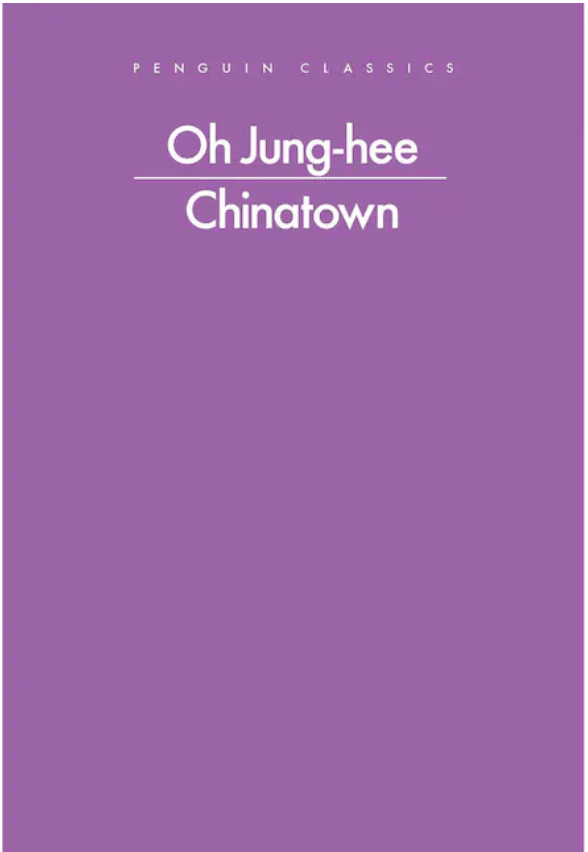
Chinatown
By Oh Jung-hee (O Jeonghui)
Translated by Bruce and Ju-chan Fulton
(1970s-1980s, translated 2025)
Penguin Random House (UK)
According to the prolific translators Bruce and Ju-chan Fulton, Oh Jong-hee is “the grand dame of modern Korean fiction. She published her harrowing first short story, “Toy Shop Woman,” while still in high school. The four stories in this collection are 1979’s “China Town,” and “Running Man,” “Mermaid,” and “Garden Party,” for which no publication dates were provided. The titular story is a coming-of-age story set in Incheon during the post-war era. At the time, Inchon’s China Town was a slum. The narrator is a nine-year-old girl who serves as a caregiver for her mother’s eight children. She befriends Ch’iok, a girl from her school, and the two use what free time they have to play at Ch’iok’s single-room apartment, which she shares with her mother, a prostitute, and a black man who may be an active or former American soldier. The child chronicles the boredom and squalor of her days and witnesses scenes of degradation and death, all in the shadow of a statue of Douglas MacArthur, which stands on a tall stone base in a filthy park. “Running Man” at first appears to be a romance between a handsome soldier and a young girl from a well-to-do family, but though the couple is trying hard enough, their behavior is awkward and forced. The true romance is playing out between the soldier and another man, a young scholar who is also at war with his own desires. “Mermaid” addresses the relationship between a mother and her adopted daughter. While her husband and son are on a fishing trip, she takes her daughter on a “girl’s trip.” Tempted to at last reveal the truth of their relationship to her daughter, she fears that she may never see her again. The final work, “Garden Party,” centers on a mother of two, a writer of short stories, who is married to an academic. Scattered and impulsive, she arrives late to an important dinner at the home of an influential college administrator. Having run straight from a project at home, she is unwashed, unmade-up, underdressed, and facing a cast of women who are youthful and elegant second wives, three in their 30s who could pass for college girls, and one or two in their 50s. As in “Mermaid,” the protagonist is struggling to come to some kind of understanding of what it means to be a woman, wife, and mother, while also trying to answer profound questions about love and purpose.
“She felt like a shoemaker who always made her shoes the same size. The kids would keep growing and the shoes would never fit–they were useless. She picked up a glass of flat beer left unattended on the table. So what about the white bird flying off into the long, long flow of time between five and six in the afternoon? What about the man on the tightrope slowly going insane from loneliness? Was it any use trying to draw meaningful metaphors of life from them?
Talk of cancer, tennis and jogging, last night’s hangover, nuclear war and Nostradamus brushed past Myŏnghye. Someone complained about the pathetic pay you could expect in his profession; someone else said, ‘Nice to meet you, hope we can see each other more often’; and someone else expressed contempt about someone not present.”
 East Asian Literature in Translation