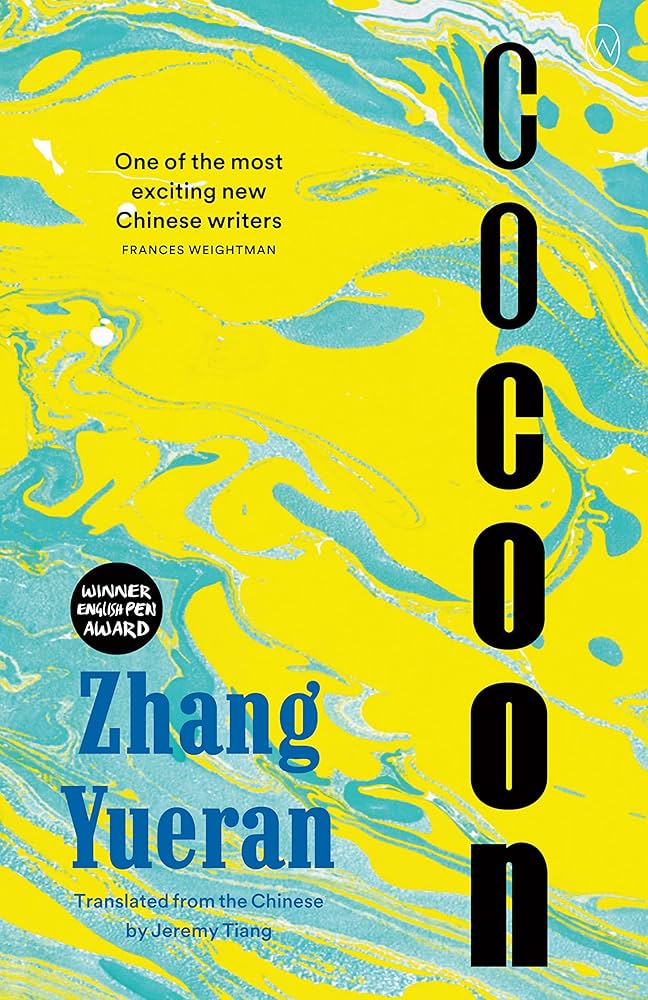
Cocoon
By Zhang Yueran
Translated by Jeremy Tiang
(2016, translated 2022)
World Editions
Zhang Yueran’s Women, Seated, features crimes in progress, corruption, flight, and cover-ups, all of which illuminate the precarious place of women in contemporary China. In Cocoon, Zhang searches China’s recent past, from the Cultural Revolution to the aughts, and across three generations of turmoil and rapid social change. Her hero, Li Jiaqui, is the only one of a friend group that grew up in Handong’s capital city, Jinan, who was (apparently) able to flee her dysfunctional family and a cursed city. She went to Shanghai, to university, and then she studied abroad and began a literary-adjacent career in arts reporting and interviewing bright lights from all over the world. As the story begins, she is called back home to care for her invalid grandfather, a homecoming that forces her to reconnect with her straight-laced cousin Peixuan, her Auntie, and the young boy she once dreamed of marrying, Cheng Gong. She hasn’t seen these people in 18 years. There is a tension between the two childhood friends: anger, perhaps bitterness, and a mutual mourning for the lives they might have lived had Li Jiaqui not fled. Li Jiaqui also revisits her relationships with her dictatorial mother, frightened aunt, and the shadowy influence of her grandfather, who is now slipping away. That wraith is now a saint; once a field medic in the Chinese civil war, then a famous surgeon at the city hospital, and finally the hospital’s director, he is the subject of a state documentary celebrating his life’s achievements. Zhang reveals the complicated stories of the two families via alternating monologues between Cheng Gong, whose family was without connections and whose own grandfather was rendered comatose in the aftermath of a struggle session during the Cultural Revolution, and the privileged Li Jiaqui. Their reminiscences are full of wistfulness as well as directness and candor. When it comes to moments when they hurt one another, they do not hold back. They acknowledge they are searching the past for answers. Cheng Gong is devoted to finding why his grandfather and his family were labeled “Black” during the Cultural Revolution, and Li Jiaqui is desperately, obsessively trying to rebuild a broken connection with her father, a college professor, poet, and alcoholic who died in a traffic accident. Their quests reveal misunderstandings, missed opportunities, and devastating truths. Zhang’s writing is beautiful in darkness and in light, and her metaphors are iconic. Li Jiaqui’s core memories circulate around the White Mansion, the nickname she and Cheng Gong ascribed to her grandfather’s hospital when they were children in the 70s, when they used to play in the adjacent wooded area where they discovered a burned and partially collapsing brick chimney containing evidence of the savagery of the times. For his part, Cheng Gong spends hours in Room 137 of the hospital, a room in an all but abandoned, underserved wing, occupied only by the living ghost of his comatose grandfather. Zhang sears these scenes into our memories, capturing the tragedy of the Cultural Revolution as well as the long tail of that trauma, as it continues to wound the children and the children’s children.
“Over the next few days, my schoolmates kept asking me questions about Granddad. I hated repeating myself, so I made up a new story each time about how he’d ended up in his current state—he was shot, it was a bayonet attack, the enemy ran him over with a truck, he was flung from a high wall. I was moved by each of these fantastical tales, and came to believe they were all true.
One drizzly evening, I brought seven or eight classmates to see him. Only family members were allowed to visit, but we managed to sneak in while the nurses and security guards were on their dinner break. In order to create more atmosphere, I’d bought a Party flag and draped it across his torso beforehand. Everyone gathered round the bed, staring at him with such respect, he might have been a Party leader. Granddad accepted their attention with equanimity while his own gaze remained fixed to the ceiling, where a gecko slowly crawled across his field of vision.”
 East Asian Literature in Translation