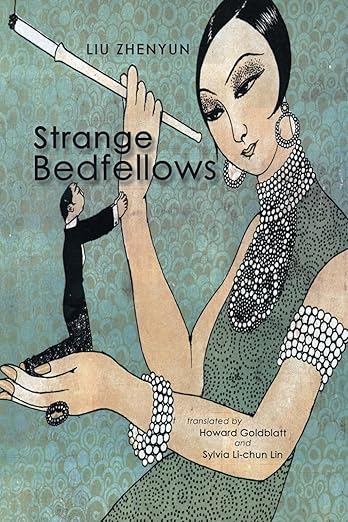
Strange Bedfellows
By Liu Zhenyun
Translated by Howard Godblatt and Sylvia Li-chun Lin
( translated 2021)
Cambria Sinophone Translation Series
Yu Hua, writing in his 2011 collection of essays, China in Ten Words, chose to close his work of social criticism by arguing that to know contemporary China, it is necessary to study the Chinese word meaning “bamboozle.” “Bamboozling” is at the heart of Liu Zhenyun’s fast-paced and ribald satire, Strange Bedfellows. Liu is lampooning a culture that has become inherently transactional and corrupt, and he gets directly down to business: in the remote Niu Clan Village, the divorced Niu Xiaoshi (his wife ran off and abandoned him and their four year old daughter) is 31 years old, 5’2” tall, and desperately in need of a wife to raise his daughter and manage his household. His younger sister, Niu Xiaoli, is in a bind as she has been taking care of Niu Xiaoshi for several years, but is now engaged to be married and will no longer be able to provide for her downtrodden sibling. She therefore secures the services of an itinerant matchmaker, who produces a petite virgin from a village in a far-off region, and all parties are haggling over the bride price of the demure Song Cai. The wheeling and dealing are intense. While the matchmaker is imposing and relentless, Niu Xiaoli gives as good as she gets; this is not her first try at negotiation. An exchange is agreed upon; for 100,000 yuan, Niu Xiaoshi marries Song Cai, his daughter has a new mother, and his sister is free to marry. Unfortunately, within the week, Song Cai flies the coop, and the matchmaker is nowhere to be found. Niu Xiaoli is in a terrible spot: in order to raise the 100,000 yuan, Niu Xiaoshi used 20,000 yuan from the family savings, and Niu Xiaoli borrowed 7,000 yuan from her fiancé and persuaded a local bank teller who had eyes for her to loan her 80,000 yuan. Since her brother can’t leave his daughter and her fiancé can’t leave work, she sets out in pursuit of the swindlers with just a small pack and a fistful of yuan. So begins her picaresque journey through a landscape of fakers, con artists, charlatans, human traffickers, and corrupt businessmen and politicians. From the smallest hamlet to the big city, everyone is bamboozling everyone. Liu is a brilliant plotter who creates one ludicrous obstacle after another for his determined heroine. Scam follows scam, and not a few are revealed to be nesting Russian dolls of deception and double-dealing. Liu’s characters coax, seduce, and spit venom, and the voice both their exultation and their fury in coarse language that hits like a punchline. Liu Zhenyun presents us with a portrait of modernity that is comically and spiritually grotesque, reminiscent of Hieronymous Bosch’s The Haywain, where humanity turns its back on beauty and the divine to better cling to material wealth and indulge its desires.
“I asked you here to give me some ideas and help me out of this jam.”
“The only solution is to go to three separate places to eliminate the potential troubles,” Zhao said as he looked at the lights flickering in the water. “Go see the discipline committee about Song and tell them you have had nothing to do with him. For Dongliang’s accident, go see the director of public security and stop him from reopening the case. As for Zhu Yuchen ruining your chance, you go and ask him to forget your previous acrimony. But you can’t do any of these, can you?” Zhao sighed with a shake of his head, “When it comes to this, you can only trust the heavens and hope for the best. No one can do anything about it.”
Li found the comment disappointing, but on second thought, he agreed that Zhao had a point. He too heaved a sigh. Not interested in drinking, they looked at the lights in the middle of the river for a while before Zhao spoke up again, “I don’t have a solution, but I know someone who does.”
“Who?” Li tensed.
“Yizong.”
“Who’s that?”
“An I Ching master.””
 East Asian Literature in Translation