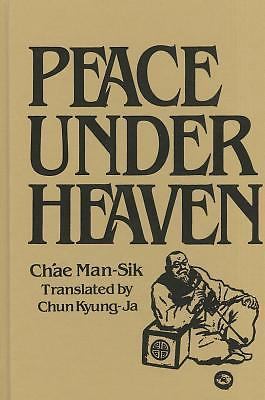
By Ch’ae Man-sik
Translated by Chun Kyung–Ja
1938, Translated 1993
M.E. Sharpe
Ch’ae Man-Sik wrote Peace Under Heaven while under Japanese colonial rule. Writing anything directly critical of the occupation or the occupiers could lead, at best, to jail or imprisonment. Instead, Ch’ae, one of Korea’s most lauded satirists, turns his eye on those Koreans who benefitted from and blessed the Japanese for restructuring Korean society, creating through so-called divine mandate and violence an artificial Tenka Taihei–a “peace under heaven”– in which the rich get richer and the poor are so ground down and intimidated they dare not ask for justice. Ch’ae’s protagonist is the gigantically corpulent landowner, Master Yun, a man who has homes in Seoul and the countryside, and a cyclopian appetite for power, cash, and sex. The great tragedy of his life was when a gang of robbers invaded his poor father’s country home. At the first sound of the thieves’ assault on his defenseless father, Yun hauls himself over a wall and hightails it into a field of crops. He reveres that night and the robbery and the murder of his father, as his great epiphany and the revelation of the philosophy that has guided him on his path through the world: “Let everyone else go to hell.” He praises the Japanese because they have driven off the robbers and declared war on the “socialist devils” that might interfere with his strategy of extorting money and rice from the farmers who lease his landholdings, charging 20% interest in his role as a friendly usurer, and bribing Japanese managers to position his two sons as policeman and judge, a scheme that will add status to the Yun family and ensure that the Master will have a magistrate and a cop to provide him access, authority, and cover. He behaves savagely to everyone, haggling with and degrading servants, rickshaw carriers, his family and relatives, and the toadies who send him a steady stream of hapless, indebted young men. But the rancor and abuse he showers upon women is extraordinarily vile. He berates the women of his household by the hour, never tiring of humiliating them. Though approaching eighty years of age, he still seeks out the company of Kisaeng girls, who provide musical entertainment and clever conversation, though he will never pay full price. In portraying Master Yun as profoundly vulgar, selfish, and unable to bring his ungovernable appetites under control, Ch’ae is making a black comedy of Korea’s tragedy: the Japanese occupation has inflicted the final blow on the nation’s spirit, eradicating Confucian ideal of the righteous patriarch ruling the home with honor and justice, and ushering in a world where greed is the only good and materialism and the pursuit of power are the new bywords. Readers should be alerted that Master Yun’s depravity has no bounds; as he grows older, he has discovered that he can only be aroused by thoughts of younger and younger girls, and a significant element of the plot involves his pursuit of a fourteen-year-old child. As a testament to the fall of Confucian values, several women who suffer under Master Yun’s umbrella of hate and abuse are themselves enterprising. Pragmatists, they continue to play the role of the chaste maiden while selling themselves after hours to men craving the company of women posing as schoolgirls, busgirls, and college students. As grotesque as Master Yun’s berating of women is, the way the women are expected to behave and the way they negotiate their lives in a hostile environment perpetuated by Korean and Japanese men makes for an eye-opening study in cruelty and survival.
“Ko had been wed at sixteen. Now she was forty-seven, and up to the day her mother-in-law died the previous January, for thirty-one long years she had lived a notoriously hard life under the heel of her mother-in-law. For more than three decades, Master Yun’s wife had supervised her every move. People called the old woman “wildcat” for her ferocity, “miser” for her stinginess, not to mention “nag” for her sheer contrariness. Many a tear of sorrow Ko had shed until the old woman’s death the previous January finally freed her from oppression. She felt as slaves feel at the hour of emancipation.
But then, this woman Ko hadn’t actually been an angelic daughter-in-law herself. True, an obedient and flawlessly virtuous daughter-in-law is only a mouse in front of a cat…”
 East Asian Literature in Translation