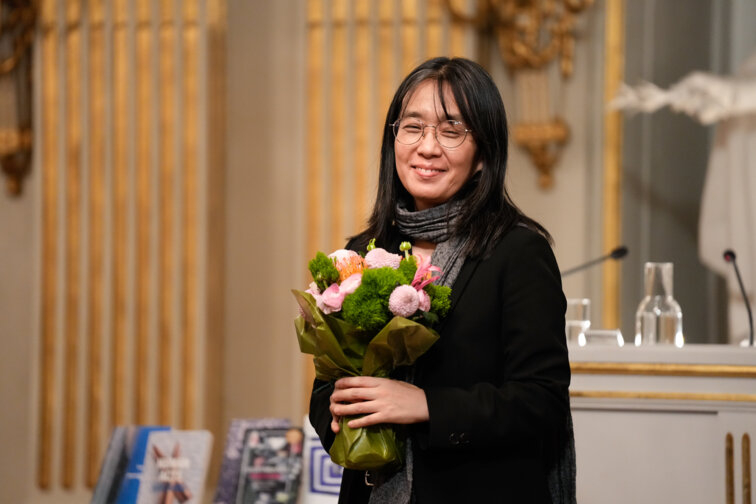
On March 26th, the National Book Critics Circle awarded South Korean writer Han Kang its top prize for her 2021 novel, We Do not Part, a novel of friendship, the role of the artist, Korean shamanism, and the Jeju Massacre. This national trauma, which for years was officially referred to as the Jeju Uprising or the The Jeju April 3rd Incident, began in April of 1948 and only ended with the start of the Korean War in 1950, during which local police, armed members of the Northwest Youth League, and Korean soldiers, all under the orders of military dictator Syngman Rhee, raged throughout the island committing extrajudicial arrests and murders of anyone suspected of being or harboring communists, and resulting in the deaths of between 10,000 and 30,000 men, women, and children.
In Han’s novel, the innocent dead haunt the two artists, drawing them to Jeju and the site of the massacre of an entire village, demanding that they bear witness to and give voice to their trauma. The re-experiencing of that trauma is not merely psychological. Set in motion by a mauling accident experienced by the sculptor that requires a lengthy, hourly course of rehabilitation, which, if it is not worse than the initial wound, is at least equal to it, the ordeal of remembrance writes its horror on the body of the author as well.
Han Kang, who was awarded the Nobel Peace Prize in 2024, builds on a long and fierce Korean tradition of using art as a tool to bear witness to violence and injustice. Han’s 2014 novel, Human Acts, which reopens the tragedy of the Gwangju Democratization Movement. Indeed, the writer in We Do Not Part is still recovering from having written a successful historical novel about another example of state-sponsored terrorism when she begins seeing visions and hearing the voices of the victims from Jeju.
Readers interested in learning more about the plight of the people of Jeju might consider two other translated works of fiction on the massacres. In 1978, while it was still a crime to speak or write about the “incident,” Hyun Ki-young published the novella Sun’i Sam-chon (My Aunt Sun’i) about a Seoulite who returns to his childhood home in Jeju and finds himself part of a yearly remembrance of the day his family’s village was burned to the ground by armed zealots. In 2010, Kim Sok-Pom, a Zainichi Korean, wrote The Curious Tale of Mandogi’s Ghost, in which the author shares his own experience of the massacre told through the filters of folklore, ghost stories, and mythology, all voiced by a young and hapless monk. And for those who seek art in all media, consider watching the top-rated Korean Drama, When Life Gives You Tangerines, a contemporary romance about Jeju youths whose families are still impacted by the tragedies they endured during this period of horror and inhumanity. If the title sounds odd, it isn’t: seedless mandarin oranges are one of the chief exports of this near-tropical black volcanic paradise.
Incidentally, today, March 29th, 2026, The Seoul Economic Daily reports that South Korean President Lee Jae-myung has promised to “establish legal grounds for revoking state honors awarded for the suppression of the April 3 Incident.” He went on to pledge, “I will ensure a system is built so that permanent accountability is enforced, just as Nazi war criminals are punished.” In a victory for the survivors, Lee is abolishing the criminal and civil statute of limitations for those found to have been involved in the violence.
 East Asian Literature in Translation