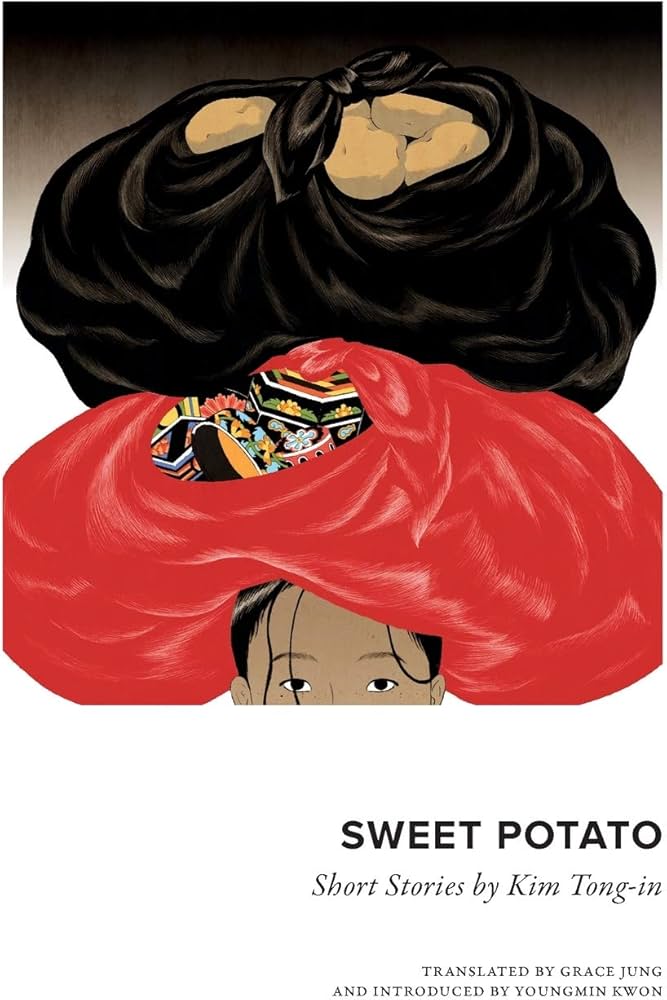
Sweet Potato: Short Stories by Kim Tong-In
By Kim Tong-In
Translated By Grace Jung
2017
Honford Star
Kim Tong-In, who lived from 1900 to 1951, is regarded as one of the great Korean realists of the 20th century. Sweet Potato: Short Stories by Kim Tong-In, translated by Grace Jung in 2017, features his iconic short story, “Sweet Potato,” as well as 13 others. Many of the stories are set in Kim’s birthplace in P’yongan. The first story in the collection, “The Life in One’s Hand,” an experiment in surrealism, is set in a hospital where a young poet is dying of an unknown disease. An old friend, an entomologist, arrives to console the comrade he so admires. The next day, when he attempts a second visit, he learns that the poet has died. Weeks later, he sees the poet in a crowded public space. To lend credulity to his claim, the entomologist presents a stack of thought experiments he claims he received from the risen poet that offer possible explanations for his return to life. In “Boat Song,” a traveller smitten by the beauty of spring thinks of love and paradise, and is transported by the mournful sound of a kisaeng performing a folk song. Searching for the source of this music, he discovers that the singer is not a female entertainer but an old man, who repeats the lyrics and then tells the visitor of the song’s inspiration: a love triangle. Like Kim, many Korean writers from this period were educated in Japan; on returning to Korea, they often wrote indirect criticisms of the Japanese colonial government and its military. Kim was not so circumspect; in “Flogging,” Kim gives a fictionalized account of the four months he spent in prison for violating the Japanese laws concerning publications. In “Red Mountain,” Kim writes of the desperation of the Koreans who fled to Manchuria in a vain attempt to escape Japanese colonial rule. Kim enjoys experimenting with the story within a story genre, creating exquisite tension between the distance of the “teller” and the experience of the narrator or protagonist of the core tale, and lending a sense of authenticity and gravitas to his inventions. Several stories share the themes of obsession, perversion, and madness, including “The Mad Painter,” a journey into the mind of a male painter who is overcome by a mania for rendering the likeness of a local beauty on the idealized body he has already created. In “Fire Sonata,” like a long-leaf pine that requires fire to release its seeds, a composer’s creativity can only rise to the surface under the influence of a conflagration. Three of his stories, “Barely Opened Its Eyes,” “Sweet Potato,” and “The Old Taet’angji Woman,” fall into the genre of “fallen women.” Yet, when we first meet these women, they are already doomed. Impoverished, all but homeless, their fate is inescapable. Kim presents their heartbreaking, fatalistic stories without judgment. Two of his heroines do not fit neatly into societal expectations for beauty. “The Old Taet’angji Woman” is Tabuko, a giantess of epic proportions who is universally mocked and degraded, described by her fellow villagers as a cross between a pig and a blowfish. Alone in the world, she sells herself at a popular mountain bath house, to disastrous effect. In “Mother Bear,” a single mother with a face and body lacking “an ounce of femininity” battles to keep herself and her child in food and shelter. Kim Tong-in’s men are layabouts and wastrels, violent and abusive, and completely unreliable. The last story in the collection, “The Traitor,” is based on the actions of Yi-Kwang Su, a leftist modernist who collaborated with the Japanese.
“He was a gambler (and not the jolly, vivacious kind of gambler, either; rather, he was the type who would languidly look over at another’s game or go and take a free cut of another’s winnings). He would fall vastly short of the title ‘a good man’. This man, who’d lived twenty-four years as a waif (wait, no–a bachelor), had met Komne out of sheer chance, and Komne was a blessing from the heavens. She was a rare and precious golden calf. He had no right to judge her by her looks. Regardless of her looks, a woman is a woman. She fed him, clothed him and was the sole breadwinner of the household (on top of working the fields, she even wove straw bags). All he lived on was his title as husband, which gave him food to eat, clothes to wear, an occasional allowance and the nightly bedding she spread out for him. He even got to be called ‘honey’. There was no better deal than this.
Her body was strong, so she never got sick. Her face was ugly, so there was no reason to worry about another man eyeing her over. Her personality was so honest that she easily fell for his lies. She was the perfect wife. She’d grown up in poverty, so she didn’t know how to hate it. When she got angry, there was no aftermath following her fit. She was born and raised in this town so if there was anything they ever needed, there were plenty of people to rely on. She was the jackpot. There was no end to the benefits she brought. The first year of their marriage was a bumper year thanks to Komne’s hard work. She’d made enough to get them through the winter months with simple side jobs. There were enough savings to go around.”
 East Asian Literature in Translation