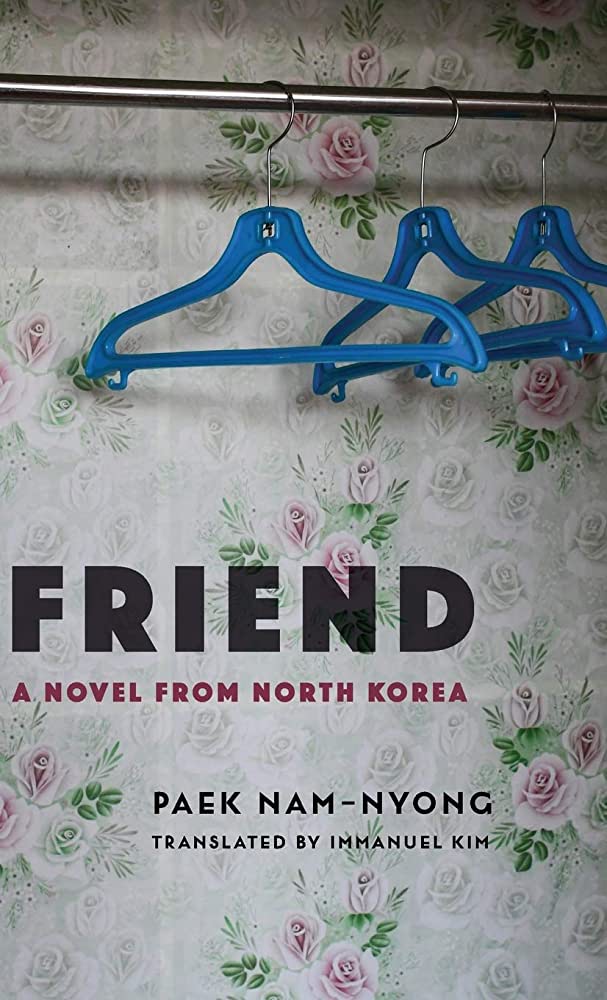
Friend, by Paek Nam-Nyong
Translated by Immanuel Kim
(1988, Translation 2020)
(Novel, Propaganda)
The translator of Friend, Immanuel Kim, provides an invaluable afterword to the novel, providing readers not only with a biography of PaekNam-Nyong, but also a brief history of the literary history of the state-sponsored literature of North Korea. According to Kim, Paek “chose a career in writing to educate his readers on the importance of self-cultivation, which entails lifelong learning, serving the country and the people, abiding by Party doctrine, and participating in collective community initiatives” ( ). Kim explains that ”Friend is set during the Hidden Hero campaign of the 1980s, which sought to recognize the extraordinary achievements of otherwise ordinary citizens” ( ). This mission is evident in every page of the novel. The primary character is a dedicated party member and Divorce Court Judge Jeong Jin Wu. Judge Jeong is contacted by two citizens petitioning for divorce. Thirty-three-year-old Chae Sun Hee, wife of thirty-five-year-old Lee Seok Chun appears to be the driving force behind the divorce. When they met, Lee Seok Chun was a lathe operator at a factory, a high-status job. He eventually trained his wife in lathe work as well as a number of other important machines. Chae Sun Hee stopped working in the factory full time when she had a son. Around this time, it is discovered that she has quite a beautiful voice. She is recruited to sing in the factory chorus and she quickly rises in skill and popularity. As her status climbs, she believes that her husband should find a way to earn an engineering degree. She would like him to improve himself and improve the party. For his part, Lee Seok Chun believes that it is nobler to work at the lathe and to continue to develop his ideas for a multi-spindle lathe that will increase the production of the factory. Chae Sun Hee believes that her husband has given up on improving himself. She claims he has stopped communicating and that he is too ignorant to even hold a conversation. Chae Sun Hee’s argument is simple: there is no harmony in the marriage. Judge Jeong is a patient and dedicated judge whose primary goal is to preserve the sanctity of the elemental unit of the government: the married couple. He interviews the couples regularly, develops an avuncular relationship with the young son, talks to friends, parents and supervisors, encouraging all to exert positive pressure on the couple to remain together. Judge Jeong also reflects on former cases, expressing true concern for his decisions and worrying about how divorces may have harmed children. He also reports on a marriage between a coal miner and a dedicated grade school teacher, and finally, he confesses his own marital struggles. Years ago, he married his wife who was then a young botanist. When they wed, she insisted that she be allowed to continue to do agricultural research to improve the yields in her home village. He agreed, perhaps not realizing how frequently she would be away and how often he would be on his own, cooking for himself as well as monitoring the plants his wife had planted in their bedroom, which, because of its large windows had been reconfigured as a greenhouse.
Step back from the fine detail and we clearly see a nation struggling with a contemporary problem: how can a marriage survive when the modern economy requires both husband and wife to work full-time? Judge Jeong is a remarkably endearing character. He is an expert in the law, but he genuinely seems to understand the couples he assists and he goes out of his way to view disputes from a variety of different points of view. But make no mistake: as engaging and informative as the text is, it climaxes, as it must, in a paean to the Democratic People’s Republic of North Korea.
“However, her naive dreams were shattered when she encountered the abysmal reality of her husband’s indifference toward her. Chae Rim was not the person whom she had loved and cherished. She never heard anything remotely romantic or affectionate from him. When she would come up to the city from her village, he would not buy her a single article of clothing that would make her fashionable like the city dwellers. He never expressed affection to her; he never opened the door to his heart. When it seemed as if he opened his heart, it was like an empty storage room with a cold breeze passing through. She felt that her husband did not consider her his wife but rather a housekeeper and a nanny for the children.”


I have print copies of this and The Accusation. I am looking forward to reading both. I am fascinated by North Korean society and wish there was more fiction available. Thank you for your detailed reviews.
LikeLiked by 1 person
Thank you! I need to post some of the escape stories as well as Barbra Demick’s Nothing to Envy.
I believe there is fiction available. I’ve learned that grad students are translating books that emerge from N Korean writers corps. From what I understand, the earliest writing is pretty terrible but that people are getting excited about the quality of the writing as time goes on. They are still producing propaganda, but the characters are becoming more complex and nuanced.
LikeLike