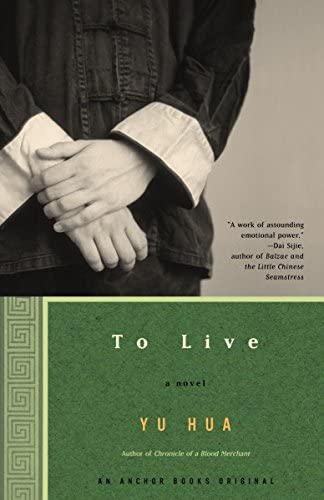
To Live
By Yu Hua
Translated by Michael Berry
(1993, translated 2003)
Anchor
(Novel)
Originally banned, Yu’s To Live is considered one of the ten most influential books published in China. To Live begins with a traveling folklorist scouring the countryside seeking representative stories from the Chinese people. He encounters a peasant, Xu Fugui, who perhaps misunderstands the man’s mission. Instead of sharing legends that have survived the test of time, Xu Fugui expresses interest in telling his own life story. Xu explains he was once a wealthy man, the son of a rich landlord. Though he has many responsibilities–a wife, a daughter, and a son—he squanders his wealth, spending every last cent on gambling, drinking, and womanizing. He humiliates his wife, and his debts are so high that he impoverishes his own family and ruins the fortune of his father and mother. He is conscripted into the Nationalist army and separated from his loved ones. Years later, he returns home to discover that his mother has died and his precious daughter has suffered a terrible infection that has rendered her deaf and mute. Living now as a peasant farmer, he reunites with his wife, daughter, and son while continuing to suffer loss after loss. Yu presents unforgettable moments of tragedy and comedy, including a scene where doctors drain the blood of a young boy to save the life of a party leader and the wooing of his mute daughter by a passionate man with a congenitally tilted head. Not surprisingly, To Live is sometimes called a Chinese Book of Job. From a historical perspective, it is a treasure trove of political commentary: Xu lives through dramatic times, including Land Reform, The Great Leap Forward, The Great Chinese Famine, and the Cultural Revolution. If you read only one Chinese novel, read this important and powerful work!
“I said to Youqing, “If you don’t study hard, I’ll kill you!” I regretted it a bit after I said it. It was only because of his family that he wanted to give up school. This kid was only twelve years old and already so sensitive, it made me both happy and uncomfortable. I realized that I would have to start being more careful about scolding him and hitting him. That day I went into town to sell firewood, and on the way home I bought Youqing five fen worth of candy. This was the first time that I had bought anything for my son. I felt I should show Youqing that I loved him.”
 East Asian Literature in Translation
I’m on the wait list at the library for this one. You had me at “banned book”. Thanks for another well done write up.
LikeLike
You won’t be disappointed!
LikeLiked by 1 person
I have it now. I will report back when I finish. Thank you, again for the recommendation.
LikeLiked by 1 person
I saw the film version, and I’ll never forget it. Now you’ve encouraged me to read this important novel.
LikeLike