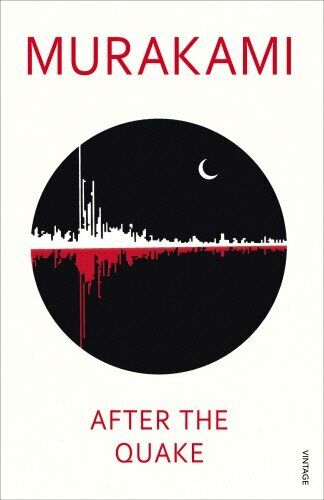
After the Quake
By Murakami Haruki
Translated by Jay Rubin
(2000, English translation 2002)
Vintage
(Short Story Collection)
The Great Hanshin or Kobe earthquake happened January 17th of 1995. Kawakami was living out of the country at the time, but returned after Tokyo suffered a second disaster just three months later, when members of the Aum Shinrikyo cult released Sarin gas inside the Tokyo subway. Kawakami turned a journalistic, investigative eye on the sarin attacks in his carefully researched Underground: The Tokyo Gas Attack and the Japanese Psyche. His writing about the Kobe quake is entirely fictional and employs the eye-opening and destabilizing twists that are the stuff of Murakami’s magically skewed imagination. The earthquake is alluded to in each of the short stories but is not central, and at no point does Kawakami attempt to directly address what happened. In almost every story, reference is made to either a bear, a frog, or both.
“UFO in Kishiro”
Although she is not connected to anyone affected, a housewife watches television coverage of the disaster in Kobe for six straight days, at the end of which she announces to her husband that she is leaving him. A concerned co-worker offers the deflated husband a brief respite from his loss: if he will only carry a small package to a friend, his colleague will pay for a hotel and a round-trip ticket to Hokkaido. Will the ensuing romp with a mysterious woman help the husband understand his personal tragedy, confront its cause, and rebuild his life?
“’You must have been thinking about your wife,’ Shimao said. ‘Yup,’ Komura said, but in fact what he had been thinking about was the earthquake. Images of it had come to him one after another, as if in a slide show, flashing on the screen and fading away. Highways, flames, smoke, piles of rubble, cracks in streets. He couldn’t break the chain of silent images.” (20)
“Landscape with Flatiron”
Twenty-something Junko, a high-school dropout and runaway, finds herself in a summer relationship with an immature, foul-mouthed, and self-involved rock and roll guitar player. One night, Miyake calls. He’s an older man, perhaps in his forties. He rents a place near the shore in Ibaraki and paints. From time to time he will build a bonfire and invite the couple to join him. A storm has just deposited a large amount of driftwood on the beach, and Miyake, whose moves are like those of a zen master, has constructed a beautiful structure for burning. As the ill-matched young couple watches Miyake coax the flame into being, they ask about his accent: is he from Kobe? Does he still know anyone there? What Miyake eventually reveals is oblique, though it does lead the two to a philosophical discussion about mortality, fear, symbolism, and art.
“Junko took her cigarettes from her pocket, put one in her mouth, and struck a match. Narrowing her eyes, she stared at Miyake’s hunched back and balding head. This was it: the one heart-stopping moment of the whole procedure. Would the fire catch? Would it erupt in giant flames?” (28)
“All God’s Children Can Dance”
Yoshiya wakes up with a terrible hangover. His mother, a member of a religious sect, had left the previous day with her church group to provide food and assistance to the Kobe survivors. He wanders about the town, spots a man with a missing earlobe, and reflects on his own origin story. Inquiring after the identity of the father he never met, his mother tells him of her precocious teenage sexuality, the odd ways that condoms failed to protect her, her abortions, and the sexual relationship with her abortionist that resulted in her son’s miraculous birth. Yoshiya becomes convinced that the man with the deformed ear is his father and determines that he will confront him in his mother’s absence.
“Yoshiya had no father. From the time he was born there had been only his mother, and she had told him again and again when he was a little boy, ‘Your father is our Lord’ (which is how they referred to their god). ‘Our Lord must stay high up in Heaven; He can’t live down here with us. But He is always watching over you, Yoshiya, He always has your best interests at heart.’ (51)
“Thailand”
A middle-aged woman in the throes of menopause makes a possibly career-ending decision. She quits her work as a pathologist of diseases of the thyroid at a prominent American university in order to return to her homeland: Japan. Before she returns to Tokyo, she gifts herself a short vacation in Thailand. A mentor recommends an out-of-the-way hotel and provides her with the use of a favorite driver, a quiet, resourceful man in his sixties. Curious about the earthquake, he asks the narrator where she lives and if she knows anyone living in Kobe. She tells him she does not. He takes her to a number of delightful and recuperative spots, but before she leaves, he asks her to accompany him to the home of an elderly woman who is a shaman. Why? He believes something quite terrible is impacting the health of his client.
“Now Erroll Garner was playing ‘I’ll Remember April,’ which brought back more memories for Satsuki. Garner’s Concert by the Sea had been one of her father’s favorite records. She closed her eyes and let herself sink into the old memories. Everything had gone well for her until her father died of cancer.” (75)
“Super-Frog Saves Tokyo”
A month after the Kobe earthquake, Mr. Katagiri, a salaryman returns from another stultifying day at the bank to discover a six-foot-tall talking frog in his kitchen. The frog explains that he is a guardian of Tokyo and that he knows that in three days’ time, a giant worm will cause a quake that will likely wipe out Tokyo. He has contacted Katagiri because he can help the frog access the bank vault and enter a hidden tunnel that penetrates hundreds of feet below the city. The frog will need Katagiri’s help in defeating the worm and saving the city. Will Katagiri heed the call to action?
“The Kabukicho neighborhood of Shinjuku was a labyrinth of violence: old-time gangsters, Korean mobsters, Chinese mafia, guns and drugs, money flowing beneath the surface from one murky den to another, people vanishing every now and then like a puff of smoke.” (96)
“Honey Pie”
“Honey Pie” is vaguely reminiscent of Norwegian Wood in that it concerns a group of three college friends, two of who fall in love with each other. In this instance, the friendship survives the dalliance and marriage, but the marriage falls apart soon after a child is born. The husband, Takatsuki, can’t quite explain why he has strayed from the lovely Sala; he admits that he is simply distracting himself with a younger woman. The “mutual friend,” Junpei, is thirty-six years old. He is a writer specializing in short stories. Although he has achieved some spotty success, his career is flatlining. His editor is pushing him to enter the arena of “real-writing” by producing a novel, but so far, Junpei is unable to make a commitment. He continues to meet with the estranged couple and their son, with whom he shares a strong connection. Junpei and Sala are pained that the divorce is taking such a terrible emotional toll on the little boy, and when the child sees footage from the earthquake on the television, his anxiety spikes.
“He hadn’t set foot on those streets since his graduation, but still, the sight of the destruction laid bare raw wounds hidden somewhere deep inside him. The lethal, gigantic catastrophe seemed to change certain aspects of his life—quietly, but from the ground up. Junpei felt an entirely new sense of isolation. I have no roots, he thought. I’m not connected to anything.” (138)
 East Asian Literature in Translation